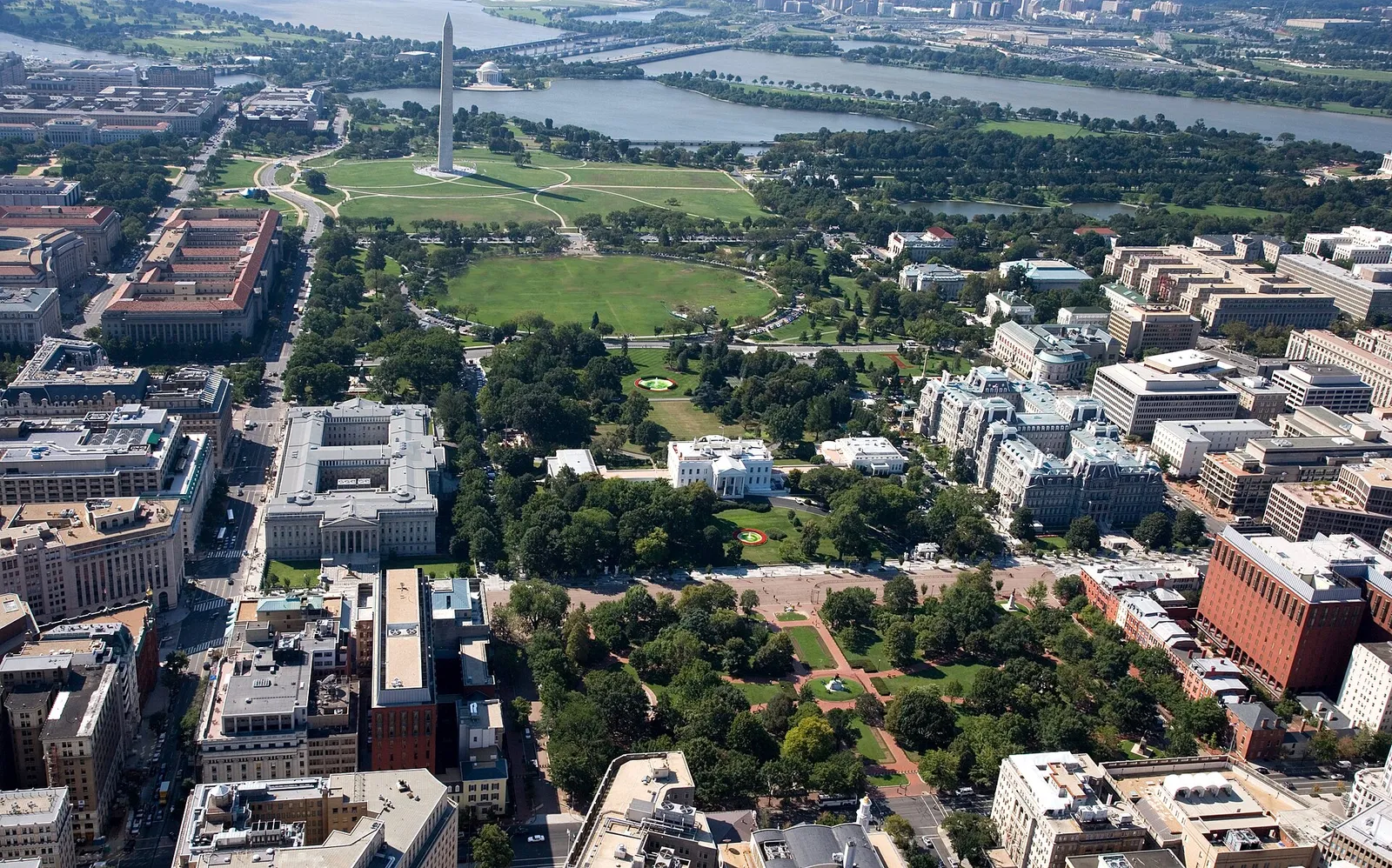
The park directly north of the White House, long a gathering place for demonstrators, could be permanently fenced off under a proposal from the Trump administration that has dismayed protesters and civil-liberties groups.
The administration has submitted a 79-page plan to the Commission of Fine Arts, one of the federal bodies that reviews building and design projects in the capital, which is due to consider it this week. The proposal would install permanent fencing around Lafayette Park, which for years has been accessible to the public and used for rallies, vigils and pickets.
A long history of protest
Lafayette Park's significance to American political life is hard to overstate. Suffragists staged the first sustained picket of the White House there in 1917, and in the decades since it has hosted demonstrations for civil rights, against the Vietnam War and on countless other causes. Its position, within sight of the president's residence, has made it a symbolic as well as practical venue for those seeking to be heard by the government.
That history is also why the plan has provoked such unease. Critics argue that permanent barriers would fundamentally alter access to one of the country's most important sites for free expression. Eleanor Holmes Norton, Washington's non-voting delegate in the House of Representatives, has introduced legislation to block permanent fencing, citing the park's role as a public forum. Protesters who spoke to reporters said the barriers would not stop them demonstrating but questioned why an administration would seek to place, as one put it, layers of fencing between citizens and their government.
The case for the fence
The administration frames the project as a matter of security. Temporary barriers have restricted parts of the park since the start of the year, initially for landscaping and repairs, and officials argue that a permanent, better-designed perimeter is needed to protect the White House complex. Under the plan, they say, the fence would generally remain open and be closed only during periods of heightened security determined by law enforcement. Concerns about the safety of the president have sharpened in recent years, including after assassination attempts during the 2024 campaign.
Supporters of tighter security contend that the area's proximity to the White House makes some controls unavoidable, and that a permanent structure can be designed to be less obtrusive than the makeshift fencing repeatedly erected in the past.
An old argument, revived
The tension is not new. The balance between securing the White House and preserving public access to the space around it has been debated for decades, and the park has seen fences come and go. It remains a charged place: in June 2020, federal officers used force to clear peaceful protesters from the area shortly before President Trump walked across it for a photograph outside a nearby church, an episode that drew fierce criticism, though a later inspector general report found the clearance had not been carried out specifically to enable the photo.
For now, the decision rests with the review commissions weighing the proposal. Whatever they conclude, the fight over Lafayette Park is, at heart, an argument about how close citizens should be able to get to the seat of power, and how a democracy balances the safety of its leaders against the visibility of those who wish to protest them.