Astronomers say they have caught, for the first time, a magnetar in the act of being born, deep inside the explosion of a dying star. The claim, drawn from an unusual supernova roughly a billion light-years away, rests on a peculiar signature in the fading light that they say only a newborn magnetar can explain.
What a magnetar is
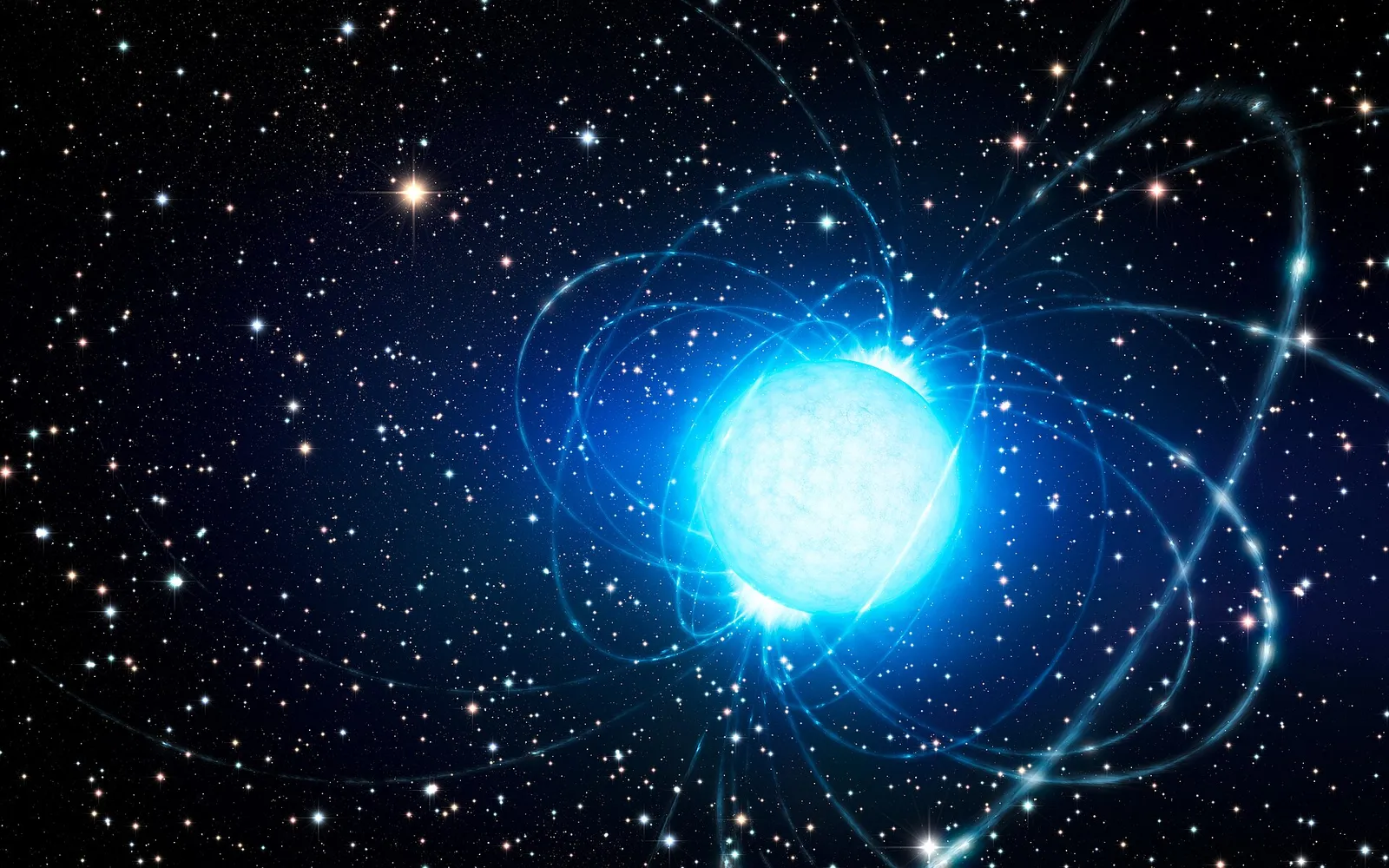
A magnetar is a kind of neutron star, the ultra-dense core left behind when a massive star collapses and explodes. Neutron stars are already extreme, packing more than the Sun's mass into a sphere the size of a city. Magnetars go further still, carrying magnetic fields trillions of times stronger than Earth's, the most powerful known in the universe. How they form has been a long-standing question.
The clue in the light
The supernova, catalogued as SN 2024afav, was tracked by a global network of telescopes at Las Cumbres Observatory, Berkeley News reported. Instead of simply fading, its light dimmed in a series of pulses that grew faster over time, like a rising chirp. The team, which included researchers at the University of California, argues that this pattern came from a rapidly spinning newborn magnetar and a disk of debris wobbling around it, ScienceDaily reported.
Explaining the wobble required Einstein's general theory of relativity: a spinning, massive object drags space-time around with it, making a tilted disk precess, or swivel, faster as it spirals inward. The researchers say this is the first time that effect has been needed to account for what is seen in a supernova.
Why it matters
The finding, published in a peer-reviewed journal, would tie together two ideas astronomers have long suspected were linked: that some of the brightest exploding stars are powered from within by a magnetar dumping energy into the expanding debris, and that magnetars are made in such explosions. A theory proposed more than a decade ago held that a magnetar could keep a supernova glowing far longer than usual; what had not been shown was the magnetar actually forming in the middle of one.
As with any single result, others will want to see the pattern repeated in more exploding stars before treating it as settled. But if it holds up, it offers a rare, direct look at the birth of one of the universe's strangest objects, in the same violent moment that ends the life of a star.