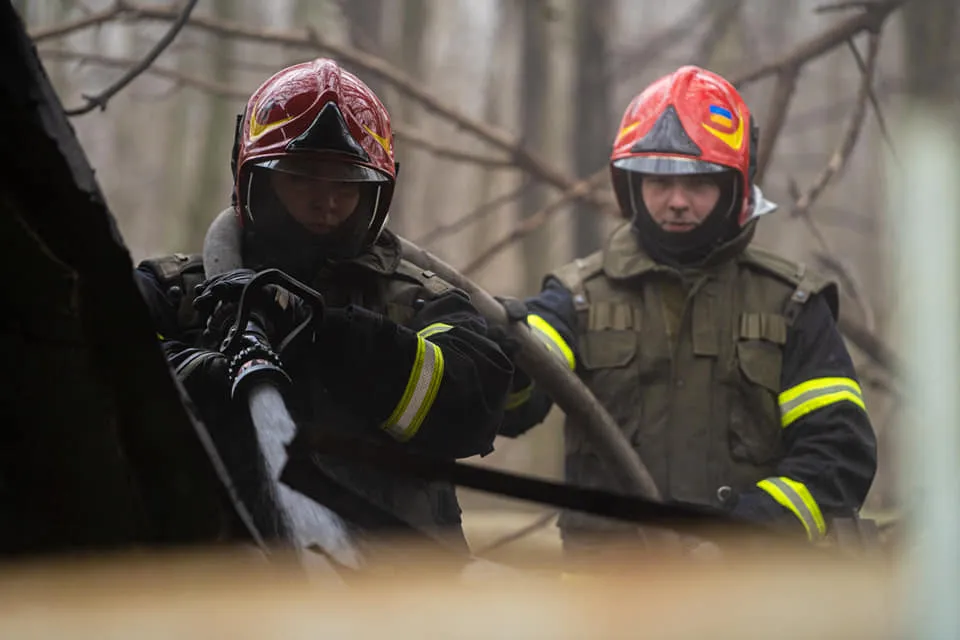
Russia subjected Kyiv to one of its heaviest bombardments of the year overnight into Wednesday, killing at least 12 people and wounding more than 30, Mayor Vitali Klitschko said, as successive waves of missiles and drones struck 28 locations across the capital. The toll rose through the morning as rescue crews worked in the rubble; at least 14 of the wounded were hospitalized.
Explosions began shortly after midnight and continued past dawn, with a second wave hitting around 6:15 a.m. Air-raid alerts extended far beyond the capital, covering more than a dozen regions, and Poland and Romania scrambled fighter jets as the attack unfolded near NATO's eastern flank, Reuters reported.
A children's hospital among the targets hit
In the Solomianskyi district, blast waves tore through a children's hospital, blowing out windows and setting vehicles on its grounds ablaze; patients had been moved to shelters during the alert. A five-story residential building in the same district took a direct hit, and homes were damaged in the Darnytskyi and Sviatoshynskyi districts, along with a school and warehouse buildings, according to the Kyiv Independent. Outside the city, a strike set an industrial facility ablaze in Brovary, where officials reported a further death.
"It was a massive attack," President Volodymyr Zelensky said. "The Russians had been preparing for a long time, combining different types of ballistic missiles, cruise missiles, and drones, aiming to cause as much damage as possible to civilian infrastructure."
The arithmetic of a saturation attack
Ukraine's air force said Russia launched 44 cruise missiles, two Banderol missiles and 168 Shahed-type drones, alongside ballistic and hypersonic missiles fired on flat, fast trajectories that are hardest to stop. Air defenses downed 39 of the cruise missiles, both Banderols and 145 drones, a high interception rate that still let enough warheads through to kill a dozen people.
That arithmetic is the point of such attacks, and it is worsening for Ukraine. Zelensky said earlier this month that only one of 27 ballistic missiles in a previous strike was intercepted "simply because there are no interceptors for the Patriot systems," and that Ukraine has received roughly a third as many air-defense interceptors this year as in the same period last year. Russia's defense ministry has described its strikes as aimed at military and defense-industrial targets; Wednesday's documented damage, hospitals, homes and schools, again told a different story on the ground.
A war of attrition in the air
The bombardment fits the pattern of recent months: massed, mixed-weapon night attacks intended to exhaust interceptor stocks, answered by increasingly ambitious Ukrainian drone strikes deep into Russia, including a 600-drone attack on Moscow and other targets last weekend. Each side is betting that the other's air defenses and public endurance will crack first.
For Kyiv's residents, the strategic logic reduces to a nightly routine of sirens, shelters, and morning body counts. The city has lived under versions of this rhythm since 2022; what is changing, officials warn, is the density of what Russia can throw and the thinning stock of what Ukraine can throw back.