
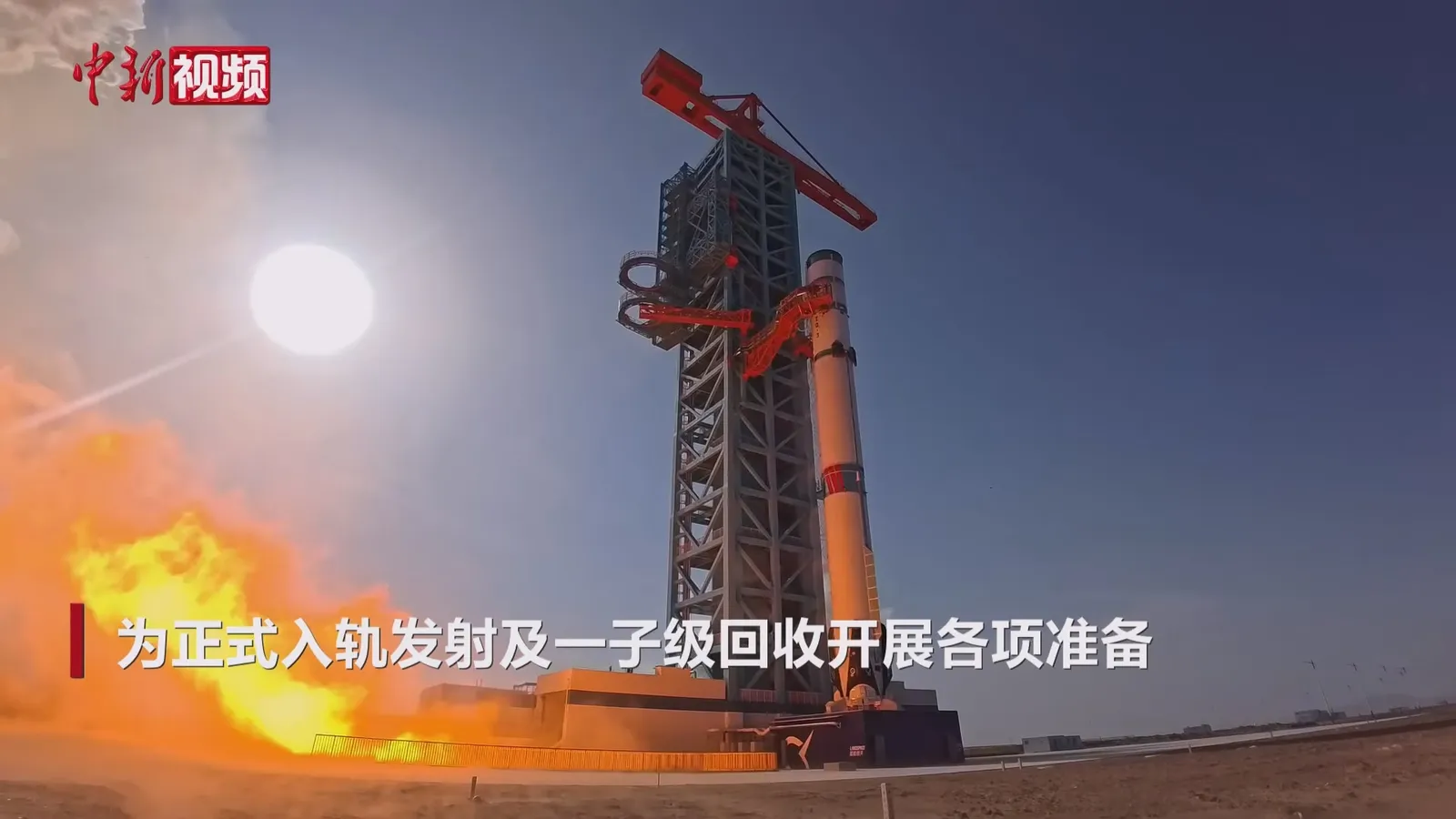
A Chinese commercial rocket company has landed an orbital-class booster for the first time. LandSpace's Zhuque-3 lifted off from the Jiuquan Satellite Launch Center in the Gobi Desert on Tuesday, placed the Honghu 03 satellite into orbit, and brought its first stage back to a powered vertical touchdown on deployable legs, SpaceNews reports.
Eight minutes to history
The stainless-steel first stage separated a little over two minutes into flight and completed a controlled descent to a landing zone in Minqin County, Gansu Province, roughly 390 kilometers downrange from the pad. The landing came on only the rocket's second flight: on Zhuque-3's maiden mission in December 2025 the vehicle reached orbit, but the booster failed in the final phase of its landing attempt, according to SpaceNews.
With the touchdown, Beijing-based LandSpace becomes the first Chinese company, state or private, to recover an orbital-class booster intact on land, and joins a short international list alongside SpaceX and Blue Origin, Space.com notes.
A different design philosophy
Zhuque-3 stands about 66 meters tall and is powered by nine methane-fueled engines on its first stage, with a stated capacity of around 14 metric tons to low Earth orbit in its current configuration, Tech Startups reports. That is below the roughly 22.8 tons of SpaceX's Falcon 9, but the vehicle's stainless-steel construction, a choice SpaceX reserved for its much larger Starship, is intended to keep production costs down and tolerate the heat of repeated reentries.
The company is no stranger to firsts. In July 2023 its smaller Zhuque-2 became the first methane-fueled rocket anywhere to reach orbit, beating American rivals to a propellant technology now seen as the industry standard for reusable vehicles.
From one landing to a fleet
A single successful landing is not the same as routine reuse. SpaceX spent years turning recovered Falcon 9 boosters into a rapid refurbish-and-refly pipeline, and that operational maturity remains the real gap between the companies. LandSpace has said it aims to refly a recovered first stage within about six months and eventually wants each booster to fly up to 20 times, per Tech Startups.
Even so, the landing is a marker for China's commercial space sector, which the government opened to private capital roughly a decade ago. Reusability is the single biggest lever on launch costs, and it is no longer exclusive to American firms. For satellite operators, and for the megaconstellation projects China plans to loft in the coming years, Tuesday's touchdown in the Gobi may prove to be the moment the launch market became genuinely multipolar.