A telescope built to do something no telescope has done before has begun its work, Scientific American reports. The Vera C. Rubin Observatory, high in the Chilean Andes, has started a ten-year project to make, in effect, a movie of the entire sky.
What it is doing
The idea is repetition on an enormous scale.
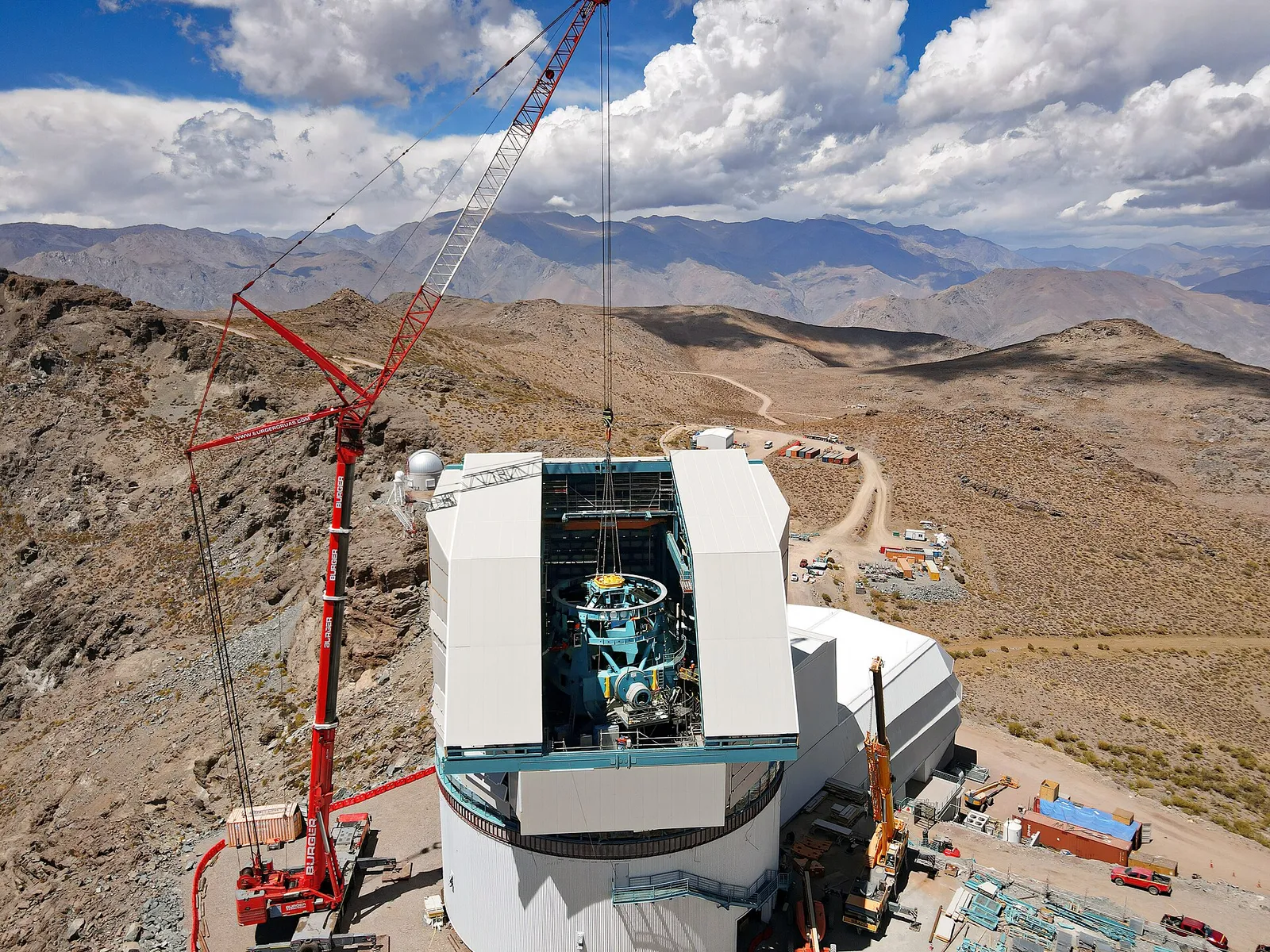
According to Scientific American, the observatory, which sits more than 2,700 meters up Cerro Pachón in Chile, began its Legacy Survey of Space and Time, or LSST, in June 2026. The survey will run for ten years, taking deep images every clear night. It will photograph the entire visible sky from its location within three successive nights, and return to each patch of sky more than 800 times over the decade, producing several million images in all.
That last point is what makes it a "movie" rather than a photograph. Most astronomy captures the sky as a still image; by imaging the same sky again and again, Rubin will record how it changes over time. As Scientific American notes, "transients," objects that move or change in brightness, are the survey's primary target.
The machine
The scale of the instrument matches the ambition of the survey.
Scientific American reports that the observatory has an 8.4-meter mirror and carries the largest digital camera ever built: 3.2 billion pixels, with the sensor measuring 64 centimeters on a side. Each 30-second exposure captures 3.5 degrees of sky, an area equivalent to about 50 full moons, through six different color filters, and the system can detect objects as faint as magnitude 27.8, extraordinarily dim. It is, in short, a camera designed to see very faint things across a very wide field, very often.
What it may find
The projected haul is difficult to grasp, and worth spelling out.
According to Scientific American, over its ten years the survey is expected to catalog roughly 20 billion galaxies, 17 billion stars, 10 million supernovae, an average of one every 30 seconds, and 6 million objects in our own solar system. It is also expected to find exoplanets, more than 100,000 near-Earth objects, 30,000 distant bodies beyond Neptune, and possibly the long-hypothesized Planet Nine, if it exists.
Those numbers are not just bragging rights. A near-complete, repeated census of the sky is the kind of dataset that lets astronomers study dark matter and dark energy through the distribution and motion of galaxies, track asteroids that might approach Earth, and catch fleeting events, exploding stars, sudden flares, that a once-over survey would miss entirely.
Why it matters
The significance of Rubin is as much about method as about any single discovery.
Much of astronomy has been the study of snapshots. Rubin turns the sky into something closer to continuous surveillance, a decade-long record that can be searched and re-searched as questions arise, including questions no one has thought to ask yet. Its data will be used by scientists around the world for years, and some of its most important results will likely come not from the objects it was designed to find, but from surprises hiding in the flood of images. It is, in that sense, less a single experiment than an instrument for making the unexpected discoverable, and its ten-year movie has just started to roll.