
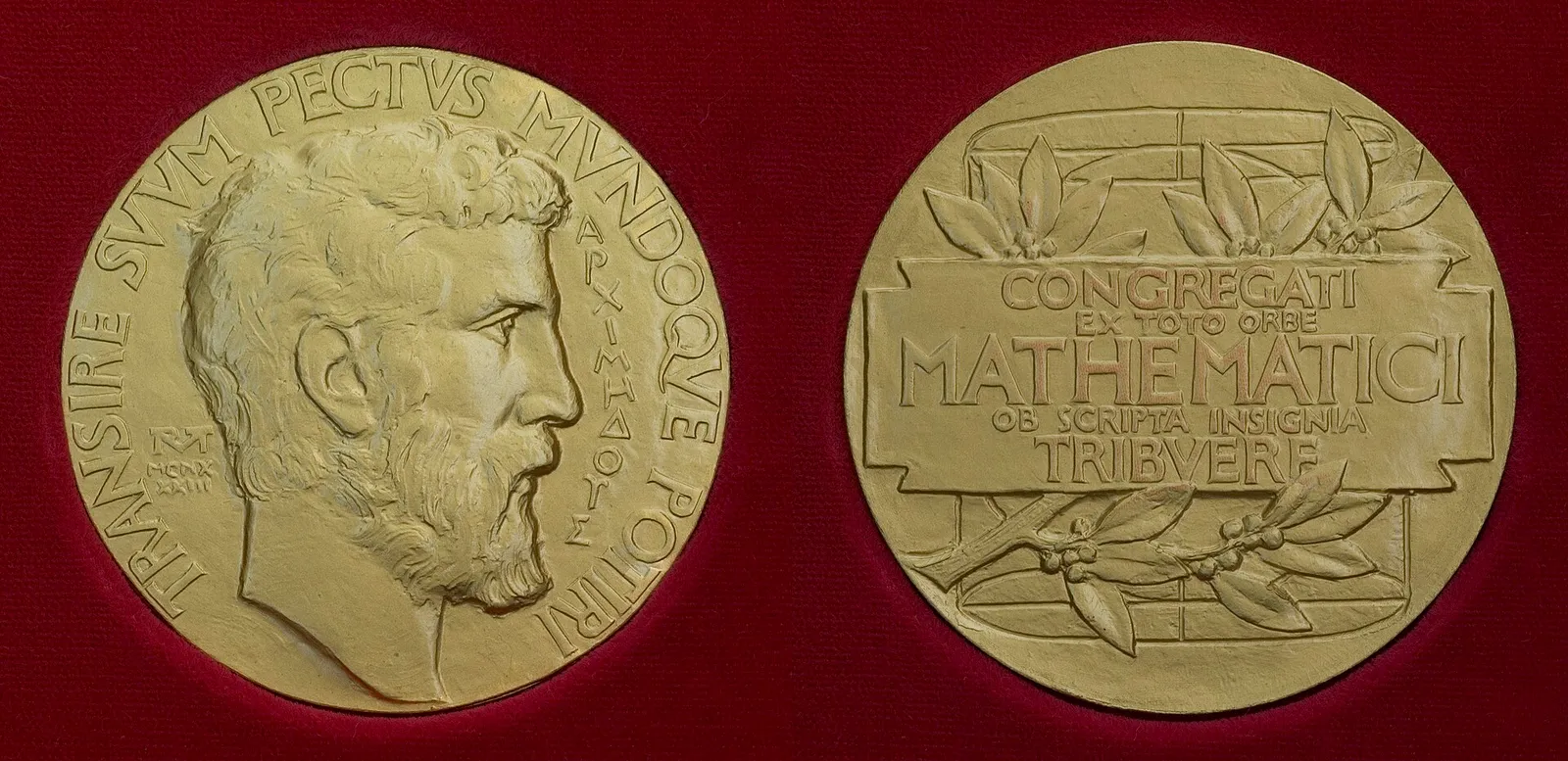
Four mathematicians have been awarded the 2026 Fields Medals, the discipline's highest honor, Scientific American reports. The winners are Hong Wang, Yu Deng, John Pardon and Jacob Tsimerman.
What the prize is
For readers outside mathematics, the Fields Medal needs a word of explanation, because its rules are unusual.
The Fields Medal is often called the "Nobel Prize of mathematics," but it differs in one striking way: it is awarded only to researchers under the age of 40, and only once every four years, to between two and four people. That youth requirement makes it as much a recognition of early, field-shaping brilliance as of a lifetime's work. According to Scientific American, this year's medals were announced on July 23 at the International Congress of Mathematicians in Philadelphia.
The winners and their work
Each medal rewards the solution of a hard, long-standing problem. The achievements are technical, but the shape of each is worth conveying.
Hong Wang, of New York University and the IHES in France, is, Scientific American reports, only the third woman to win the medal in its roughly 90-year history. She was recognized, with Joshua Zahl, for proving the three-dimensional Kakeya conjecture, a problem colleagues had called a "holy grail," concerning the smallest space a rotating needle can occupy while pointing in every direction. That it can be described in a single sentence belies how difficult it was to prove.
Yu Deng, of the University of Chicago, was honored for work showing that the equations governing fluid motion behave consistently across scales, from the microscopic to the large, resolving a century-old apparent contradiction in the mathematics of fluids. One mathematician, Scott Armstrong, called it "a truly spectacular, singular result," according to Scientific American.
John Pardon, of Stony Brook University, was recognized for work in knot theory and geometry, including, remarkably, solving a major conjecture about how much a knot can be distorted while he was still a 21-year-old undergraduate at Princeton in 2010.
Jacob Tsimerman, of the University of Toronto, was honored for proving the André-Oort conjecture, about special points on structures called Shimura varieties, and for contributions to Hodge theory connected to one of the Millennium Prize Problems, another set of famously hard open questions.
Why it matters
It is fair to ask why prizes for abstract mathematics deserve wide attention, and the answer is partly about time.
Mathematics is the slow foundation beneath much of science and technology: ideas that look purely abstract when proved often turn out, decades later, to underpin physics, cryptography, computing or engineering. The problems honored here, about fluids, knots, geometry and the deep structure of numbers, are exactly the kind that can lie dormant and then become useful in ways their discoverers never imagined. Recognizing them is a way of marking the frontier of human understanding, wherever it happens to be.
There is also the human story, which the youth rule sharpens. These are people who, before turning 40, and in one case before turning 22, resolved questions that had defeated others for generations. Hong Wang's place as only the third woman ever to win is its own marker of a field slowly broadening. The medals are a reminder that, quietly and far from the headlines, some of the hardest questions humans have ever posed are still being answered, by people at the very start of their careers.