
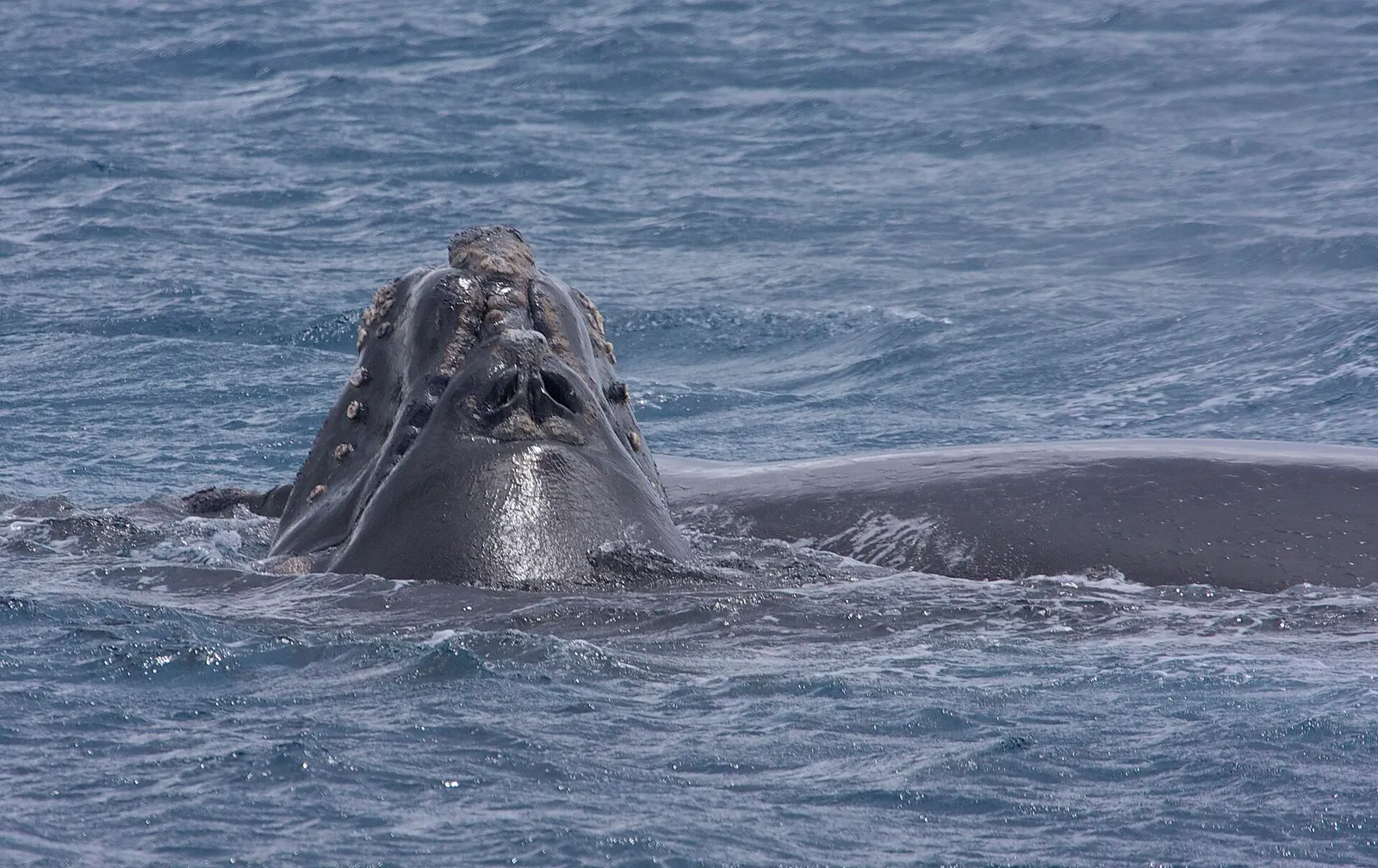
Southern right whales do something no other whale is known to do: they rest at the surface upside down, belly to the sky, pectoral fins in the air. A new study suggests the reason is surprisingly domestic, Scientific American reports. It may be how a mother controls when her calf feeds.
What the researchers saw
The work was done not from a boat but from the air.
Researchers at the University of Western Australia used drones to film 90 mother-and-calf pairs for about 75 hours at the Head of the Bight, a calving ground in South Australia, and published their findings in the journal Mammalian Biology on July 6. That vantage point matters: from directly above, a drone can record what a whale is doing at and just below the surface in a way that an observer at sea level cannot.
The lead researcher, Renae van Noort, a conservation biologist, did not overstate the strangeness of it. "This is definitely an unusual behavior," she said. "It looks quite odd, especially when you see them from a distance with their pectoral fins out of the water."
The likely explanation
The proposed answer connects the posture to nursing.
When a mother right whale turns belly-up, her calf cannot reach the mammary slits on her underside, so it cannot nurse. The researchers suggest, according to Scientific American, that inverting is a way for the mother to rest while also controlling feeding time, effectively closing the milk bar while she recovers. It is a piece of parenting rather than a quirk: a large animal managing both its own need to rest and a calf's constant demand to feed.
The numbers put the behavior in proportion. The study found that mothers spent an average of 33 percent of their time resting, and that about a quarter of the mothers used the upside-down posture, though it accounted for only around 2 percent of total resting time. So it is a real and repeated behavior, but a specialized one, used some of the time rather than as the usual way to rest.
Why a small finding is worth telling
A whale's resting position may sound like a minor curiosity, and in one sense it is. But it illustrates something larger about how animal behavior is now being studied.
Drones have quietly changed marine biology. Behaviors that happen at the surface, brief, easily missed, and hard to watch from a rocking boat, can now be recorded from above at length and in detail, which is how a subtle pattern like this one gets noticed and quantified at all. The upside-down right whale is a small, human-scale window onto that shift: a mother resting, a calf kept waiting, and a new tool finally able to see it clearly.