A grid battery and a grid storage problem are not the same thing. Most of the batteries installed on electricity networks over the past decade solve one specific problem well: they shift a few hours of solar generation from the afternoon into the evening peak. That is genuinely useful, and lithium-ion is very good at it.
The harder problem is a still, overcast week in winter. Covering that requires holding energy for days, and the economics of lithium-ion work against it.
Why duration is the awkward variable
In a lithium-ion system, the thing that stores energy and the thing that delivers power are the same object: the cells. Doubling how long the system can run means roughly doubling the number of cells, which also doubles the power output, whether or not more power is wanted.
For a four-hour battery this is fine. For a hundred-hour battery it is not, because most of what is being paid for sits idle almost all the time. The cost of the store scales with the amount of energy held, and the energy held is large.
This is the structural reason the alternatives look different. Nearly all of them separate the store from the machinery that converts energy in and out, so that adding duration means adding a cheap substance rather than more expensive apparatus. A bigger tank, a bigger pile of salt, a bigger heap of iron.
Growth in this category is real: long-duration storage deployments rose 49 percent in 2025, passing 15 GWh, according to Wood Mackenzie figures reported by Utility Dive.
Salt that holds heat
The oldest of these approaches stores energy as heat rather than as electricity, in molten nitrate salt held at several hundred degrees.
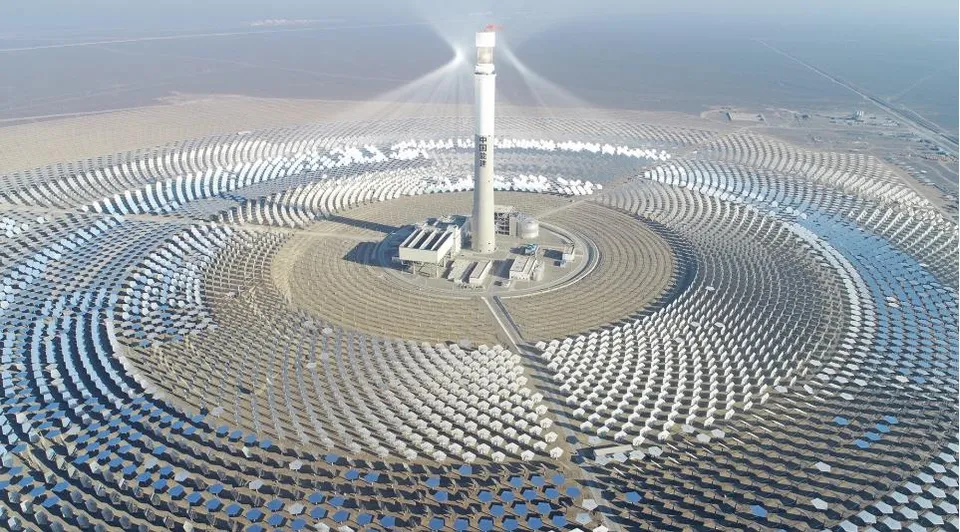
The Crescent Dunes plant in Nevada is the best-documented example: mirrors concentrate sunlight onto a tower, the heat melts salt, and the hot salt boils water to drive a steam turbine hours later, after dark.
It is also a caution. The plant has had a troubled operating history and has run well below its design output, which is a reminder that thermal storage at scale is a demanding engineering problem rather than a solved one.
The efficiency question here is easy to misread. Storing and recovering heat can be done with very little loss. Turning that heat back into electricity runs into the same thermodynamic ceiling as any steam plant, which is why round-trip efficiency to the grid is modest. Thermal storage makes most sense where heat itself is the product, as in industrial process heat, and where the conversion step can be skipped.
Iron that rusts on purpose
The chemistry attracting the most investment takes the opposite approach: make the round trip inefficient but make the materials almost free.
Iron-air batteries work by controlled rusting. Discharging oxidizes iron in contact with air and an alkaline electrolyte; charging reverses it. The materials are iron, water and air, which is the cheapest bill of materials in the field.
The penalty is efficiency. A meaningful fraction of the electricity put in does not come back out, far worse than lithium-ion's round trip. For a battery cycled daily that would be disqualifying. For one that sits full for a week and discharges during a wind drought, it matters much less than the cost of the store, because the alternative is not a more efficient battery but a gas plant or a blackout.
The technology is moving out of the laboratory. Google and Xcel Energy announced an agreement in 2026 for a 300 MW system described as the largest grid battery by energy capacity announced anywhere. That is an announcement, not an operating plant, and the distinction matters: this chemistry is at pilot and early-commercial stage, not proven at scale.
Liquids in tanks
Flow batteries, most commonly using vanadium, store energy in liquid electrolytes pumped from external tanks through a cell stack.
This is the cleanest expression of the decoupling principle. Power is set by the stack; energy is set by tank size. Want twice the duration, buy a bigger tank. Reviews of the technology put round-trip efficiency in the region of 75 to 85 percent, between iron-air and lithium, with very long cycle life because the electrolyte does not degrade the way a solid electrode does.
The obstacle is the vanadium itself, which is expensive and subject to a volatile commodity market. Systems are commercially available and deployed, notably in China, but cost per kilowatt-hour remains well above lithium-ion.
No single winner
It is tempting to ask which of these will replace lithium-ion. The likely answer is none of them, because they are not competing for the same job.
Lithium-ion is well matched to daily cycling and will probably keep that role. The others are competing for the much less glamorous task of covering the rare, long, expensive gap, where efficiency stops being the important number and cost per unit of stored energy becomes the only one that counts.
That is worth remembering when a new storage technology is announced with a poor efficiency figure attached. For this application, the inefficiency may be the point: it is what was traded away to make the store cheap enough to build at the size the problem actually requires.