
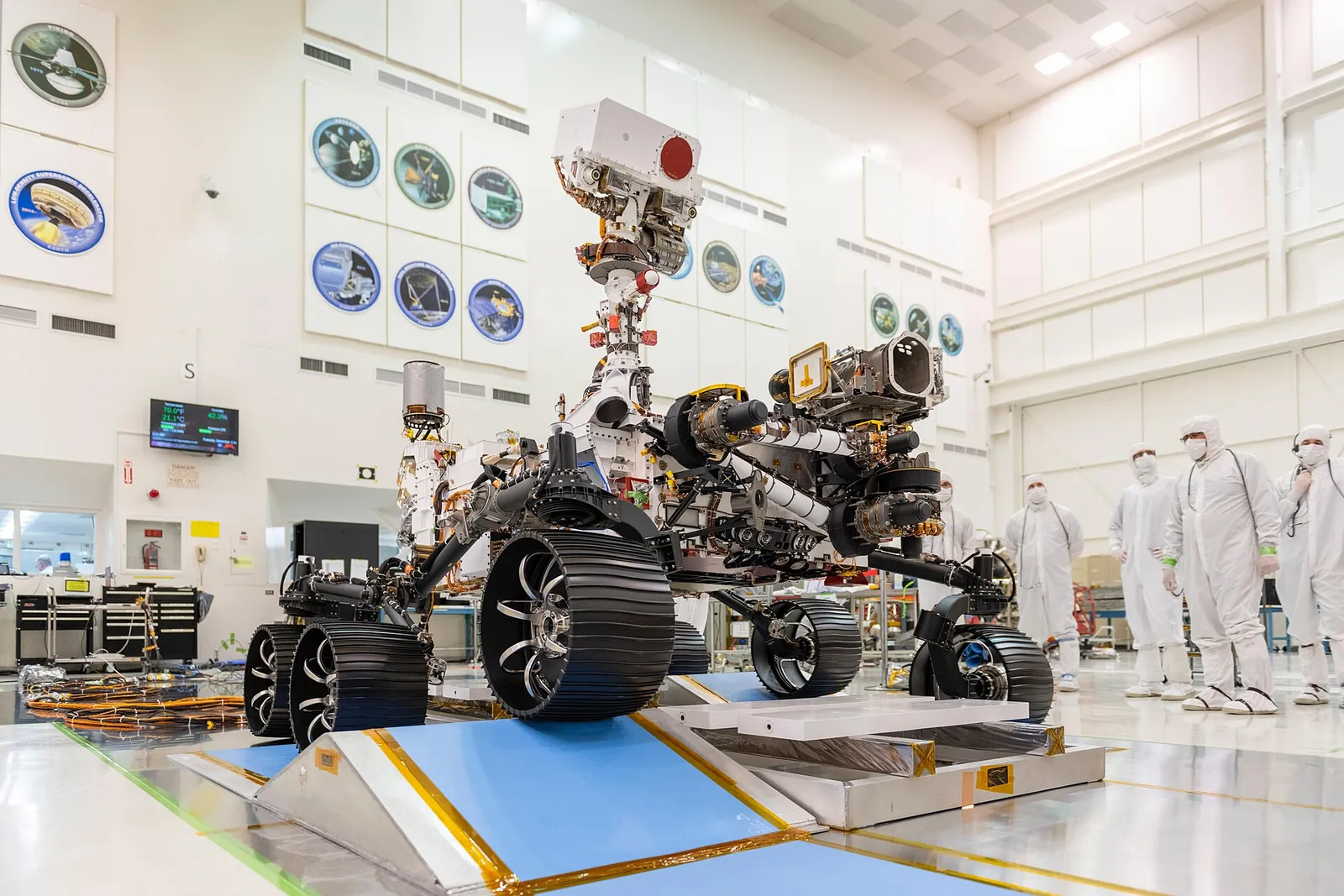
NASA's Perseverance rover has read a chapter of Mars's oldest and most violent history, examining rocks that record a barrage of asteroid and meteorite impacts during the earliest days of the solar system.
The rover studied a thick sequence of ancient bedrock on the rim of Jezero Crater, in a formation researchers have named Broom Point, NASA said. Dating back roughly four billion years, these are among the oldest rocks any Mars rover has explored, and they preserve, layer by layer, the marks of a period when large impacts were far more common than today.
Shattered rock as evidence
Perseverance found rocks known as breccias, made of angular fragments shattered by impacts and then cemented back together, a classic signature of violent collisions. Mixed in were once-molten fragments and tiny glassy beads, formed in the intense heat of impacts, which scientists compared in abundance to material found at the Chicxulub crater on Earth, the scar left by the asteroid linked to the extinction of the dinosaurs.
Many of the rock layers are tilted at steep angles, some more than 80 degrees from flat, suggesting the landscape was heaved and jumbled by successive blows. Researchers describe a kind of cosmic one-two punch: the giant impact that carved out the nearby Isidis basin, followed by the one that formed Jezero Crater itself, leaving the rocks in their near-vertical arrangement.
Why Mars keeps its secrets
Part of what makes the find valuable is that Mars, unlike Earth, has largely preserved its ancient surface. Earth constantly recycles its crust through plate tectonics, erasing most traces of its earliest bombardment. Mars long ago lost that geological churn, so its old rocks remain in place as a natural archive. "The lack of plate tectonics on Mars preserves this record," in ways impossible on Earth, scientists including Ken Farley of NASA's Jet Propulsion Laboratory have noted.
That record matters for one of the biggest questions about Mars: whether it could ever have supported life. A heavily bombarded young planet would have been a hostile place, yet water appears to have flowed there around the same era, hinting at how narrow, or how resilient, any early window for life might have been.
Samples for the future
Perseverance has collected core samples from the area, part of a cache the mission hopes will one day be returned to Earth. In a laboratory, scientists could date the rocks precisely and settle questions the rover can only begin to answer from the surface, not just about Mars, but about the storm of impacts that battered all the young worlds of the inner solar system, Earth included.