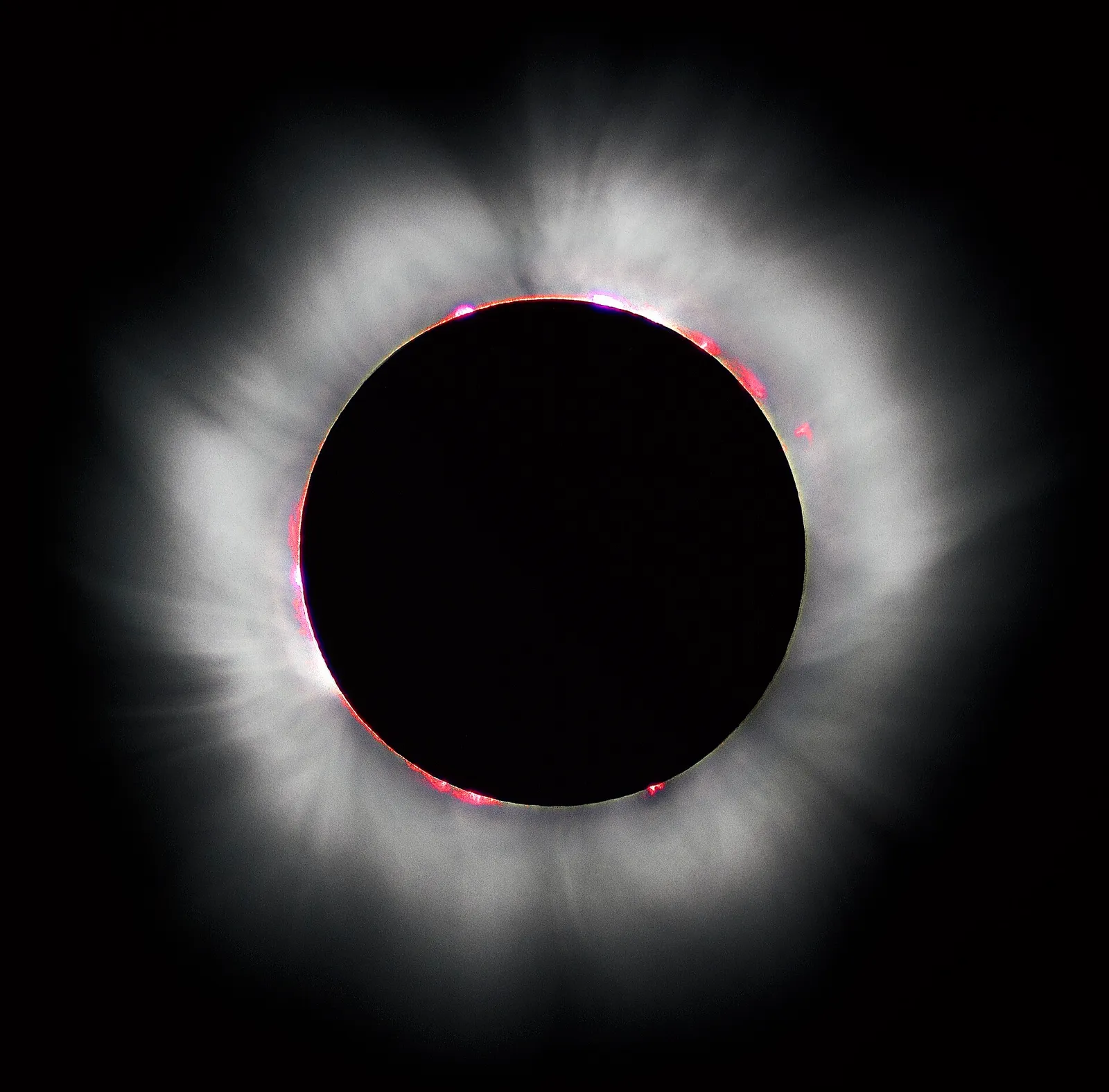
On August 12, the Moon's shadow will race across Greenland, Iceland, a sliver of northern Russia and Spain, plunging those on its path into a brief, total solar eclipse. For much of Europe it will be the first such event in years, and for scientists it is a rare and coveted opportunity.
A total eclipse blots out the blinding disk of the Sun for a couple of minutes, revealing its faint outer atmosphere, the corona, which is normally impossible to see. That short window has drawn an international scramble of experiments, from aircraft and balloons to a symbolic rerun of one of the most famous tests in the history of physics.
Chasing the corona
To make the most of totality, some researchers plan to rise above the weather. NASA intends to fly two high-altitude WB-57 jets over Iceland, racing along the shadow's path to stretch out their view of the corona and photograph it across visible and infrared light. Flying high above the clouds gives their instruments a clearer, steadier look at the corona's structure and heat, part of a long effort to understand why the Sun's outer atmosphere is so extraordinarily hot.
Balloons and cosmic rays
Closer to the ground, teams will send high-altitude balloons up from Iceland and Spain as part of a ballooning project coordinated by Montana State University. Their target is the atmosphere itself: the sudden cooling as the Sun vanishes can set off ripples known as gravity waves, and tracking them can help refine models of weather and climate. Other instruments will look for any change in the cosmic radiation reaching the ground during totality.
Retracing Einstein
Among the most evocative plans is a modern echo of the 1919 eclipse expedition, as Scientific American reported. In that year, the astronomer Arthur Eddington measured the apparent shift in the positions of stars near the eclipsed Sun and found that their light had been bent by the Sun's gravity, just as Einstein's general theory of relativity predicted, a result that made Einstein a global celebrity.
More than a century later, a researcher plans to repeat the measurement during August's eclipse with modern equipment, checking once again whether starlight bends by the tiny amount Einstein foresaw. Relativity has passed countless tests since, so no one expects a surprise. But the experiment is a reminder of how a few minutes of daytime darkness once reshaped our understanding of gravity, and of why, even now, scientists will travel to the ends of the Earth to stand in the Moon's shadow.