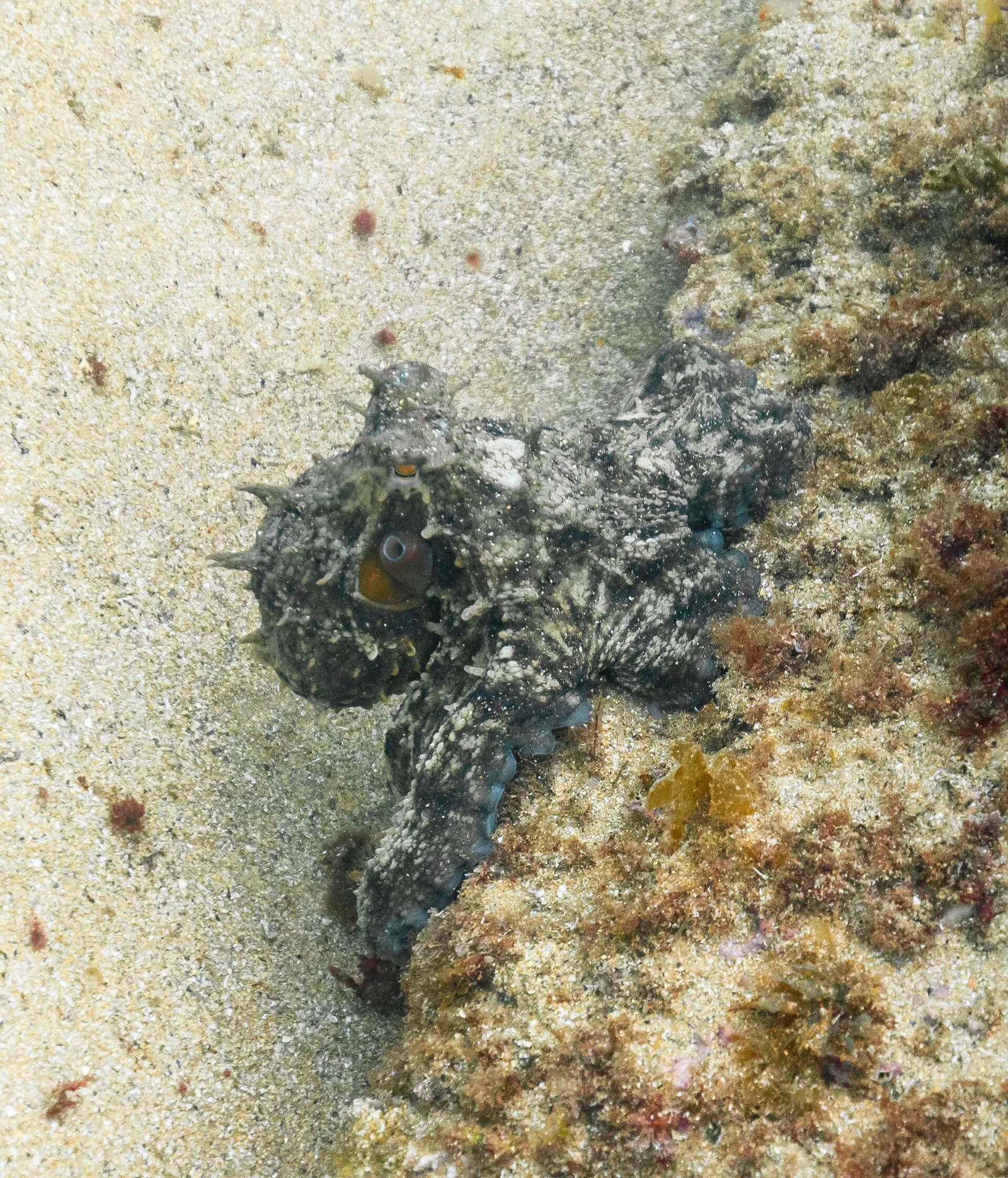
An octopus is, by any ordinary reckoning, a mollusk — a soft-bodied invertebrate more closely related to clams and snails than to anything with a backbone. And yet these cephalopods, the group that also includes squid and cuttlefish, do things no clam ever could. They solve mazes, unscrew jars, recognize individual human faces, and stage escapes from sealed aquarium tanks. How a creature on such a distant branch of the tree of life became so demonstrably clever is one of the most intriguing puzzles in modern biology.
A mind that isn't where you'd expect
The octopus nervous system is built unlike our own. An octopus carries roughly 500 million neurons, a tally comparable to a dog's and the largest of any invertebrate. But the striking part is the layout: only about a third sit in the central brain, while roughly two-thirds are distributed through the eight arms, as researchers describe in coverage of cephalopod neurobiology by Scientific American.
That arrangement gives the arms a measure of autonomy. Each limb can taste, touch and respond to its surroundings, processing information and initiating movement without waiting for instructions from the central brain. In experiments, severed arms still produced coordinated motions, suggesting much of the control logic lives in the limb itself. Some scientists describe the result, loosely, as a body with something like nine brains.
Tool use, without a backbone
The behavioral evidence for octopus intelligence is hard to dismiss. The most celebrated example came in 2009, when the biologist Julian Finn and colleagues, writing in Current Biology, reported veined octopuses (Amphioctopus marginatus) gathering discarded coconut-shell halves, carrying them awkwardly across the seafloor, and reassembling them into a shelter only when needed, as ScienceDaily reported. Acquiring an object for later use had not previously been documented in any invertebrate, making the species, in the researchers' framing, the first tool-user without a backbone.
In the laboratory, octopuses navigate mazes using spatial memory, learn to pull or push to crack a puzzle box, and open jars — including, famously, childproof containers — to reach a meal. Their escape artistry is the stuff of aquarium legend.
Camouflage without color vision
The octopus's most theatrical talent is camouflage. Using millions of pigment-filled skin cells called chromatophores, along with reflective and texture-changing structures, an octopus can transform its color and even its skin texture in under a second. The paradox is that it likely does all this while being colorblind: studies of Octopus vulgaris find a single visual pigment in the eye, meaning the animal probably cannot distinguish colors the way we do.
How it matches a backdrop it cannot see in color remains debated. Researchers have found light-sensitive proteins in octopus skin, suggesting the body itself can detect light independently of the eyes, and recent work indicates the animals are especially good at matching brightness rather than hue.
An intelligence that evolved alone
What makes the octopus mind feel genuinely strange is its independence from ours. The last common ancestor of cephalopods and vertebrates lived more than 500 million years ago and was, in all likelihood, a simple wormlike creature without anything resembling a complex brain or a camera-style eye. Complex brains and sophisticated eyes therefore arose twice, by separate routes — a textbook case of convergent evolution. The octopus is, in this sense, a second, independent experiment in building a mind.
That idea anchors the philosopher Peter Godfrey-Smith's influential 2016 book Other Minds, which treats the octopus as a way to glimpse how consciousness might arise on a foreign branch of life. The 2020 documentary My Octopus Teacher brought a similar fascination to a mass audience.
The lingering paradox
One riddle resists easy explanation. Most highly intelligent animals — primates, elephants, crows — are long-lived and social, traits thought to favor the evolution of big brains. Octopuses are the opposite: largely solitary, and often dead within one to two years of hatching. Godfrey-Smith poses the puzzle directly, asking what all that brainpower is for in an animal that lives so briefly and mostly alone. One proposed answer is that when ancestral cephalopods abandoned the protective shell, they traded armor for mobility and sensitivity — a gamble that rewarded ever more elaborate bodies and the nervous systems to run them. The octopus, it seems, thinks with its whole body, and only briefly. That it thinks at all, so far from our own lineage, is what keeps drawing scientists back to the water.