Few objects have crossed as many borders, languages and centuries as the chessboard. The game played today on smartphones in Lagos, Lima and Seoul descends in an unbroken line from a war-game devised in northern India roughly 1,500 years ago — but it has been redesigned so many times along the way that its earliest players would barely recognize it.
A board of four armies
The prevailing scholarly view, traced largely to H.J.R. Murray's landmark 1913 study "A History of Chess," holds that chess began in India around the 6th century CE as a game called chaturanga. The Sanskrit word means "four divisions" — a reference to the branches of an Indian army: infantry, cavalry, elephants and chariots, ancestors of today's pawn, knight, bishop and rook. As Britannica notes, chaturanga already had the two features that define all later chess: pieces with different powers, and a game decided by the fate of one piece, the king.
That 6th-century date, however, is an approximation rather than a documented founding. Historians work from scattered references in Sanskrit, Persian and Arabic texts, and the precise birthplace and timeline remain debated. What commands broad consensus is that India is the most likely origin, and that chaturanga is the common ancestor not only of modern chess but of related games such as Chinese xiangqi, Japanese shogi and Thai makruk.
Shah mat: the Persian inheritance
From India the game traveled to Persia, where it became shatranj. The Persians gave chess its most enduring verbal legacy. A player attacking the king announced "shah!" — "king!" — and when the king could not escape, "shah mat!" Most authorities, including the Metropolitan Museum of Art, render this as "the king is helpless" or "the king is defeated"; a common popular gloss, "the king is dead," likely entered later through Arabic. The phrase survives, worn smooth by centuries, in the English words "check" and "checkmate."
After the Arab conquest of Persia in the 7th century, chess was absorbed into the Islamic world, where scholars analyzed openings and endgames and composed problems — an intellectual tradition that preserved and refined the game for centuries.
Crossing into Europe
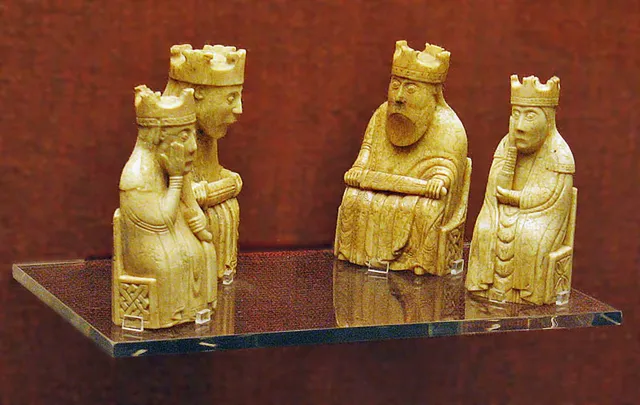
Chess reached Christian Europe chiefly through the Islamic world, by two routes: Al-Andalus, Islamic Iberia, and Sicily. By around the year 1000 it had spread across the continent. The famous Lewis chessmen — walrus-ivory pieces found on Scotland's Isle of Lewis, generally dated to the 12th or 13th century and thought to be Scandinavian in origin — testify to how far north the game had carried along medieval trade routes.
The 'mad queen' revolution
For centuries, European chess remained slow. The piece beside the king, descended from the Persian vizier, could shuffle only one square diagonally. Then, in a burst of change around 1475 — most likely originating in Valencia and Italy — the queen and bishop were given their sweeping modern ranges. The queen became the most powerful piece on the board, and the game grew dramatically faster and more tactical.
The transformation was so striking that contemporaries called the new style "mad queen" chess. Some historians link the queen's rise to the era's powerful female rulers, notably Isabella I of Castile, though that connection remains a plausible suggestion rather than established fact. Whatever its inspiration, the new game swept Europe within decades — and is, in essence, the game played worldwide today.
Standardizing the board
Two modern milestones fixed chess in its present form. In 1849 a distinctive set of pieces went on sale in London, made by John Jaques and endorsed by the English master Howard Staunton, whose name it carries; the clear, stable design became the universal tournament standard. In 1924, delegates meeting in Paris founded FIDE, the International Chess Federation, which today governs world championships and the global rating system.
Machines, and the online boom
Chess's latest chapters have been written in code. On May 11, 1997, IBM's Deep Blue defeated reigning world champion Garry Kasparov in a six-game rematch in New York, 3½–2½ — the first time a computer had beaten a reigning champion under tournament conditions, a landmark for artificial intelligence as much as for chess. Decades later, the game found a vast new audience online, as streaming, accessible apps and a pandemic-era surge drew tens of millions of new players — proof that a 1,500-year-old game of four armies still has fresh moves to make.