
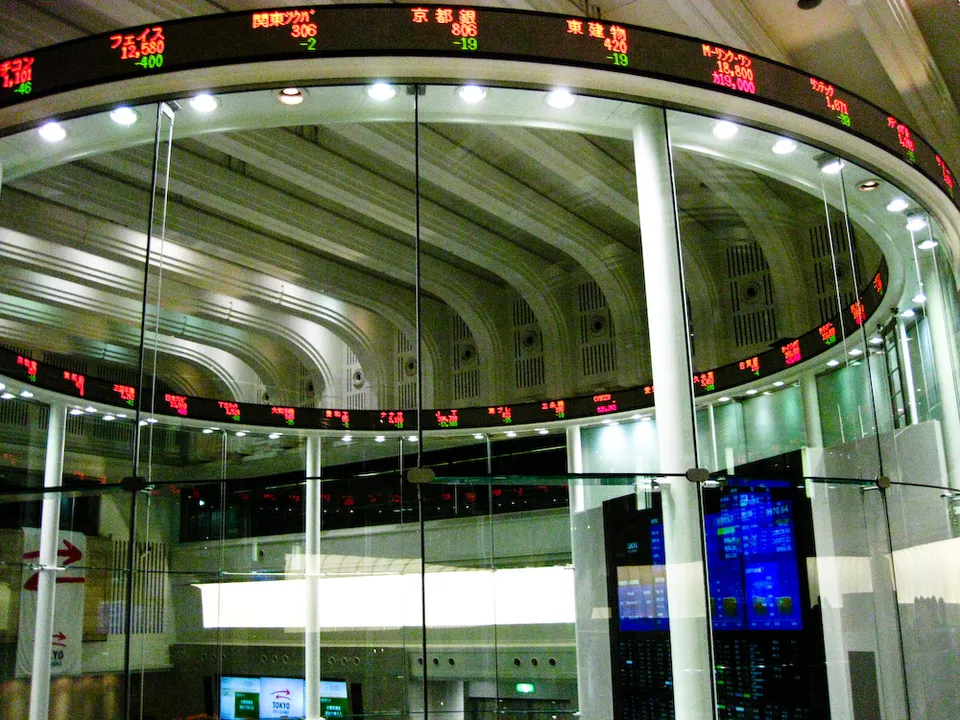
A sell-off in semiconductor and artificial-intelligence stocks swept across Asian markets on Friday, extending a rout that began on Wall Street and reviving doubts about whether the enormous sums being poured into AI can be justified.
Japan's Nikkei 225 index fell about 5%, and the broader Topix dropped, as chip-related shares led the declines. The Japanese memory-chip maker Kioxia slumped sharply, and SoftBank, the technology investor heavily exposed to AI, fell around 9%. South Korea's market, home to the big memory makers Samsung Electronics and SK Hynix, also dropped steeply, while Hong Kong's Hang Seng index fell more modestly. US stock futures pointed lower, with those tracking the S&P 500 and the tech-heavy Nasdaq 100 both sliding before the American open.
What set it off
The immediate trigger was the market's response to results from TSMC, the Taiwanese company that manufactures most of the world's most advanced chips. TSMC reported strong profits, but it also raised its planned capital spending for the year, to as much as $60bn-$64bn, and its commentary on margins gave investors pause. Rather than reassuring the market, the scale of the spending seems to have fed a nagging worry: that the industry is investing colossal amounts in the expectation of AI demand that may take longer than hoped to translate into profits.
That worry is not new, but it has grown louder. Chip and AI stocks have been the engine of this year's stock-market gains, climbing to valuations that leave little room for disappointment. When a company as central as TSMC prompts second thoughts, the effect ripples quickly through a sector whose fortunes are tightly linked.
A familiar debate
At the heart of the sell-off is a question that has hung over markets for months: whether the vast build-out of data centres, chips and infrastructure for artificial intelligence represents a durable new era of growth, or an overheated boom that has run ahead of the actual returns. Enthusiasts point to genuine demand and rapid advances; skeptics warn of echoes of past technology manias, in which investment surged well beyond what the economics could ultimately support.
Friday's moves suggest that, for now, caution has the upper hand. Investors appeared to be trimming their exposure to the stocks that have risen the most, demanding clearer evidence that the AI spending will pay off before pushing prices higher again.
Not just about chips
Other factors added to the unease. The continuing conflict between the United States and Iran has kept geopolitical risk elevated and given investors another reason to take money off the table, particularly in the higher-risk, higher-priced corners of the market. Heading into the weekend, some preferred to reduce exposure rather than hold on through more uncertainty.
It is worth stressing that markets move fast, and a single volatile session does not by itself signal a lasting change of direction; the same stocks have rebounded from sharp falls before. But the breadth of Friday's decline, spanning the biggest chipmakers across several countries, and its trigger in one of the industry's bellwethers, made it more than a routine wobble.
For an AI boom that has powered global equities to repeated records, the episode was a reminder that sentiment can turn quickly, and that the enormous expectations now built into chip stocks cut both ways. Whether this proves a passing correction or the start of a broader reassessment will depend, ultimately, on whether the promised returns from artificial intelligence begin to materialise.