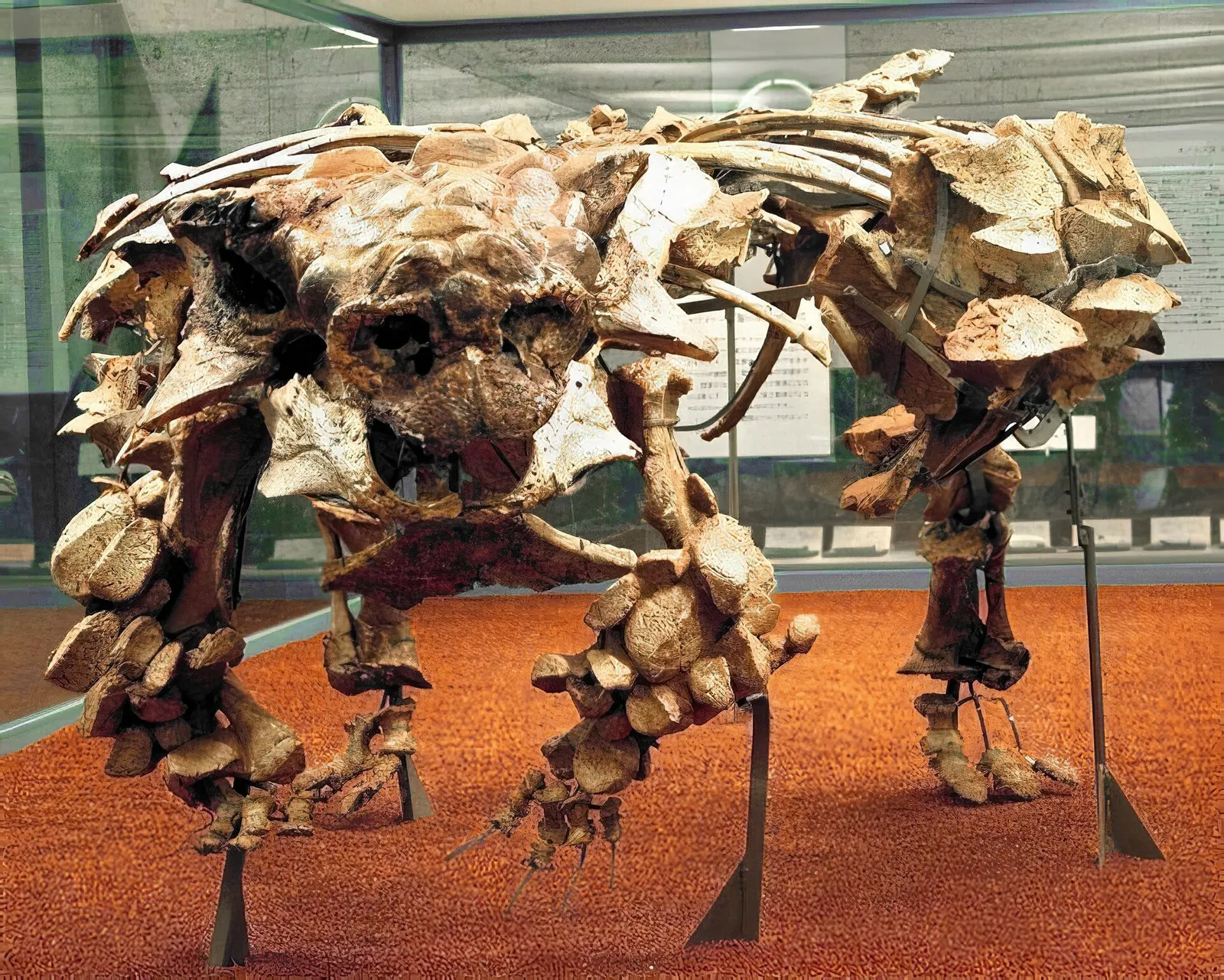
In January 1986, the Argentine geologists Eduardo Olivero and Roberto Scasso were working on James Ross Island, a rugged landmass off the tip of the Antarctic Peninsula, when they noticed bones weathering out of the rock. What they had stumbled upon would prove historic: the first dinosaur fossil ever recovered from Antarctica. Yet the find was so fragmentary, and the conditions so punishing, that excavation stretched across roughly a decade, and the animal was not formally named until 2006, when paleontologists Leonardo Salgado and Zulma Gasparini described it as Antarctopelta oliveroi — "Antarctic shield," honoring its discoverer.
A curious quirk of timing
Although Antarctopelta was the first dinosaur found on the continent, it was not the first to be named. That distinction went to the crested predator Cryolophosaurus, described in 1993 from older Antarctic rocks — meaning the dinosaur discovered first ended up second in the scientific record, a reflection of just how slowly the fragmentary southern bones gave up their secrets.
The animal itself was an ankylosaur: a low-slung, broad herbivore clad in bony armor plates known as osteoderms. It lived during the Maastrichtian stage of the Late Cretaceous, roughly 70 million years ago, and is estimated to have reached about four meters in length. Only a fraction of the skeleton survived — scattered vertebrae, limb fragments, teeth and armor — which long left its precise place in the dinosaur family tree uncertain.
A redescription that moves the branches
Much of that uncertainty has eased. A comprehensive reappraisal of the original specimen, published in the journal Advances in Polar Science, places Antarctopelta within a distinct, early-branching group of southern-hemisphere armored dinosaurs called Parankylosauria. The grouping suggests that armored dinosaurs diversified in the south far earlier and more independently than once assumed, and that Antarctica was not an evolutionary dead end but an active part of the Cretaceous world.
That picture has been reinforced by analyses of additional ankylosaur armor recovered from the same formation on James Ross Island, whose internal structure ties the Antarctic animals to their relatives elsewhere in Gondwana, the great southern supercontinent that was then breaking apart.
A continent that was once green
The Antarctica these dinosaurs knew would be unrecognizable today. In the Late Cretaceous the landmass sat farther north and enjoyed a temperate climate, cloaked in forests and threaded with rivers, still joined to South America by land. Animals could move between the two, which is precisely why Antarctopelta matters: it is a data point in a much larger story about how life dispersed across the southern continents before they drifted into isolation.
For now, the armored herbivore from James Ross Island remains the earliest dinosaur discovery from the frozen continent — and a reminder that even the most ice-bound place on Earth was, in deep time, a living, growing world.