On September 4, 1992, two Belgian mountaineers set out from the Weissmies hut in the Swiss canton of Valais, intending to climb the Weissmies, a peak of 4,017 meters. They got as far as the Almagell hut, were caught by severe weather, and never reached the summit. They were 39 and 41. The search that followed did not find them.
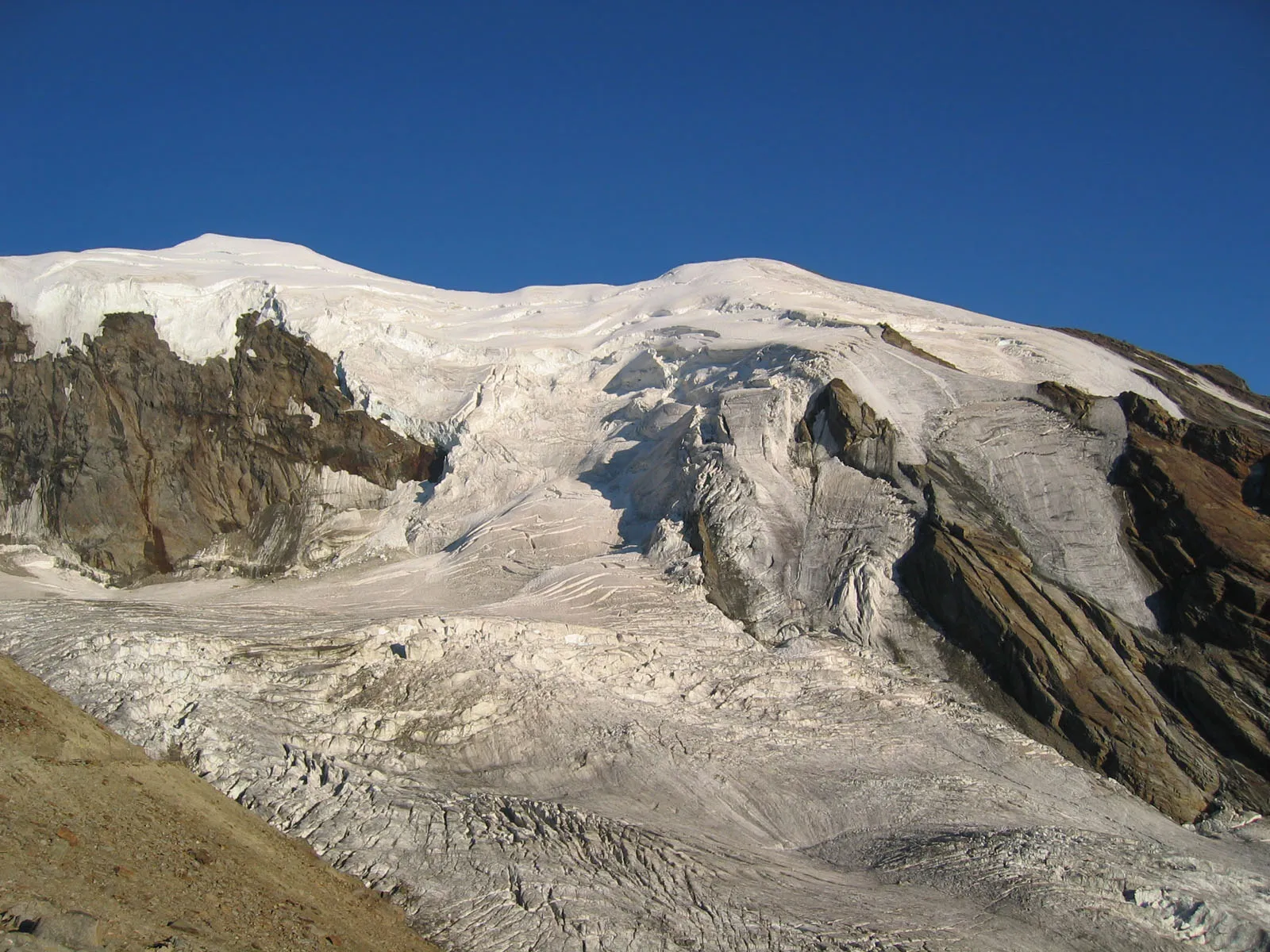
On July 26 this year a hiker found human remains in the melting ice of the Trift glacier. The remains were taken to the Institute of Forensic Medicine at the Wallis hospital in Sion, and police said that a "direct comparison of DNA profiles conclusively established that the individuals were two mountaineers who had been missing in the Weissmies region since 1992". Thirty-four years.
Why this keeps happening
A glacier is not a static block of ice. It flows, slowly, carrying whatever falls into it downhill and eventually delivering it to the snout, where the ice melts away. Anything that goes into a crevasse high on the mountain will, if it stays in the ice, come out lower down decades later. That process has always operated. What has changed is the rate at which the ice is disappearing, which both accelerates the delivery and, more importantly, exposes ice that has not been at the surface in a very long time.
The Swiss figures are unambiguous. Glaciers in Switzerland lost about 24 percent of their volume in the ten years to 2025. The rate has climbed steadily across successive decades: around 10 percent in the decade to 2000, 14 percent in the 2000s, 17 percent in the 2010s, and 24 percent in the last ten years. In 2025 alone, a winter with little snow followed by heat in June and August cost the glaciers 3 percent of their remaining volume, the fourth-largest annual loss since measurements began, behind only 2022, 2023 and 2003.
The monitoring is done by GLAMOS, the Swiss glacier monitoring network, and reported through ETH Zurich and the Swiss Academy of Sciences. More than 1,000 Swiss glaciers have disappeared entirely, most of them small ones that stopped being glaciers and became patches of ice and then nothing.
The cold archive
The Alps have functioned for a century as an accidental archive. People who died in the mountains and were not recovered went into the ice, and the ice kept them. Valais police maintain records of people reported missing in the mountains going back decades, which is what makes identification possible when remains appear: there is a list to check against, and DNA from surviving relatives to compare.
Similar recoveries have become routine rather than remarkable. Remains and wreckage that entered the ice in the middle of the last century have emerged across the Alps in recent summers, each identification closing a file that had been open for decades.
There is something uncomfortable in the arithmetic. Every one of these discoveries is, for one family, the end of a long uncertainty, and that is unambiguously worth having. Each is also a measurement. The ice is releasing what it has been holding because there is less of it every year, and the two families who now know what happened in September 1992 know it because the Trift glacier is smaller than it was.