Five people convicted of criminal damage at a bank in Lancashire are waiting to learn whether the court will treat their offense as having a terrorist connection, a finding that would substantially increase their sentences.
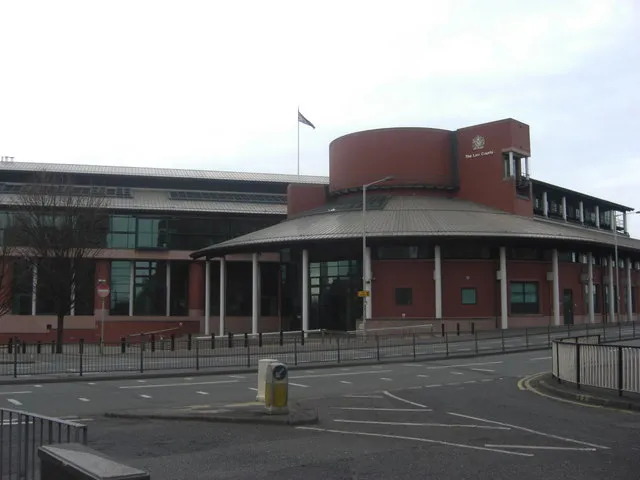
Brendon O'Hagan, 28, Amanda Kelly, 31, Hmeera Atiqnisar, 31, Mohammed Malik, 28, and Alma Yaniv, 70, damaged a Barclays branch in Burnley in August 2024, causing £212,000 of damage, in a protest over the bank's shareholdings in the Israeli defense company Elbit Systems. They were convicted of criminal damage. They were not charged with any terrorism offense. The case is before Preston Crown Court, and sentencing is set for September 4.
What a terrorist connection actually is
The mechanism at issue is not a charge and not a separate crime. It is a finding a sentencing judge can make about an offense that has already been proved, and it applies where the judge concludes the offense was committed for the purposes of terrorism or had a connection to it.
The statutory definition of terrorism sits in section 1 of the Terrorism Act 2000, which covers action involving serious damage to property where the action is designed to influence the government or to intimidate the public or a section of it, and is done to advance a political, religious, racial or ideological cause. Property damage is expressly within the definition. Violence against people is not required.
The practical consequences of such a finding are significant. It increases the sentence, changes the proportion of a sentence that must be served before release can be considered, and brings continuing notification and monitoring obligations afterward.
The two arguments
The prosecution's case rests on reading the statute as written. If serious property damage was carried out to pressure a company and, through it, government policy, and if it was done to advance a political cause, then the statutory test is met on its own terms, whatever the charge on the indictment happened to be.
The objection is not that the words do not fit but that applying them here changes what they were understood to cover. Critics note the defendants were tried on a charge that carries no terrorism element, and that the jury which convicted them was not asked to consider terrorism at all. Raj Chada, a criminal defense lawyer, said that "using the law like this is very, very unusual and appears to be being used to target Palestine Action activists".
There is also a question of timing. Palestine Action was proscribed as a terrorist organization in July 2025, roughly eleven months after the Burnley protest. The proscription itself has been contested: in February 2026 the High Court ruled the ban unlawful and disproportionate, though the designation has remained in place pending further proceedings.
Not the first case
This is the second time the approach has been used against activists from the same group. In June, four Palestine Action activists were sentenced at Woolwich Crown Court over a raid on an Elbit Systems site near Bristol in August 2024 that caused around £1.2 million of damage. The judge in that case, Mr Justice Jeremy Johnson, made a terrorism connection finding, saying he was sure each defendant's criminal damage involved serious damage to property, was designed to intimidate the government and a section of the public, and was done to advance a political or ideological cause. The sentences ran from five years and eight months to eight years and eight months.
Why the outcome matters beyond these five
The question the court is deciding is narrow in form and broad in effect. Sabotage and property destruction have been part of protest movements in Britain for well over a century, and have generally been prosecuted as criminal damage, with sentences to match.
If serious property damage carried out for a political cause reliably attracts a terrorism finding at sentencing, the consequences of that kind of protest change considerably, without any change to the law itself and without a jury being asked the question. Supporters of the approach would say that is simply the statute being applied as Parliament drafted it. Opponents would say a definition written with political violence in mind is being extended to conduct nobody had it in mind for. The court's ruling will not settle that argument, but it will determine which way the practice runs.