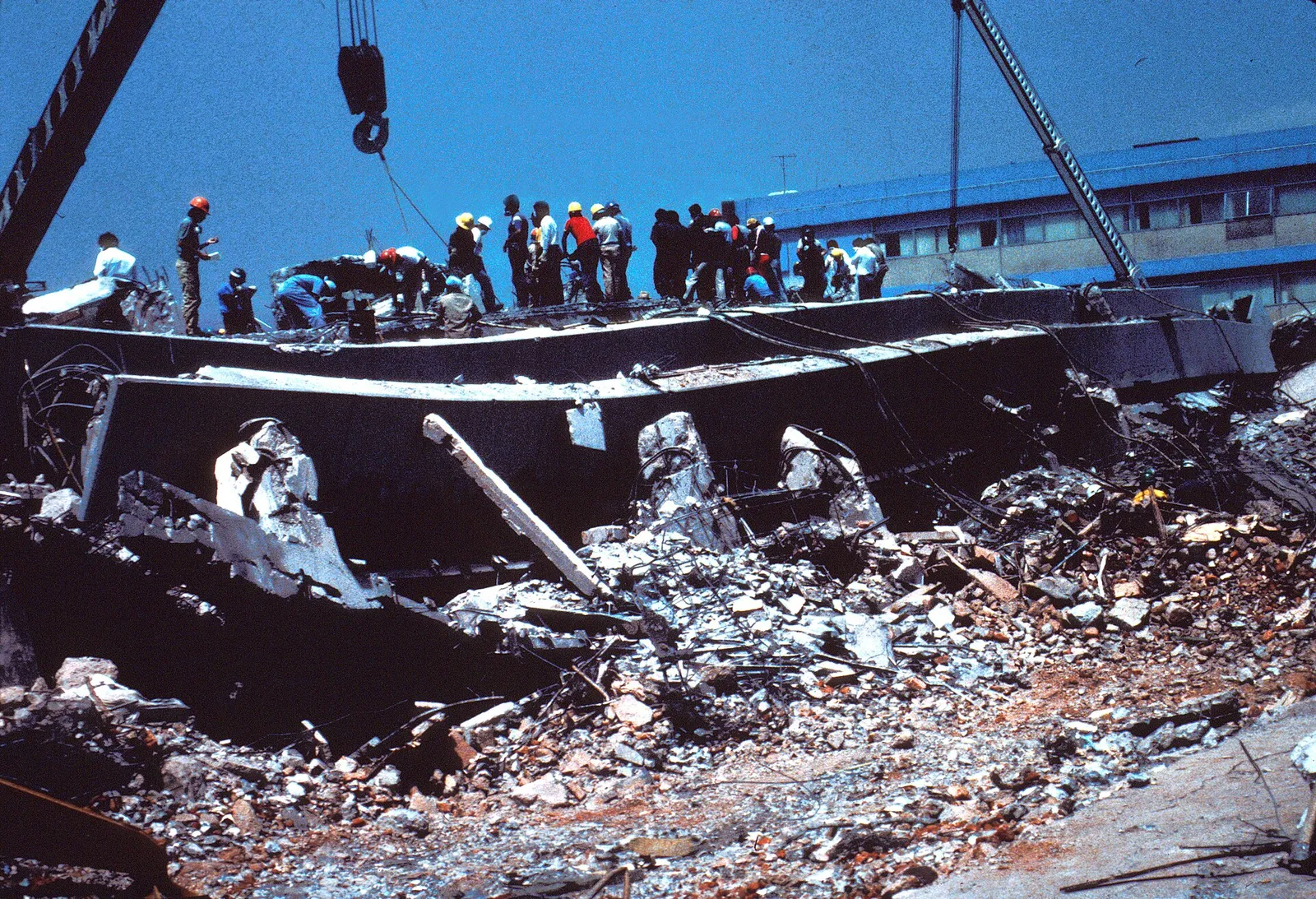
After almost every major earthquake, the same grim pattern emerges: it is not the ground opening up that kills people, but the buildings coming down. Why some structures ride out violent shaking while others collapse is, to a large degree, a solved problem of engineering — and a much harder problem of enforcement.
The shaking that does the damage
When a fault ruptures, it sends waves of energy to the surface as ground motion. "Ground shaking is the primary cause of earthquake damage to man-made structures," the US Geological Survey notes. How a building responds depends partly on resonance: every structure has a natural sway frequency, and if the ground shakes at a matching rate, the motion builds — much as the right note can shatter a glass. Soft soils make it worse, amplifying waves well beyond what is felt on bedrock.
How buildings fail
A few failure modes recur. A soft story — a ground floor with far fewer walls than those above, often for parking or shops — can buckle and let the upper floors drop. Unreinforced masonry, brick or stone with no steel inside, cracks and sheds outward. The most lethal is the "pancake" collapse, in which floor slabs break free of their columns and fall onto one another. Saturated soils can also "liquefy," letting foundations sink or tip.
The engineering that helps
Decades of research have produced reliable defenses. Ductile reinforced concrete — concrete laced with steel so beams and columns bend instead of snapping — and steel framing let a building flex and absorb energy. Shear walls stiffen a structure against sideways forces. At the high end, base isolation places flexible bearings between a building and its foundation so the ground can move beneath it; engineering studies find isolated buildings can feel a fraction of the acceleration a conventional one would, as Oregon State University materials explain. Tuned mass dampers — heavy weights near the top of tall towers — counteract sway. For older buildings, retrofitting with bracing and bolting can sharply improve survival.
Codes — and whether they're enforced
None of this helps unless it is actually built. Modern seismic codes are, in effect, lessons written after disasters, and FEMA stresses they protect lives only when builders follow them and inspectors check. The difference shows up starkly in the record: in Japan's 1995 Kobe earthquake, the large majority of buildings that collapsed had been built before a 1981 code upgrade, while newer ones performed far better.
The same magnitude can produce vastly different death tolls depending almost entirely on construction quality. Researchers at University College London, studying recent major quakes, concluded that "construction shortcuts and deficient buildings" — not shaking intensity alone — were the main cause of mass casualties, the university reported. Places with strong inspection and professional oversight tend to lose far fewer people per unit of shaking than those where codes exist mainly on paper.
The human factor
A large share of the world's housing is built informally — without permits, engineering review or inspection — often by people using whatever they can afford. Much of it sits in earthquake-prone regions. Even in well-regulated cities, many older buildings predate modern codes, and retrofitting them is slow and costly without mandates or incentives.
The encouraging part, engineers emphasize, is that the science is well understood: we know how buildings fail and how to stop them. The gap is institutional — the capacity and will to turn that knowledge into the homes, schools and offices where people actually are. That gap, more than geology, is why an earthquake of the same size can be a manageable emergency in one place and a catastrophe in another.