
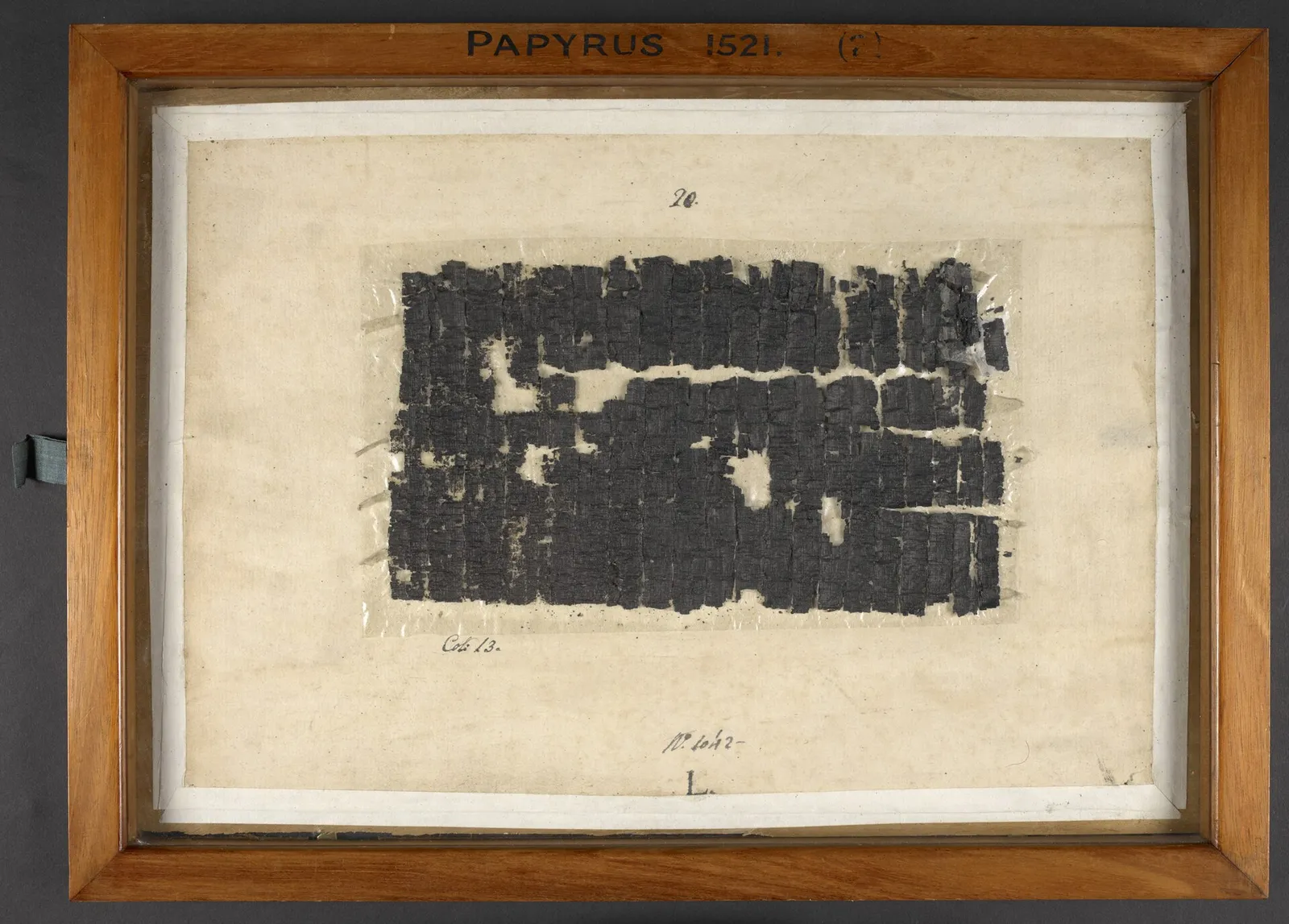
When Mount Vesuvius erupted in AD 79, it did more than bury the Roman towns of Pompeii and Herculaneum. At a seaside villa near Herculaneum it entombed a private library of roughly 1,800 papyrus scrolls — the only library known to survive in its entirety from classical antiquity. The blast of superheated gas and ash carbonized the scrolls where they sat, leaving them as fragile, charred cylinders that could not be opened without crumbling to pieces.
Now researchers have, for the first time, digitally "unrolled" one of those scrolls from end to end and made nearly all of its text legible, Scientific American reported.
Why the scrolls could never be opened
Rediscovered in the 18th century, the Herculaneum papyri have tormented scholars ever since. Early attempts to physically unroll them destroyed many; the survivors were too brittle to touch. The problem is also chemical. The ancient ink was carbon-based, and the eruption turned the papyrus itself to carbon. To an ordinary X-ray, letters and blank page look identical — there is no contrast between writing and background — so even non-destructive imaging long failed to reveal the text.
Reading without opening
The solution treats an intact scroll as a three-dimensional object. High-resolution X-ray scanning, in some cases at particle-accelerator facilities, builds a precise model of the rolled-up layers; software then computationally flattens those layers into readable sheets, and machine-learning models trained to spot the faint traces of ink pick out the characters.
That approach was propelled by the Vesuvius Challenge, an open competition launched in 2023 by technology investors Nat Friedman and Daniel Gross to crowdsource the problem. It worked: a student competitor became the first person to read a word inside an unopened scroll — the Greek for "purple" — and a team led by Youssef Nader, Luke Farritor and Julian Schilliger won the contest's grand prize for recovering hundreds of characters of a previously unread Epicurean text.
The newest breakthrough
The latest advance goes further. A team led by the computer scientist Brent Seales of the University of Kentucky has now fully unrolled a scroll catalogued as PHerc. 1667, recovering some 20 columns of continuous, mostly legible text. "We were not only able to completely unroll this scroll, from end to end, but we were able to extract nearly all the text, and make it legible," Seales told Scientific American. The group has scanned dozens of scrolls in all, and artificial intelligence has sharply accelerated the work of detecting ink and testing new techniques.
The contents are a genuine discovery: a work by the first-century BC philosopher Philodemus, who is thought to have served as the resident philosopher at the villa whose library these scrolls formed. Much of his writing had been lost, and the newly read passages touch on the nature of the gods and divine providence — questions at the heart of ancient debate between Epicurean and Stoic schools.
Why it matters
Every other body of ancient literature has reached us through centuries of hand-copying, each step a chance for error or loss. The Herculaneum scrolls are originals, physically present since the Roman Republic. If the same methods can be applied to the hundreds of scrolls still sitting in archives in Naples — and to others believed to remain buried at the villa — the result could be a meaningful expansion of the surviving canon of ancient thought, read at last without a single scroll being opened.