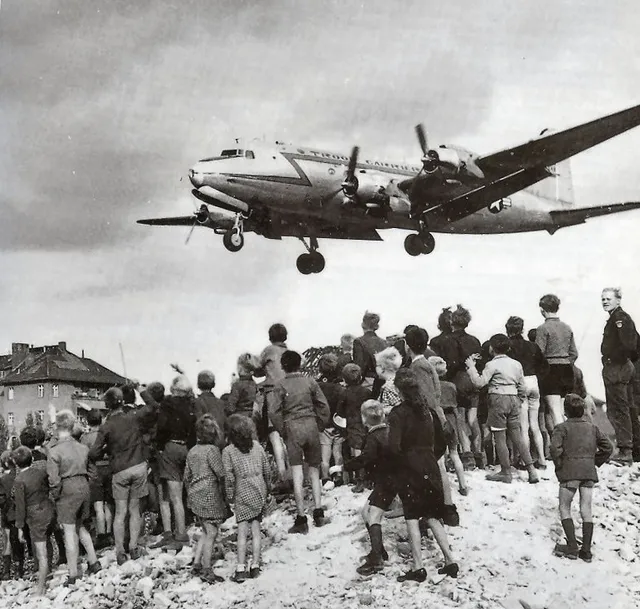
On this day in 1948, Soviet authorities cut off land and water access to the western sectors of Berlin, beginning a blockade that would last almost a year. The response from the United States, Britain and other Western allies — a sustained airlift of food, coal and supplies — became one of the defining episodes of the early Cold War.
A divided Germany, a divided city
After Nazi Germany's defeat in 1945, the victorious Allies split the country into four occupation zones administered by the United States, the United Kingdom, France and the Soviet Union. Berlin, the former capital, was likewise divided into four sectors — but the city lay roughly 160 kilometers (about 100 miles) deep inside the Soviet zone, leaving the Western sectors as an island surrounded by Soviet-controlled territory. Western Berlin depended on road, rail and canal routes running through Soviet-held land for nearly everything its residents needed.
The trigger: currency reform
By 1948, the wartime alliance had frayed into mutual suspicion, and the immediate spark was economic. According to the US State Department's Office of the Historian, the Western powers moved to introduce a new currency, the Deutsche Mark, in their zones in June 1948 as part of broader efforts to rebuild the German economy and lay the groundwork for a West German state.
Moscow objected. The Office of the Historian records that Soviet leader Joseph Stalin cut all land and water routes between western Germany and Berlin on June 24, 1948, in response to the currency reform. Each side cast the other as the aggressor — the West describing the move as an attempt to squeeze it out of Berlin, Moscow framing Western actions as a unilateral breach of agreed occupation arrangements.
The airlift begins
Rather than abandon the city or try to force the blockade with ground troops — a step that risked open war — the Western allies turned to the air. The only guaranteed access to Berlin lay in three 20-mile-wide air corridors agreed earlier with the Soviets.
The United States launched "Operation Vittles" on June 26, 1948, and Britain followed with "Operation Plainfare" on June 28. Cargo aircraft, eventually dominated by the C-54 Skymaster, ferried flour, coal, medicine and other essentials into airfields including Tempelhof in the American sector. The scale grew enormous. The Air Mobility Command Museum reports the airlift delivered roughly 2,334,374 tons of supplies — nearly two-thirds of it coal — across about 278,228 flights. At its peak, the Office of the Historian notes, aircraft landed in Berlin as often as one every 45 seconds. On April 16, 1949, during a single record day sometimes called the "Easter Parade," Allied crews delivered nearly 13,000 tons in a single 24-hour stretch.
The 'Candy Bomber'
One enduring image of the airlift is that of the US pilot First Lieutenant Gail Halvorsen, who began dropping small parachutes of candy and gum to children gathered near Tempelhof. He waggled his aircraft's wings to signal the children, earning the nickname "Uncle Wiggly Wings," and the effort — dubbed "Operation Little Vittles" — grew into an organized campaign that dropped some three tons of sweets over the city. The gesture became a powerful symbol of goodwill amid the standoff.
The blockade lifted
The airlift demonstrated that Berlin could be supplied indefinitely from the air, and the blockade failed to dislodge the Western powers. Moscow agreed to end it, and the blockade was lifted on May 12, 1949; Allied crews kept flying for months afterward to build up reserves.
Why it mattered
The Berlin crisis hardened the emerging division of Europe between East and West. It unfolded alongside the founding of the North Atlantic Treaty Organization, whose treaty was signed on April 4, 1949, and it accelerated the creation of two separate German states later that year — the Federal Republic of Germany (West Germany) in May 1949 and the German Democratic Republic (East Germany) that October. For much of the world, the confrontation came to symbolize the broader contest that would shape international politics for four decades. Berlin remained a Cold War flashpoint — culminating in the building of the Berlin Wall in 1961 — until the wall's fall in 1989 and German reunification the following year.