For nearly 15 years, space shuttle Endeavour has rested where most retired orbiters do — on its belly, wheels down, a museum piece. This November it will rise again, and Los Angeles will get to see a spacecraft displayed as it stood on the launch pad.
A first-of-its-kind display
The California Science Center will open its new Samuel Oschin Air and Space Center on November 13, with Endeavour as its centerpiece. The shuttle is mounted vertically in a full launch stack — attached to an external fuel tank and flanked by two solid rocket boosters — the only authentic shuttle assembled this way for public display anywhere in the world.
Of the four surviving orbiters, the others are shown horizontally or at an angle. None has been raised into the towering configuration in which the shuttles actually flew. Admission to the new center will be free, ABC7 reported.
Real flight hardware
The display is built from genuine components, not replicas. The external tank, the last flight-qualified tank that survived the program, was never launched; the boosters are made from segments that flew on dozens of past shuttle missions. Because the structure stands in earthquake country, engineers placed it on seismic isolators designed to let the stack ride out a quake.
Assembling it was a feat in its own right. Crews lifted Endeavour upright with cranes and mated it to the tank in early 2024, then built the surrounding gallery around the standing stack.
Endeavour's story
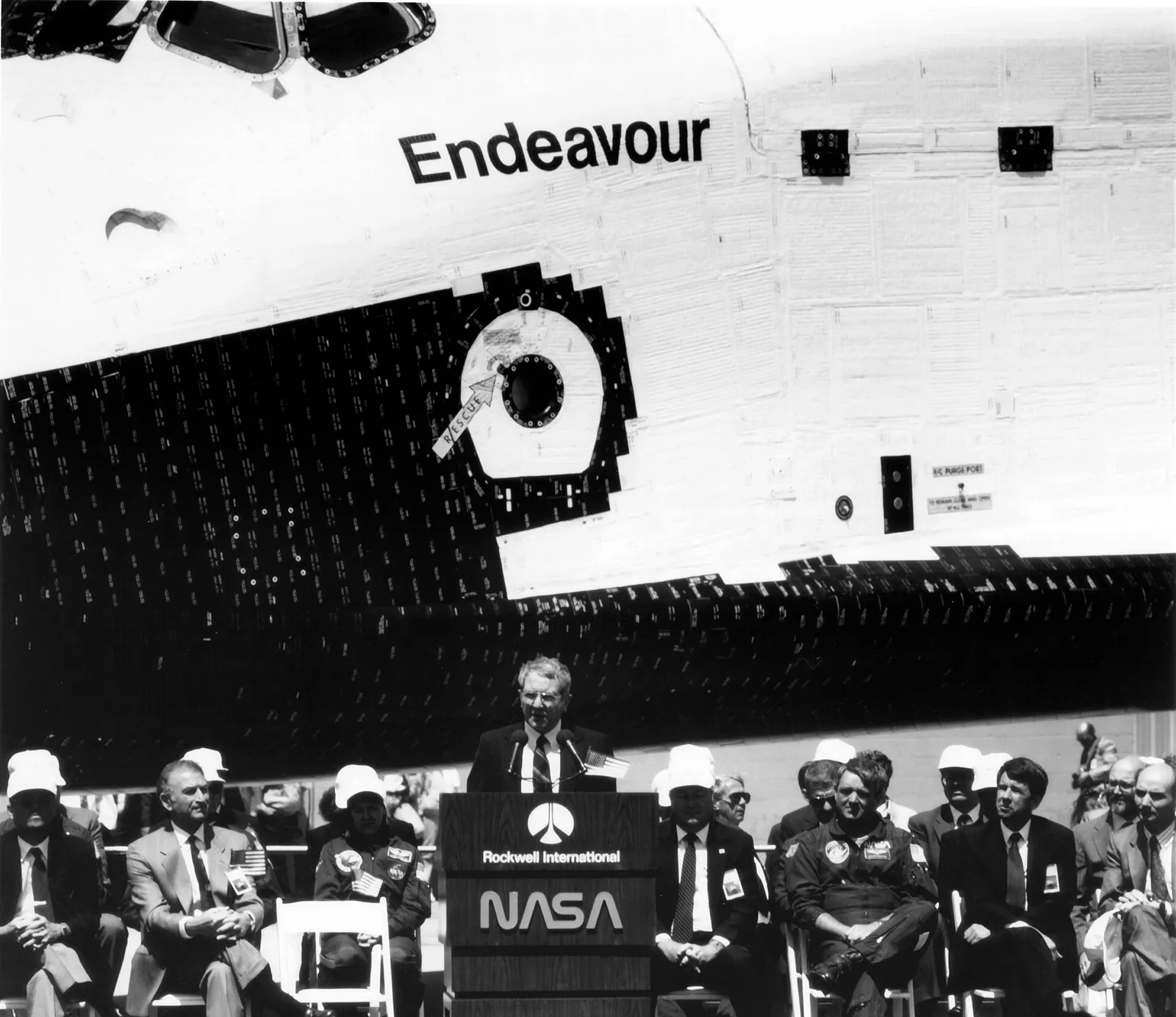
Endeavour was the last shuttle NASA built, authorized after the loss of Challenger in 1986 and assembled in part from spare structural parts. It first flew in 1992 and went on to fly 25 missions, including a 1993 flight that repaired the Hubble Space Telescope's flawed optics and later flights that helped assemble the International Space Station. It made its final landing in 2011, when the shuttle program ended.
After retirement, NASA awarded the orbiter to the California Science Center, and in 2012 Endeavour made a slow, much-watched journey through the streets of Los Angeles to reach the museum.
What visitors will see
The new center is designed to convey the scale of human spaceflight. Visitors will be able to ride up alongside the towering stack and view the orbiter's heat-shield tiles up close, see the main engines and payload bay from multiple levels, and explore other aerospace artifacts and hands-on exhibits.
At a public preview on Wednesday, California Governor Gavin Newsom framed the project as a reflection of the state's "enduring commitment to science, education, and innovation." For younger visitors who have never watched a shuttle launch, the standing Endeavour offers something close: a full-scale reminder of how, and how high, these machines once flew.