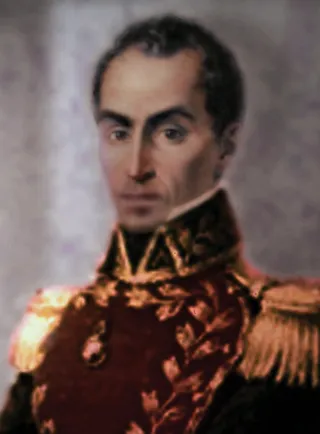
A criollo child of Caracas
Simón Bolívar was born on July 24, 1783, in Caracas, in the Spanish Captaincy General of Venezuela, into one of the wealthiest criollo families in the Americas. The criollos — American-born Spaniards — embodied a paradox that would shape his politics: they held vast land and enslaved people, yet were barred from the highest colonial offices, which Spain reserved for Iberian-born officials. That exclusion gave the elite a grievance on which revolutionary ideas could take root.
Orphaned young — his father died in 1786, his mother in 1792 — Bolívar was raised by tutors and an enslaved household. His education took him to Europe, where he absorbed Enlightenment philosophy; in Madrid in 1802 he married María Teresa Rodríguez del Toro, who died of yellow fever in Venezuela the next year. He never remarried. On a later European tour, the young Bolívar is said to have sworn an oath to liberate Spanish America — a moment recorded in his own later telling, and one whose exact words come down to us through reconstruction.
Campaigns that remade a continent
Bolívar entered the independence struggle in 1810. The road to full liberation took fifteen years and was marked by defeats and exiles that would have ended lesser careers. After early reverses, he found refuge in the Caribbean, where Haiti's president, Alexandre Pétion, supplied men and arms in exchange for a promise to abolish slavery in liberated lands — a pledge only partly kept, as later critics noted.
The turning point came in 1819, with one of the most audacious maneuvers in the hemisphere's history. Bolívar led an army of Venezuelans, New Granadans and British volunteers across the flooded plains of the Orinoco and then over the Andes through a high, freezing pass that Spanish commanders had dismissed as impassable; many men and horses died in the crossing. On August 7, 1819, his forces defeated the royalists at the bridge of Boyacá in a battle that lasted barely two hours. As Britannica records, Boyacá effectively secured the independence of New Granada — present-day Colombia — and the viceroy fled Bogotá within days.
Victory at Carabobo in 1821 sealed Venezuelan independence; Pichincha in 1822 freed Ecuador; and the battles of Junín and Ayacucho in 1824 ended Spanish military power in Peru. In 1825, the newly independent territory of Upper Peru named itself Bolivia in his honor — the only country in the world to bear a liberator's name.
The dream of Gran Colombia
Even amid the campaigns, Bolívar was building a political vision. By 1821, Gran Colombia — uniting present-day Colombia, Venezuela, Ecuador and Panama — had been constituted with Bolívar as its first president. The union embodied his core conviction: that the former colonies, lacking the institutions he believed democracy required, needed strong, centralized governance to survive. He admired aspects of the British constitutional model, proposed a hereditary senate in one draft, and sketched a presidency-for-life in the Bolivian constitution of 1826. When Gran Colombia's regions proved ungovernable, he assumed dictatorial powers in 1828 and survived an assassination attempt that year.
Admirers cast his authoritarianism as a pragmatic answer to genuine chaos; critics, then and now, argue it was incompatible with the democratic ideals he invoked and set a template for the strongman rule that recurred across Latin America. Britannica and other historians treat the tension as central to understanding him.
Collapse and a lonely death
The forces Bolívar feared proved stronger than the institutions he built. Venezuela and Ecuador withdrew from Gran Colombia in 1830. Stripped of authority and gravely ill, he resigned that April, intending to sail into exile. He never left: by December 1830, tuberculosis had killed him at a hacienda near Santa Marta, on the Caribbean coast of present-day Colombia. He was 47. The bleak summary often attributed to his final months — that "America is ungovernable" and that those who served the revolution had "plowed the sea" — captures the disillusionment around his end, though its precise wording is debated.
A legacy still being contested
Two centuries on, Bolívar's image saturates Latin American public life. Venezuela's official name — the Bolivarian Republic of Venezuela — was adopted under Hugo Chávez in 1999, who invoked Bolívar's anti-colonial and unification rhetoric as the foundation of a project he branded Bolivarianism; his government also exhumed Bolívar's remains in 2010 to investigate the cause of death, with inconclusive results. Across the spectrum, rival movements claim him — nationalists, socialists, pan-Americanists and populists of left and right alike.
What is documented, as opposed to mythologized, is striking enough: one man, across roughly fifteen years of near-continuous campaigning, contributed centrally to the independence of six nations and the end of three centuries of Spanish imperial rule across a continent. That the republics he left behind quickly fractured, and that he died regarding his life's work as a failure, belongs to the record as surely as the victories — a legacy that resists the clean heroic narrative any one flag or platform tries to pin on it.