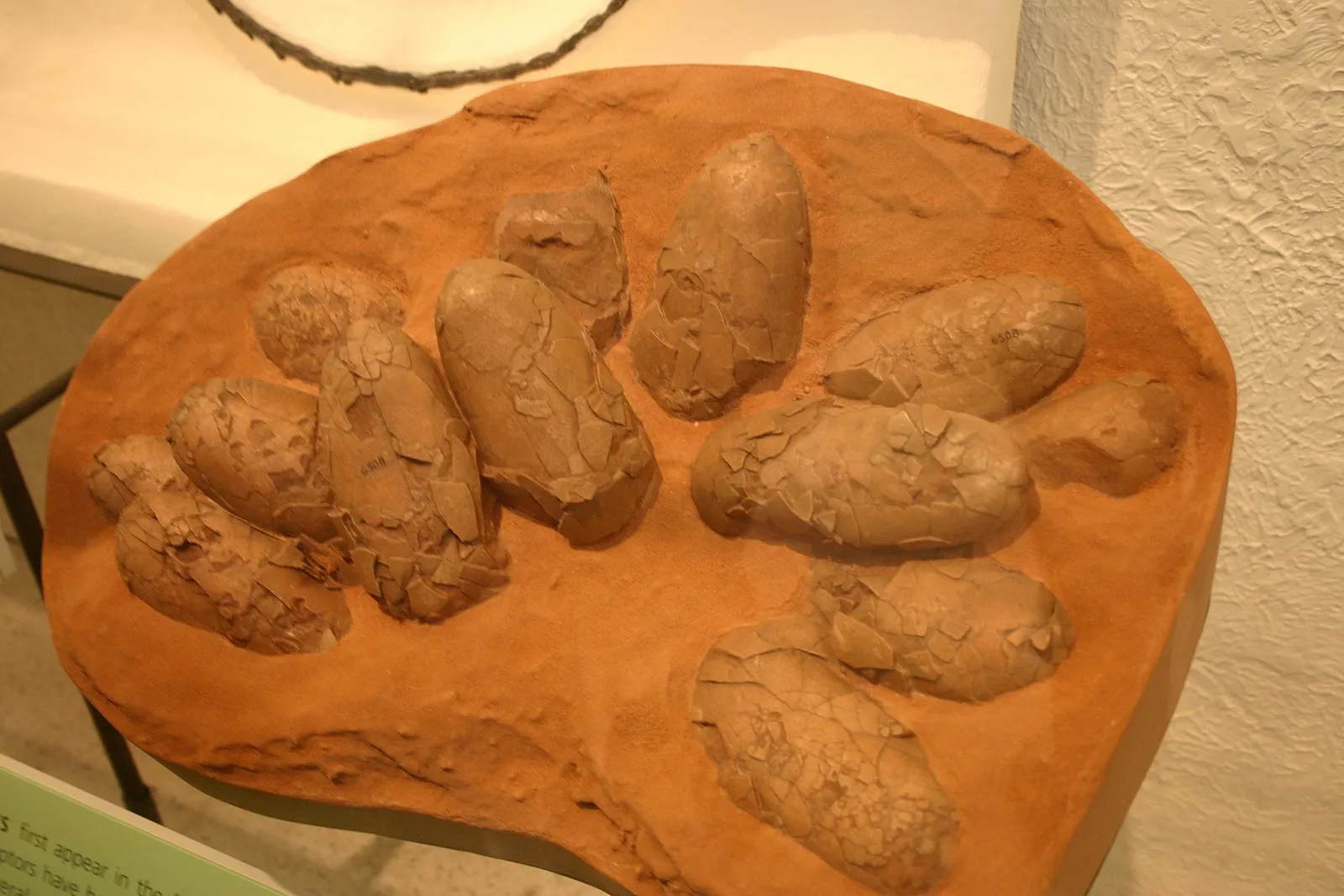
Some 70 million years ago, in what is now southern China, a feathered dinosaur called an oviraptor settled onto a ring of eggs and waited for them to hatch. Fossils have preserved that intimate scene many times over — adults crouched atop carefully arranged clutches, looking strikingly like a brooding bird. But a stubborn question has lingered: could these animals actually keep their eggs warm enough to develop, or were they relying on something else? A team of researchers in Taiwan set out to answer it in an unusual way — by building a dinosaur.
The puzzle of a cold-blooded incubator
Modern birds are living dinosaurs, and many warm their eggs with body heat, pressing a bare patch of skin against the clutch to hold it near the temperature a developing embryo needs. Oviraptors — small, beaked theropods roughly 1.5 meters long — clearly sat on their nests too. Yet it was never clear whether they generated and delivered enough heat to do the job like a bird, or whether, like crocodiles and turtles, they depended on the warmth of their surroundings.
The distinction matters. It speaks to how much these animals resembled their bird descendants, and to how the whole strategy of sitting on a nest evolved in the long transition from dinosaur to bird.
A model dinosaur, wired for heat
Rather than argue the point from fossils alone, researchers led by Tzu-Ruei Yang at Taiwan's National Museum of Natural Science, with first author Chun-Yu Su, built a full-scale physical model of an oviraptorid — the species Heyuannia huangi — and tested it, as ScienceDaily reported.
The team constructed the roughly 1.5-meter animal from a wooden frame and foam, fitted it with a heating element to stand in for a brooding adult's body warmth, and arranged eggs cast from resin in the double-ring pattern seen in real fossil nests. Then they measured how heat spread across the clutch under different conditions. The work was published in the journal Frontiers in Ecology and Evolution.
The sun does the heavy lifting
The results pointed away from a purely bird-like picture. Because an oviraptor's nest was open to the air rather than buried, and because the outer ring of eggs partly shielded the inner ones from the adult's body, warmth from the parent alone spread unevenly. In cooler conditions, the study found, eggs in the outer ring could sit as much as 6 degrees Celsius colder than those nearer the center — a gap large enough to make some embryos develop faster than others.
When the researchers added simulated sunlight, that imbalance nearly vanished: the temperature difference across the clutch narrowed to about 0.6 degrees Celsius. "Since oviraptor clutches are open to the air, heat from the sun likely mattered much more than heat from the soil," Yang said, according to ScienceDaily.
The implication is that oviraptors did not incubate quite like a modern hen. Instead they appear to have used a hybrid approach — combining a parent's body heat with solar warmth — that sits somewhere between the strategies of today's birds and those of reptiles such as crocodilians. It is a reminder that "brooding" in these animals may have looked familiar without working the same way.
Why a half-measure could still succeed
A less efficient incubator might sound like a liability, but the study suggests it need not have been. The very structure of the nest — eggs laid in a ring, with the adult positioned at the center — may have been an adaptation that spread the available heat as evenly as the arrangement allowed, helping even the outermost eggs along.
There is a deeper evolutionary point as well. Relying on a parent and the sun, rather than on soil temperature alone, would have loosened the link between how warm a nest was and how its embryos turned out — a link that, in some living reptiles, even determines the sex of the young. Animals whose sex was fixed at conception, as in birds, would have been better insulated from the swings of a hot or cold season.
A window into deep time
Beyond the specifics of one dinosaur, the experiment is a small demonstration of how paleontology now works — pairing fossils with physical models and basic physics to reconstruct behavior that left no direct trace. The nests themselves have long been known; what was missing was a way to test what the animals crouched over them were actually accomplishing.
The answer, it seems, is that these dinosaurs were neither indifferent parents nor perfect ones. They tended their eggs, arranged them with care, and let the sun make up the difference — a modest, workable solution that carried their lineage forward, and that echoes, faintly, in every bird that warms a clutch today.