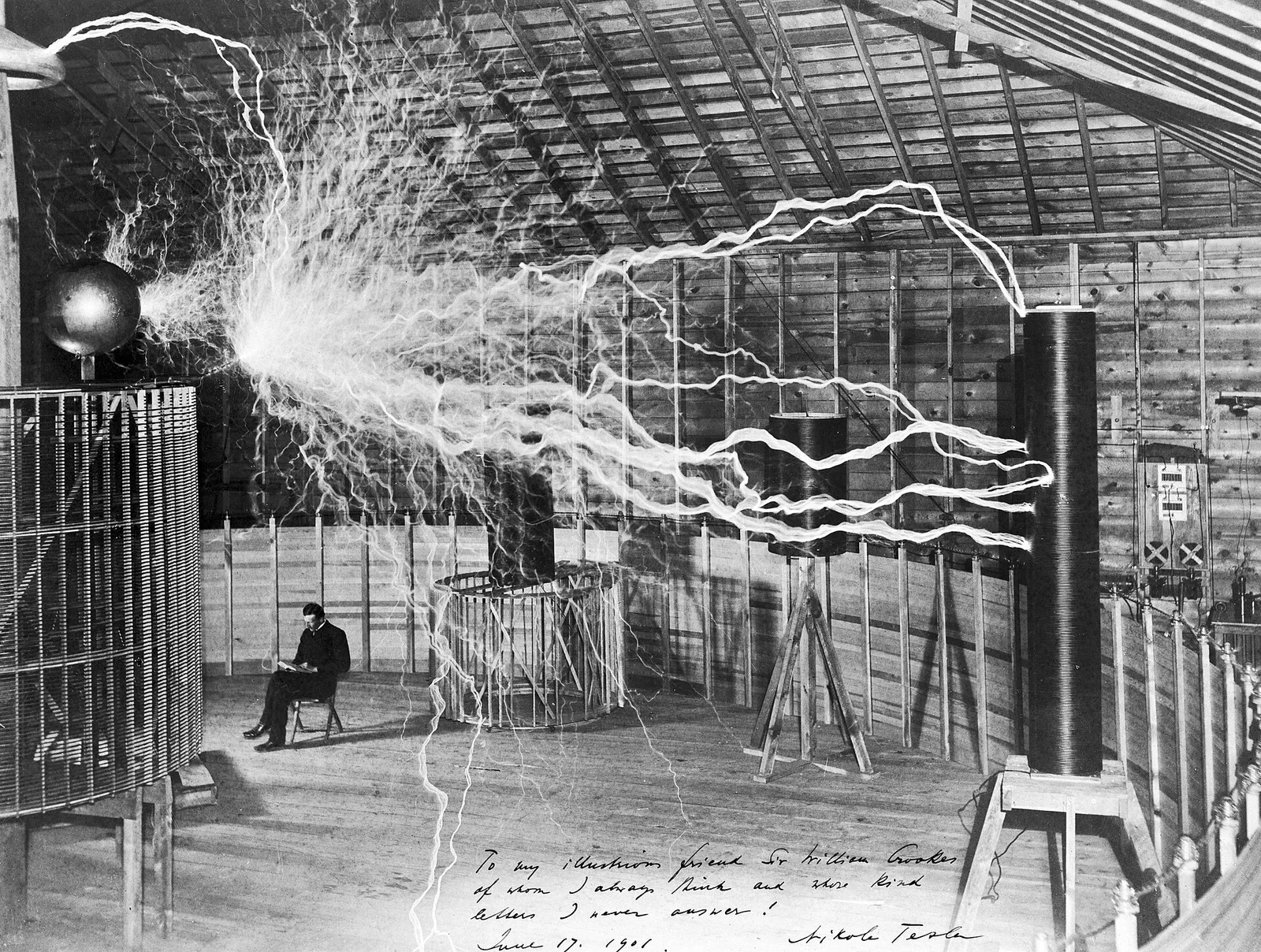
Nikola Tesla was born 170 years ago, on July 10, 1856, in the village of Smiljan, then part of the Austrian Empire and now in Croatia. Few individuals have done more to shape the physical fabric of modern life, and few great inventors have been so thoroughly mythologized. On his birthday, it is worth separating what Tesla actually did, which was extraordinary enough, from the tangle of legend that has grown up around him.
The engineer who backed the right current
Tesla's central achievement, as recorded by Encyclopaedia Britannica, was his development of practical alternating-current (AC) systems and the rotating magnetic field that underlies the AC induction motor. It was a decisive bet. In the 1880s, the electricity business was split between Thomas Edison's direct current (DC), which could not be sent efficiently over long distances, and alternating current, which could. In 1888 the industrialist George Westinghouse acquired the rights to Tesla's polyphase patents, and the two men found themselves on one side of a bitter commercial fight, the so-called "war of the currents," against Edison's entrenched DC interests.
Winning the war of the currents
Alternating current's advantages proved decisive. A turning point came at the 1893 World's Fair in Chicago, lit by Westinghouse and Tesla's AC system, and again when Westinghouse won the contract to harness Niagara Falls; by 1896 power generated there was being sent to Buffalo. That infrastructure, built on Tesla's patents, is in a direct line of descent to the grid that powers the world today. It is the clearest, most consequential part of his legacy, and it is not in dispute.
Brilliance without fortune
Where Tesla's story turns is in his inability to convert genius into lasting wealth. His grandest scheme, the Wardenclyffe Tower on Long Island, was meant to transmit information and even power wirelessly across the globe. Backed by the financier J.P. Morgan, construction began in 1901, as Smithsonian Magazine recounts, but the money ran out, Morgan declined to provide more, and the project collapsed. Around the same time Guglielmo Marconi captured the world's attention, and its investment, with transatlantic radio. Tesla spent his later years increasingly isolated and short of money, and died in a New York hotel room in January 1943.
Sorting legend from fact
Part of Tesla's modern fame rests on claims that outrun the evidence. Stories that he built a working "death ray," powered a car from cosmic rays, or received messages from other worlds belong to folklore rather than the historical record, and should be treated with skepticism. The verified Tesla is impressive without embellishment: a prodigiously inventive engineer who held around 300 patents, pioneered AC power, and did early work on wireless control and high-frequency electricity. His name now marks a unit of magnetic field strength, an electric-car company he never knew, and an airport in Belgrade.
Why he still fascinates
Tesla endures partly because his life reads like a parable: the visionary who saw the future clearly but could not master the business of profiting from it, outmaneuvered by more commercially ruthless rivals. That framing can be overdone, and it flattens a complicated man into a symbol. But the core of it is true, and it is why, 170 years after his birth, he remains a figure people argue over and claim. The world he imagined, wired and electrified and connected, is largely the one we live in. That is a rarer kind of immortality than any death ray, and it needs no myth to sustain it.