

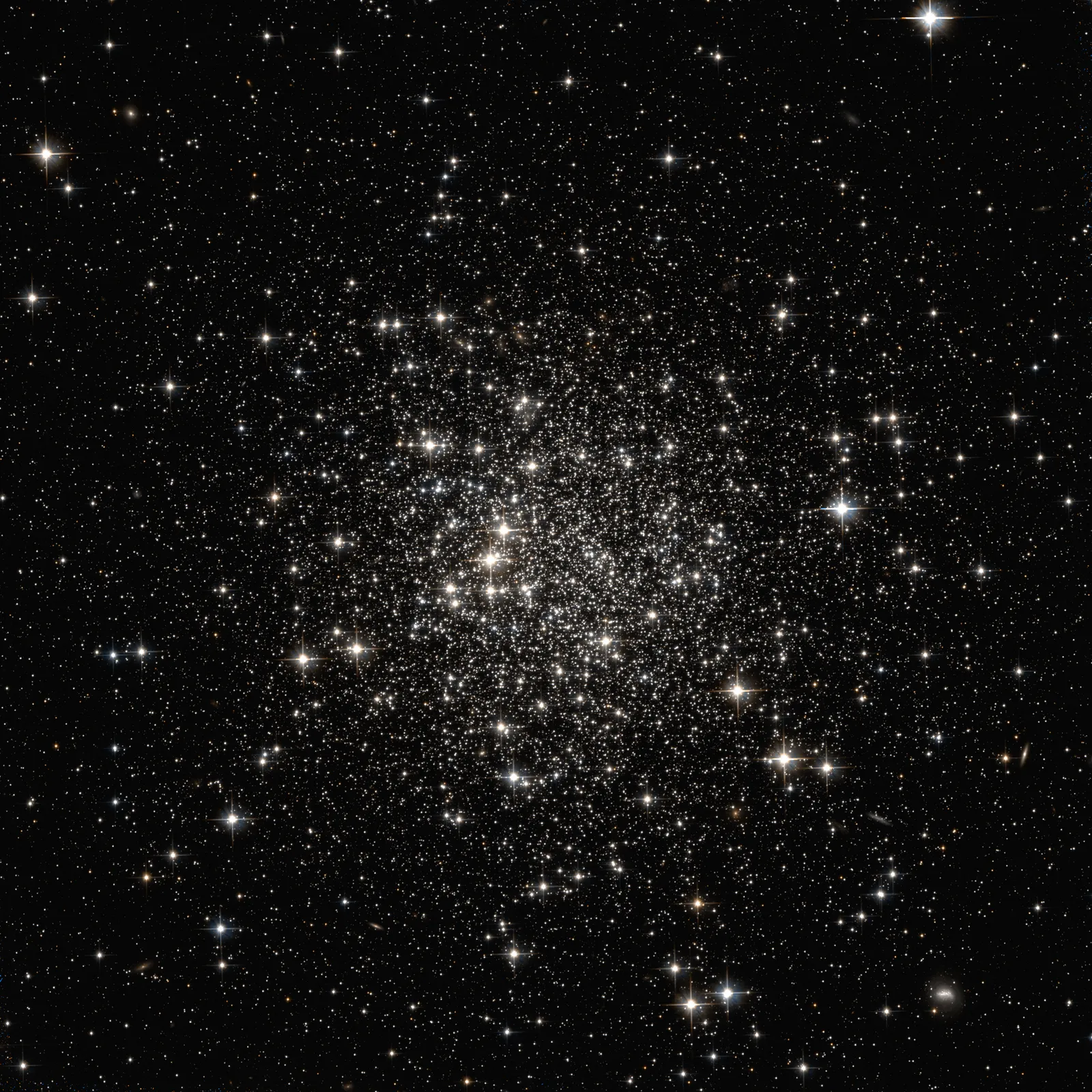
To mark the Fourth of July, NASA released a Hubble Space Telescope portrait of NGC 6426, describing it as a cosmic "sparkler" of red, white and blue stars. The holiday framing is a bit of fun, but the cluster itself is a serious object of study: at roughly 13 billion years old, NASA says, it is one of the Milky Way's oldest globular clusters, almost as old as the 13.7-billion-year-old universe.
An ancient star city
Globular clusters are dense, roughly spherical swarms of stars bound together by their mutual gravity. NGC 6426 is one of about 150 such clusters known in our galaxy, and it belongs to the galaxy's outer halo, the sparse spherical region surrounding the Milky Way's disk. The cluster lies in the direction of the constellation Ophiuchus, some 67,000 light-years away, which is why it took a telescope above Earth's atmosphere to resolve its faint, crowded stars.
The colors in the image are not decorative; they track temperature. As NASA notes, the blue stars are hotter and the red stars are cooler, so a single frame captures stars at very different stages and states.
A window on the early universe
What makes NGC 6426 scientifically interesting is its chemistry. Its stars have low "metallicity," meaning they contain only small amounts of elements heavier than hydrogen and helium. That is a signature of great age: the cluster formed when the universe had not yet been enriched by generations of exploding stars.
Even so, the cluster is not entirely uniform. Researchers have found evidence for two chemically distinct populations of stars within it. NASA says the younger group appears to have been enriched by material cast off in the explosive deaths of the cluster's earliest stars, a small-scale example of how the cosmos gradually built up the heavier elements that later worlds, and living things, are made from.
Why astronomers keep looking
Old, metal-poor globular clusters act as fossils. Because their stars formed at nearly the same time from nearly the same material, they let astronomers test models of how stars age and how galaxies assembled. Studying a cluster like NGC 6426 is, in effect, a way of reading the early chapters of the Milky Way's history, chapters written long before the Sun and its planets existed. That a 13-billion-year-old object can also look like a handful of holiday sparks is a reminder of how much depth sits behind even a festive image.