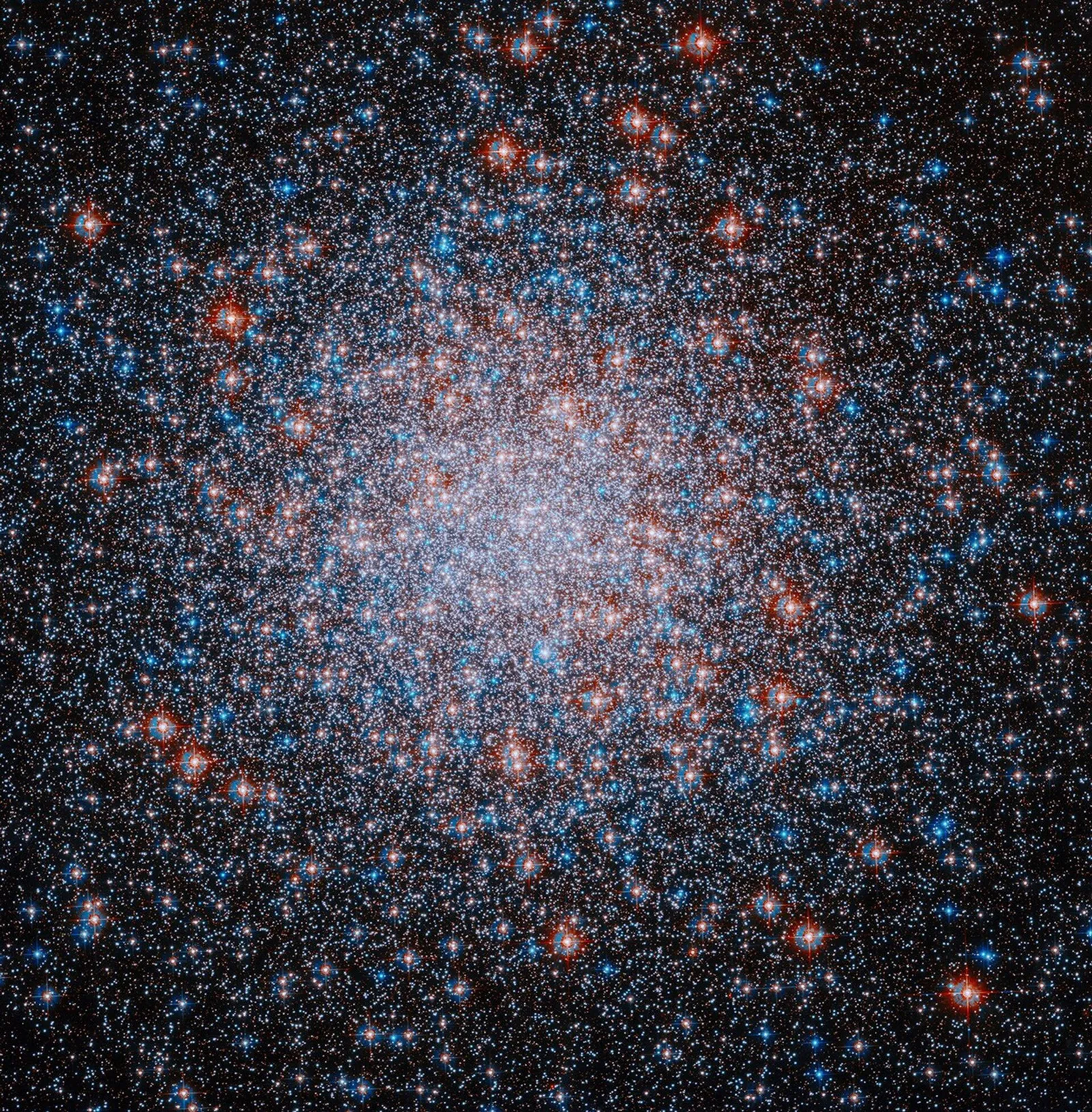
For the Fourth of July and the nation's 250th birthday, NASA has offered a celestial version of red, white and blue. The agency released a Hubble Space Telescope image of Messier 3, a glittering ball of stars whose natural colors happen to echo the American flag, NASA reported. The patriotic framing is a bit of holiday fun, but the object itself is one of the more remarkable star systems in our galaxy.
What you are looking at
Messier 3, also cataloged as NGC 5272, is a globular cluster — a roughly spherical swarm of stars bound tightly together by gravity, orbiting the outer regions of the Milky Way. It is one of the galaxy's largest and most massive such clusters, containing more than 500,000 stars packed into a dense, brilliant sphere. It lies tens of thousands of light-years from Earth.
The "star-spangled" colors are not artistic license so much as physics. A star's color reflects its temperature: hotter stars shine blue-white, cooler ones glow red. In a cluster as populous as M3, that spread of temperatures produces the mix of red, white and blue points of light that NASA highlighted for the anniversary.
A laboratory for cosmic distances
Beyond its looks, M3 is scientifically prized for what it contains. The cluster is home to more than 240 RR Lyrae stars — the largest known population of them in any globular cluster in the galaxy. RR Lyrae stars are a type of variable star, meaning their brightness rises and falls in a regular rhythm.
That rhythm is enormously useful. The pattern of an RR Lyrae star's pulsing reveals its true, intrinsic brightness, and by comparing that with how bright it appears from Earth, astronomers can calculate how far away it is. Objects that work this way are known as "standard candles," and they are among the essential tools for measuring distances across the universe. A cluster stuffed with them, like M3, is a valuable natural yardstick.
Stars that look younger than they are
M3 also hosts around 70 "blue straggler" stars — objects that shine with a bright blue light, making them appear younger and hotter than the ancient stars around them. In a cluster of old stars, that is a puzzle, and the leading explanation is that blue stragglers gain a new lease of life through stellar collisions or by drawing material from a companion star, effectively rejuvenating themselves.
There is a further clue to the cluster's history in its makeup: astronomers think M3 may itself have formed from the merger of two smaller clusters, once part of a dwarf galaxy that the Milky Way later absorbed. If so, it is a relic of our galaxy's long history of growing by consuming its smaller neighbors.
Why images like this matter
Beautiful pictures from Hubble serve a purpose beyond decoration. They translate abstract science — variable stars, stellar populations, galactic history — into something people can see and connect with, and they remind a wide audience of what a decades-old telescope continues to deliver.
Tying the release to the 250th anniversary is a bit of showmanship, but a harmless and appealing one: a reminder that, on a holiday spent looking up at fireworks, there is a far older and grander display permanently overhead. Messier 3 has been shining for billions of years, indifferent to human anniversaries — and now, briefly, it doubles as a cosmic set of stars and stripes.