The United Nations Security Council is charged with maintaining international peace and security, and its decisions are binding on all UN member states. Yet built into its design is a power that lets just one country block action supported by the rest of the world: the veto. Understanding how it works means going back to the document that created it.
The five permanent members and the math of a resolution
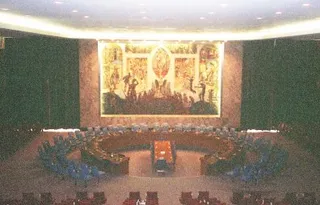
The Security Council has 15 members. Five are permanent — China, France, Russia, the United Kingdom and the United States, collectively known as the P5. The other ten are elected by the General Assembly for two-year terms.
Under Article 27 of the UN Charter, adopted in 1945, voting works in two tiers. Procedural matters are decided by an affirmative vote of any nine of the 15 members. "All other matters" — substantive questions such as sanctions, peacekeeping mandates or authorizing the use of force — require nine affirmative votes that include "the concurring votes of the permanent members."
In practice, that second requirement is the veto. As the UN's own voting system page explains, a resolution on a substantive matter fails if any one of the five permanent members casts a negative vote — even if the other 14 members vote in favor. The word "veto" does not actually appear in the Charter; the power flows from that phrase about "concurring votes."
Substantive versus procedural
The distinction matters, because the veto only applies to substantive decisions. On a genuinely procedural question — such as putting an item on the agenda — nine votes are enough and no P5 member can block it. But who decides whether a matter is procedural? That determination is itself treated as a substantive question, meaning a permanent member can veto the attempt to classify something as procedural — a quirk critics call the "double veto."
Abstentions don't count as vetoes
One of the most important features of the veto is something the Charter does not literally say. Although Article 27 requires the "concurring votes" of the permanent members, long-standing practice holds that a permanent member can abstain or be absent without blocking a resolution. Only an explicit "no" is a veto.
This interpretation was upheld at the International Court of Justice. In its 1971 advisory opinion on Namibia, the Court found that the voluntary abstention of a permanent member had "consistently and uniformly" been interpreted as not barring the adoption of resolutions — settling a question that dated to the Soviet Union's absence from the Council in 1950.
Who has used it, and how often
The veto has been cast hundreds of times since 1946, but not evenly. According to the UN's own records, the Soviet Union and its successor Russia have used the veto more than any other member — well over 100 times — followed by the United States. The United Kingdom, China and France have each used it far less often. (Exact running totals shift as the Council's dashboard updates.)
The pattern has changed over time. In the early Cold War, the Soviet Union cast the overwhelming majority of vetoes, many to block new member admissions. The United States did not cast its first veto until 1970, but has used it frequently since — often, observers note, on resolutions concerning Israel. Neither France nor the United Kingdom has used the veto since 1989.
The long debate over reform
The veto has drawn criticism almost since the UN's founding, with detractors arguing it can paralyze the Council on major crises and supporters contending it keeps the most powerful states inside the system rather than walking away from it. Several reform tracks have emerged. The so-called Group of Four — Brazil, Germany, India and Japan — has pushed for an expanded Council with new permanent seats, while a rival bloc, Uniting for Consensus, opposes new permanent members and favors more elected seats. Those competing visions, along with disagreements over Africa's representation, have left formal reform stalled for decades — not least because any Charter amendment itself requires P5 ratification.
A more recent step focused on transparency rather than abolition. In April 2022, the General Assembly adopted by consensus the "veto initiative" (Resolution 76/262), spearheaded by Liechtenstein. It requires the General Assembly to convene within 10 working days whenever a veto is cast, giving the wider membership a forum to debate the decision and obliging the vetoing power to explain itself. The measure does not limit the veto — but it ensures that using it now triggers a debate among all 193 member states.