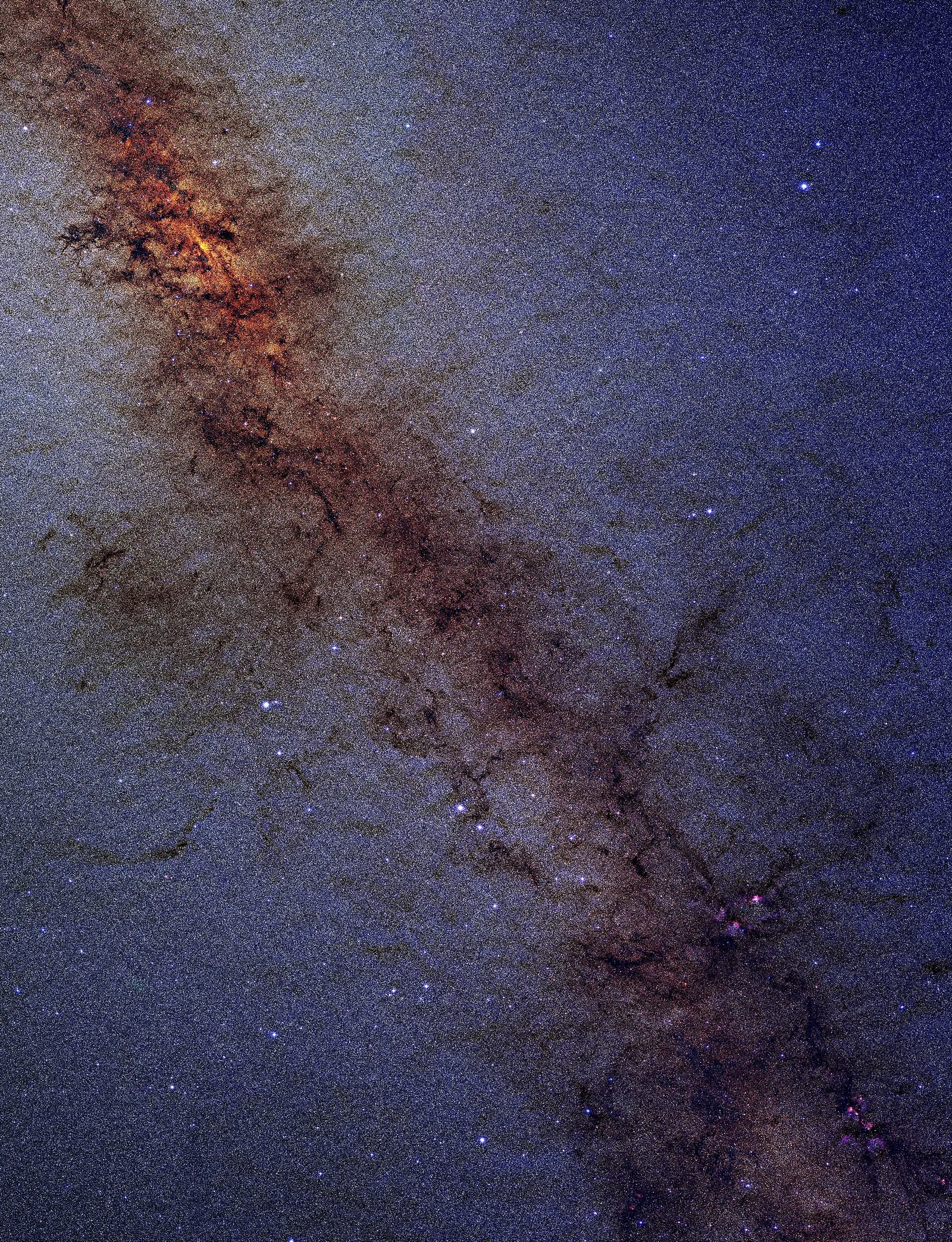
The European Space Agency on Tuesday opened a new tranche of data from its Euclid space telescope, including a deep, high-resolution view of the dense star fields toward the Milky Way's central bulge — a region near the galaxy's core that is among the most crowded patches of sky observable from Earth's vicinity.
The release, known as Quick Data Release 2, was published on June 24, 2026 and centers on the Euclid Galactic Bulge Survey. According to ESA Cosmos and the Euclid Consortium, the data offer "an unprecedented deep, wide-field, high-resolution view of the inner bulge region of our Milky Way galaxy."
What was released
The survey is built from observations taken on March 23, 2025, when Euclid pointed close to the Galactic Centre. According to the ESA Cosmos page, the telescope's optical camera imaged nine adjoining fields spanning a total of 4.8 square degrees over roughly 24 hours, each field receiving about 1.8 hours of total exposure. The data products include calibrated images plus astrometry and photometry catalogues of the stars in the field. The region is extraordinarily dense with stars; a precise published total for how many stars appear was not stated in the primary release materials.
Hubble-class sharpness over a far wider patch
What makes the bulge view notable is the combination of resolution and breadth. Euclid's optical resolution of 0.16 arcseconds is comparable to the Wide Field Camera 3 on the Hubble Space Telescope, the Euclid Consortium notes — but each Euclid field "covers an area that is 270 times larger than a WFC3 field." That gap underlines Euclid's role as a wide-field survey machine rather than a narrow, deep-zoom instrument.
A by-product of a dark-universe mission
Euclid was not designed to study our own galaxy. The telescope launched on July 1, 2023 aboard a SpaceX Falcon 9 and operates from a halo orbit around the Sun-Earth L2 point, about 1.5 million kilometers from Earth, according to ESA. Its core, six-year mission is to map the geometry of the "dark universe": by surveying the shapes and positions of billions of galaxies across more than a third of the sky, scientists hope to constrain the nature of dark matter and dark energy and build one of the largest 3D maps of the cosmos to date.
Measured against that goal, the dense Milky Way star fields are a secondary use of the same instrument. The bulge lies in the plane of our galaxy, away from the high-latitude regions Euclid normally surveys to see distant galaxies cleanly.
Why the bulge matters
The central scientific motivation for the bulge survey is the hunt for exoplanets via gravitational microlensing — brief brightenings that occur when one star passes in front of another and its gravity bends the light. According to ESA Cosmos, more than 200 distant exoplanets have already been found toward the Galactic bulge using microlensing, and the Euclid data can help confirm the planetary nature of historic microlensing events and refine measurements of planet masses. The survey is also designed to dovetail with NASA's Nancy Grace Roman Space Telescope, whose own bulge survey is expected after Roman's planned 2027 launch.
A note on "largest" claims
Euclid has drawn superlatives before: an earlier release was billed by ESA as the first piece of the "largest-ever" cosmic map. For the bulge survey, ESA and consortium materials emphasize that the view is "unprecedented" in its combination of depth, width and resolution for the inner bulge, rather than asserting a single record for star count. Any specific "millions of stars" or "largest image" framing is best read as descriptive, pending the peer-reviewed paper accompanying the release.