For nearly a century, astronomers have collected evidence that the universe contains far more matter than telescopes can see. This unseen substance, called dark matter, emits and absorbs no light, so it is detectable only through its gravitational pull. Despite decades of searching, no one has identified what it is made of — making it one of the central unsolved problems in physics.
The evidence from spinning galaxies
The most famous early evidence came in the 1970s from astronomer Vera Rubin and instrument-maker Kent Ford. Using a sensitive spectrograph, they measured how fast stars orbit within spiral galaxies. Under standard gravity, stars far from a galaxy's bright center should orbit more slowly, much as outer planets move slower than inner ones. Instead, Rubin and Ford found that outer stars moved roughly as fast as inner ones, producing a "flat" rotation curve, according to the American Physical Society. Repeating the measurements across dozens of galaxies, they found the same pattern everywhere. The simplest explanation: each galaxy sits inside a vast halo of invisible mass that outweighs its stars and gas.
Bending light and colliding clusters
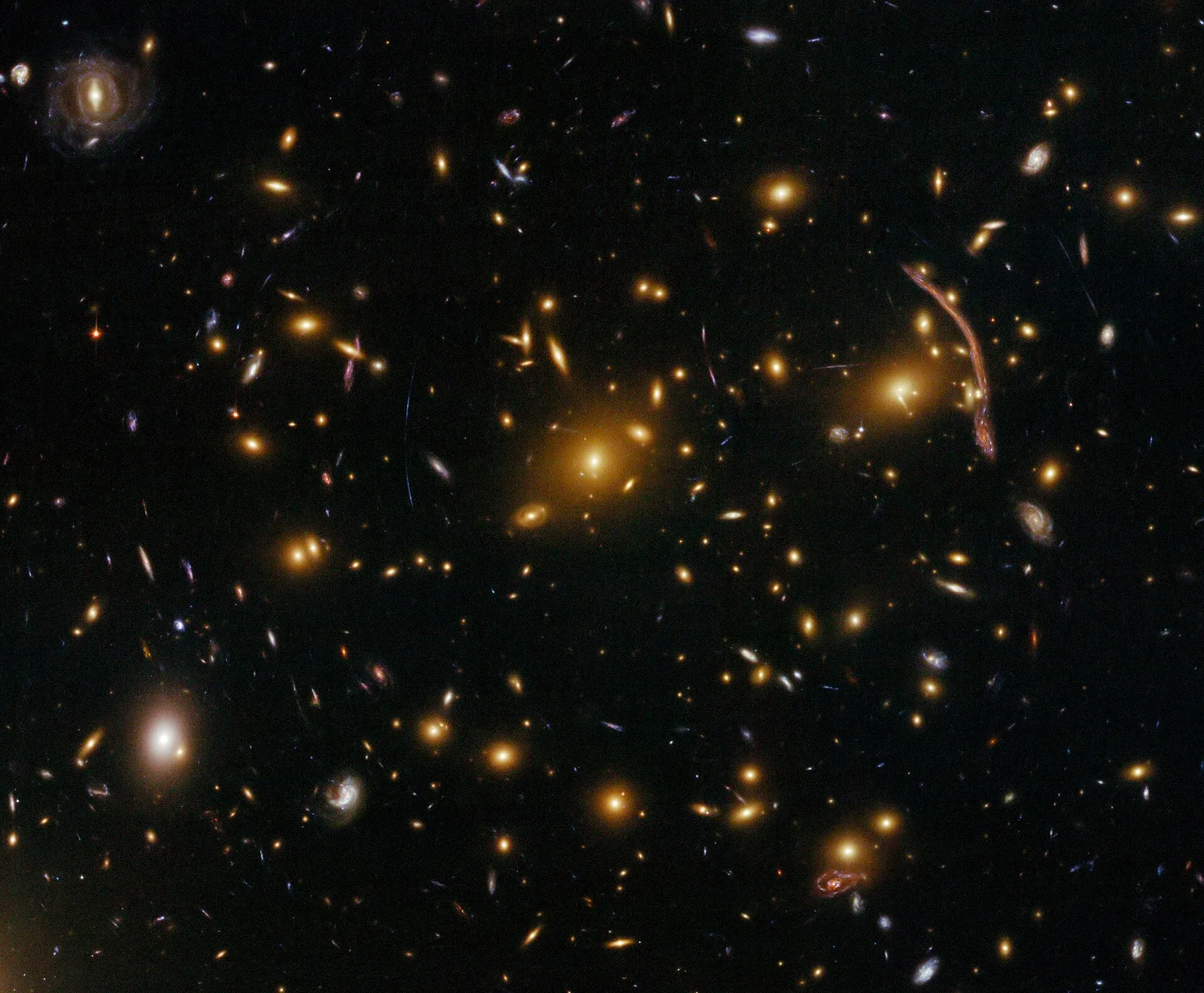
A second line of evidence comes from gravitational lensing. Mass bends the path of light, so the total mass along a line of sight can be weighed by how it distorts images of more distant galaxies — independent of whether that mass glows. These measurements consistently find far more mass than visible matter alone can account for.
The most striking case is the Bullet Cluster, the wreckage of two galaxy clusters that collided. X-ray telescopes show that most ordinary matter — hot gas — piled up in the center, slowed by the collision. But gravitational lensing shows the bulk of the mass lies in two clumps that sailed past each other, as described by NASA. Because dark matter barely interacts, it appears to have passed straight through while the gas collided — a result widely cited as among the strongest evidence that mass and visible matter can be physically separated.
The cosmic recipe
The broadest evidence comes from cosmology. The cosmic microwave background — faint radiation left from the early universe — carries a precise pattern of temperature ripples. The European Space Agency's Planck satellite mapped these ripples and used them to weigh the universe's contents. Planck's results put normal matter at about 4.9 percent, dark matter at about 26.8 percent, and dark energy — a separate, repulsive influence driving cosmic expansion — at about 68.3 percent, ESA reported. The same models that fit the microwave background also reproduce the large-scale cosmic web of galaxies, which requires dark matter's extra gravity to have formed.
What could it be?
The leading candidates are new types of particle. Weakly Interacting Massive Particles, or WIMPs, would be heavy and interact only feebly with ordinary matter; axions, an alternative, would be extremely light. Both are theoretically attractive, but neither has been confirmed. Underground detectors and particle colliders have searched for years and ruled out large swaths of possibilities, yet no experiment has produced a confirmed dark-matter signal. The absence of a detection is itself an important, much-discussed result.
The main competing idea
A minority of physicists argue the problem lies not in missing matter but in our understanding of gravity. Modified Newtonian Dynamics, or MOND, proposed in the 1980s, tweaks the law of gravity at very low accelerations and reproduces galaxy rotation curves with notable success. But most researchers favor dark matter because MOND struggles to explain the full range of evidence — particularly cluster collisions like the Bullet Cluster and the detailed structure of the cosmic microwave background.
The weight of evidence — from galaxies, lensing, colliding clusters and the early universe — points consistently toward an unseen form of matter. What that matter actually is remains, for now, unknown.