

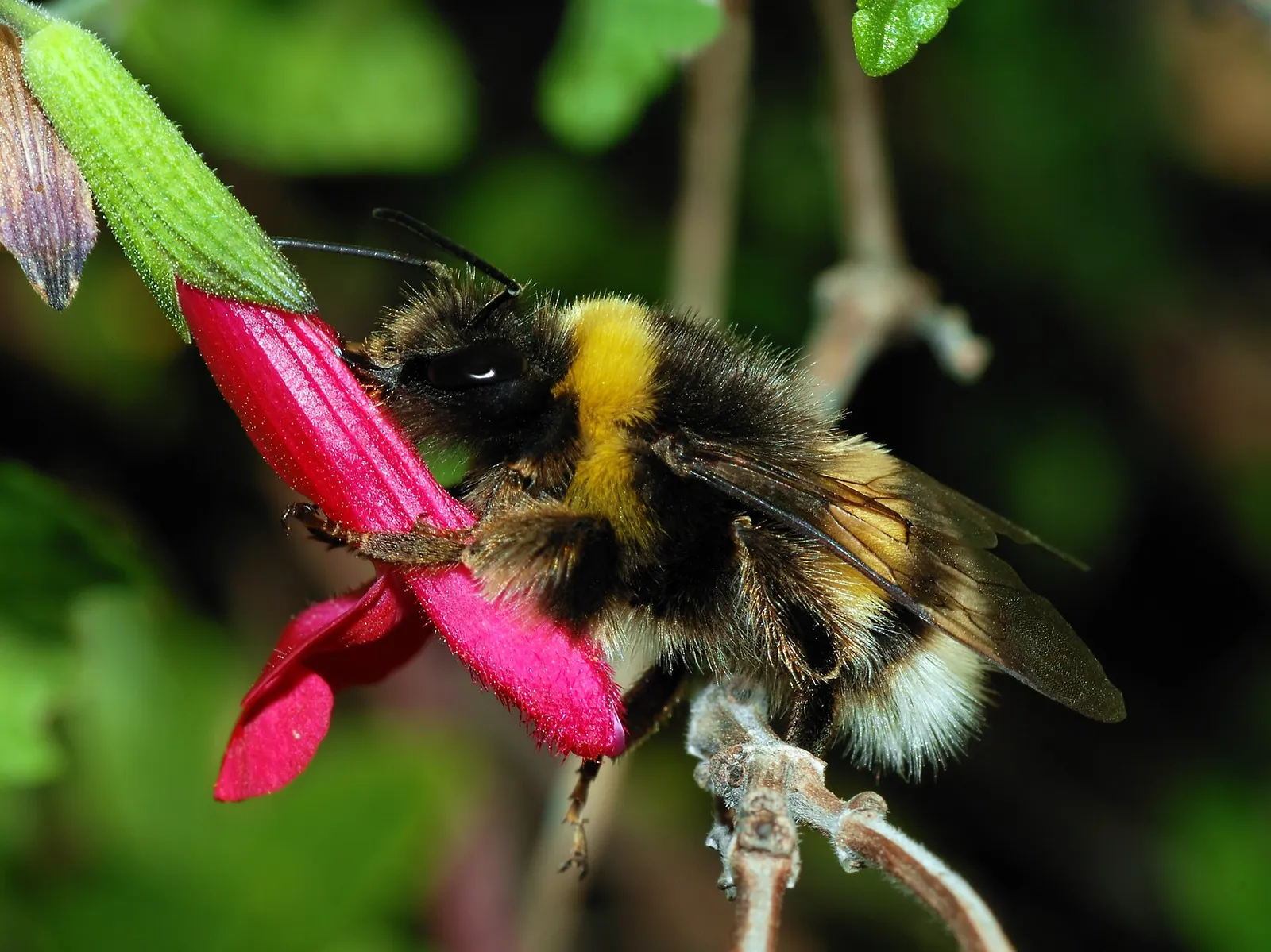
It is one of the most famous experiments in the study of animal minds: nearly a century ago, the psychologist Wolfgang Köhler watched a chimpanzee stack boxes to reach a banana hung out of its grasp, and argued that the animal had grasped a solution through insight rather than blind trial and error. Now scientists have watched something strikingly similar — in a bumble bee.
The test
Researchers first trained bumble bees (Bombus terrestris) to associate blue artificial flowers with a sugar reward. Then they raised the stakes, suspending the flower above the ground, out of the bees' reach, ScienceDaily reported. Nearby sat a small ball. The only way to reach the reward was to move the ball beneath the flower and climb onto it — a two-step trick the bees had never been taught.
Many of them worked it out. Rather than fumbling at random, successful bees combined two things they already knew — that the flower meant food, and that the ball could be moved — into a purposeful sequence that led straight to the reward. The senior author, Olli Loukola of the University of Turku in Finland, described the successful insects performing a "highly efficient sequence of actions" toward the solution. The work, led by researchers at the universities of Oulu, Helsinki and Turku, was published in the journal Science.
Why it matters
What makes the result notable is not that the bees learned a task — insects learn plenty — but the flavor of the behavior. Combining separate pieces of knowledge to solve a brand-new problem, without being trained on the specific solution, is a hallmark of flexible, goal-directed thinking. It is the kind of "means to an end" reasoning that scientists have traditionally attributed to animals with much larger brains: primates, crows, dolphins.
A bumble bee's brain contains fewer than a million neurons, against the tens of billions in a human. That such a tiny organ can generate this sort of on-the-fly problem-solving challenges the long-held assumption that big brains are a prerequisite for sophisticated cognition. It suggests that what matters may be how a brain is organized, not simply how large it is.
Ruling out the boring explanations
Findings like this invite skepticism, and rightly so — it is easy to over-read cleverness into an animal simply doing something that happens to work. The researchers say they built in controls to guard against that. They checked that the bees were not stumbling onto the answer by accident, not merely being drawn by a visual cue, and not slowly grinding toward it through trial and error. The bees that solved the task, they argue, appeared to understand what they were doing.
Even so, scientists who study animal cognition tend to be cautious about words like "insight" and "understanding," which carry heavy assumptions about inner experience. The safer conclusion is behavioral: the bees produced a novel, efficient solution by flexibly combining prior knowledge — a capability more impressive than their reputation as simple, instinct-driven insects would suggest.
Small brains, bigger questions
The study joins a growing body of research revealing unexpected talents in bees, which have been shown in various experiments to learn from watching others, to manipulate objects for rewards, and to handle surprisingly abstract tasks. Together, these findings are reshaping how biologists think about the relationship between brain size and intelligence.
They also carry a quieter significance. Bees are ecologically vital pollinators under pressure worldwide from habitat loss, pesticides and climate change. Evidence that they are not merely tiny automatons but capable, flexible learners adds a further reason to take their decline seriously — and a certain wonder to the sight of one working out, all on its own, how to reach a flower just out of reach.