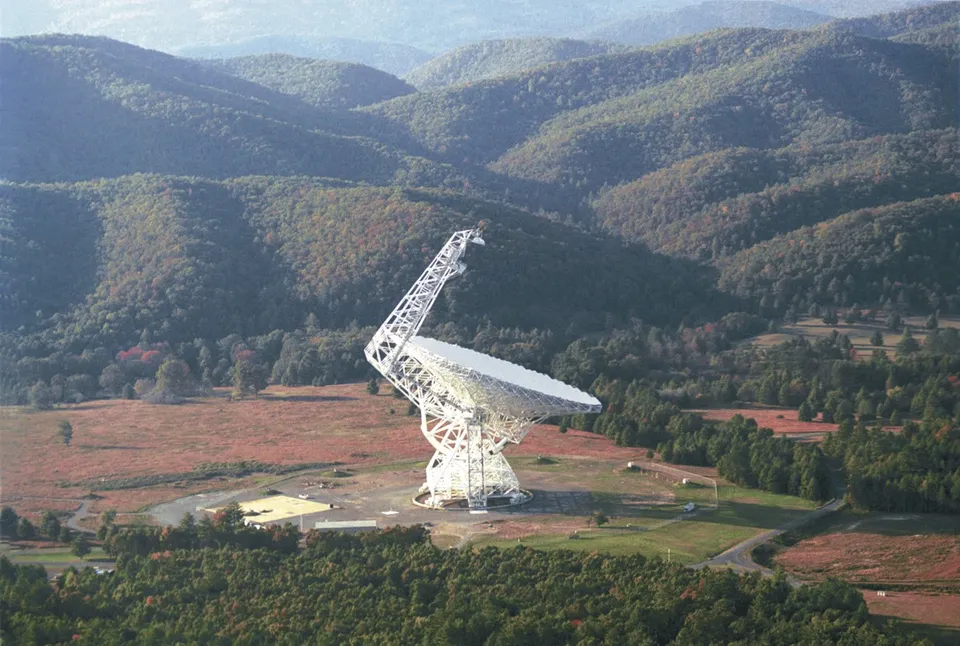
One of the most powerful instruments in modern astronomy is caught in a budget fight. The Green Bank Observatory in West Virginia, which operates the world's largest fully steerable radio telescope, faces the threat of closure under a US government spending proposal that would cut its funding sharply and set it on a path to being shut down.
The proposal
The National Science Foundation's budget request for the 2026 fiscal year would reduce the observatory's federal support from about $9.5 million to roughly $3 million and, in the agency's own language, "pursue decommissioning and disposition" of the facility, according to West Virginia Public Broadcasting. The NSF has framed the move as a difficult choice forced by budget pressures and a need to focus limited money on higher-priority projects.
The cut is part of a much broader squeeze on the agency, which funds most of the United States' ground-based astronomy. Under the proposal, several long-running facilities would face reductions or closure as the NSF's overall budget shrinks.
What would be lost
Completed in 2000, the Green Bank Telescope is a dish measuring roughly 100 by 110 meters that can be pointed across most of the sky — a flexibility that fixed dishes cannot match. Astronomers say its combination of size and sensitivity makes it uniquely suited to detecting faint radio signals, Scientific American reported.
The telescope is central to a range of research. It is a key instrument for the NANOGrav collaboration, which watches the steady ticking of distant pulsars to detect gravitational waves — ripples in space-time that carry information about merging black holes. It is also used in astrochemistry, the study of complex molecules in space, and in the search for signals from possible extraterrestrial civilizations. Much of its observing time is open to researchers around the world.
The site sits in a "quiet zone"
Green Bank's location is not incidental. The observatory lies inside the National Radio Quiet Zone, a large area where radio transmissions are restricted to protect sensitive instruments from interference. That protection is difficult to replicate elsewhere, which is part of why scientists argue the facility cannot simply be rebuilt if it closes.
Beyond the science, the observatory is an economic anchor in a rural part of Appalachia, supporting local jobs and drawing visitors to its education and public-outreach programs.
Congress pushes back
The proposal is not the final word. Spending decisions rest with Congress, and the Senate has moved in the opposite direction. Its appropriations committee recommended rejecting the deep NSF cuts and keeping the observatory funded at close to current levels, the American Astronomical Society noted in its summary of the Senate report.
That sets up a familiar standoff between the executive branch's request and Congress's spending bills, which must be reconciled before any budget takes effect. For now, the telescope keeps working — but its supporters say the recurring threat of closure makes long-term planning difficult, and that once such an instrument is dismantled, the expertise and access it provides are hard to recover.