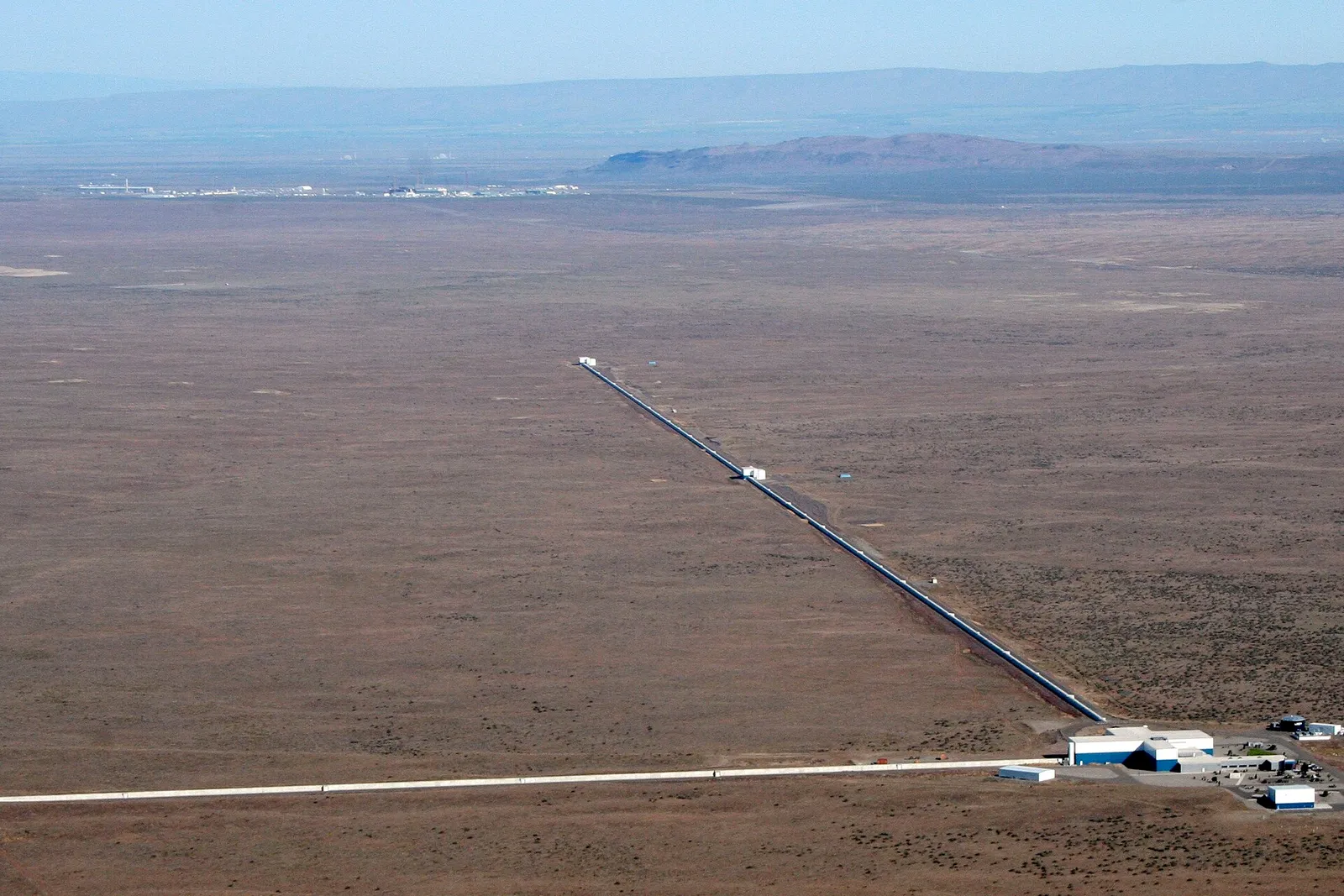
A curious blip in the data from the LIGO gravitational-wave observatory has physicists entertaining a remarkable idea: that it was made by a black hole far too small to have come from a dying star, and perhaps a relic from the universe's very first moments. If the interpretation holds up — and that is a large if — it could bear on one of science's deepest mysteries, the nature of dark matter, ScienceDaily reported.
An object that shouldn't exist
LIGO detects gravitational waves — tiny ripples in spacetime set off by violent cosmic events, such as two black holes spiraling together and merging. Since the first detection a decade ago, such events have become almost routine. What made this signal, recorded in late 2025, stand out was not the collision but the size of what collided: at least one of the objects appears to have weighed less than the Sun.
That is a problem for standard physics. Black holes are normally the corpses of massive stars, and the collapse that forms them cannot easily produce anything lighter than a few times the Sun's mass. A black hole weighing less than a single solar mass has no accepted way of forming through ordinary stellar death. So if it is real, it demands an unusual origin.
Enter the primordial black hole
Researchers at the University of Miami, led by the physicist Nico Cappelluti with the doctoral student Alberto Magaraggia, propose one: a primordial black hole, the university said. These are hypothetical objects thought to have formed not from stars but from the extreme densities of the infant universe, in the first tiny fraction of a second after the Big Bang, before any star existed. Their analysis was published in the journal The Astrophysical Journal.
Primordial black holes have long tantalized physicists because they could help solve the puzzle of dark matter — the invisible substance that makes up roughly 85 percent of all matter and reveals itself only through its gravity. Decades of searching have failed to identify what dark matter is. If primordial black holes exist in sufficient numbers, they could account for some, or conceivably all, of it. A subsolar-mass black hole detected by LIGO would be a natural, if not the only, candidate for such an object.
Why caution comes first
Here the story needs its brakes. This is an interpretation of a single, ambiguous signal — not a confirmed detection of a new kind of object, and certainly not proof about dark matter. The researchers themselves are careful on this point. Cappelluti has said that pinning the idea down will require finding more such signals: "We'll need to detect another such signal or even several others to get the smoking-gun confirmation that they are real."
There is also a more mundane possibility that has to be ruled out: that the blip was not a cosmic event at all, but noise in the instrument. Gravitational-wave detectors are astonishingly sensitive, and separating a faint real signal from background fluctuations is difficult; some scientists suspect this particular signal may fall on the wrong side of that line. Until it is confirmed, the honest description is a promising anomaly, not a breakthrough.
What would settle it
The way forward is more data. LIGO and its partner detectors are being upgraded to see fainter and more distant events, and a new generation of observatories is on the drawing board. If primordial black holes really are out there in any number, more subsolar-mass mergers should eventually turn up. A second, cleaner detection would transform the current tantalizing hint into something far more solid; continued silence would suggest the first signal was a fluke.
That is how this kind of physics tends to work — not in a single triumphant flash, but through the slow accumulation of evidence, with each candidate event scrutinized and, more often than not, explained away.
Why it matters
Even as a maybe, the signal is a reminder of how gravitational-wave astronomy has opened a genuinely new sense with which to observe the universe, capable in principle of detecting objects that emit no light at all. If it holds, it would tie together two of the biggest ideas in modern physics — the exotic black holes predicted to have formed at the dawn of time, and the unseen matter that shapes the cosmos — in a single, astonishing observation.
For now, the right posture is curious patience. Scientists have glimpsed something that does not fit the familiar picture, floated a bold explanation, and been admirably clear that it needs confirming. Whether this particular signal proves to be a messenger from the Big Bang or a trick of a delicate machine, the search it has spurred is exactly the kind that, over time, tends to move knowledge forward.