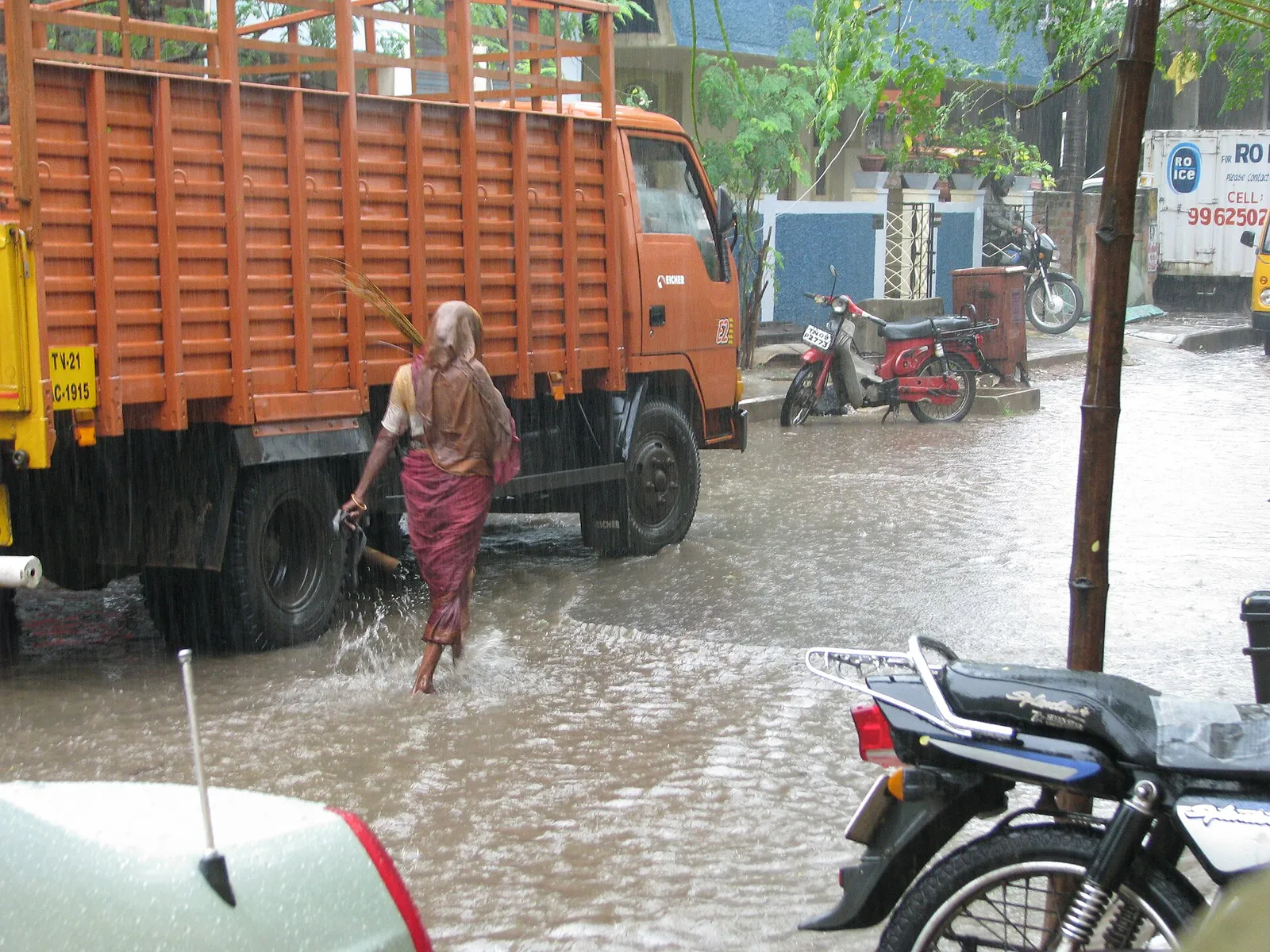
For roughly half the world's population, the year is divided not into four seasons but two: the dry months, and the rains. The agent of that division is the monsoon, a planetary-scale shift in wind and weather that arrives on a broadly predictable schedule and reshapes economies, harvests and lives across Asia, Africa and the Americas.
The engine: land, ocean and a giant plateau
At its core, the monsoon is a seasonal reversal of prevailing winds driven by the different ways land and water heat and cool. Land warms and cools far faster than the ocean. In summer, intense sunshine heats continents, the air above rises and low pressure forms; cooler, moisture-laden air is drawn in from the relatively cool ocean. In winter the contrast reverses, and dry winds blow from land to sea. The US National Oceanic and Atmospheric Administration describes a monsoon as fundamentally "a seasonal change in the direction of the prevailing winds of a region," NOAA explains.
Two features make the Asian monsoon the largest on Earth. The first is the Indian Ocean, a deep reservoir of warm, evaporating water feeding the incoming winds. The second is the Tibetan Plateau, an elevated landmass that heats the atmosphere high above the surface and helps drive the rising motion that pulls the rains northward. Tying the system together is the Intertropical Convergence Zone (ITCZ), the belt of thunderstorms near the equator; as the sun's overhead position migrates with the seasons, the ITCZ shifts too, and its northward summer excursion over land is, in effect, the monsoon rainband.
South Asia's four-month lifeline
The South Asian, or southwest, summer monsoon runs roughly June to September. By convention the India Meteorological Department declares onset when the rains reach the southern state of Kerala, typically in early June, before the system advances across the subcontinent and retreats through September and October.
The stakes are enormous. These four months deliver the large majority of India's annual rainfall — frequently cited as around 70 percent, though the exact share varies by year — and underpin the sowing of staple crops, the recharge of groundwater and the filling of reservoirs used for drinking water, irrigation and hydropower. A timely, well-distributed monsoon supports food output, rural incomes and prices; a weak or erratic one can stress agriculture and the wider economy. Because so many farmers depend on rain rather than irrigation, the monsoon's behavior reverberates through national accounts.
Gift and threat
The same rains that sustain billions can kill. Concentrated downpours routinely trigger flooding and landslides across South Asia, displacing communities and damaging infrastructure; Kerala's catastrophic 2018 floods are a stark example. The central challenge of monsoon societies is managing this duality — storing and channeling water for the dry months while defending against the destructive intensity of the wet ones.
Monsoons beyond India
The monsoon is not uniquely Indian. The West African monsoon brings the Sahel and Guinea coast their rainy season as the ITCZ migrates north over the heated continent, moist Atlantic air meeting dry Saharan air. The East Asian summer monsoon waters China, Korea and Japan. And the North American monsoon delivers summer thunderstorms to northwestern Mexico and the US Southwest; NOAA notes that Arizona and New Mexico can receive more than half — and northwestern Mexico up to about 75 percent — of their annual precipitation from the July-to-September monsoon, according to Climate.gov.
A warming, more erratic future
Climate change is reshaping these systems, though some effects are clearer than others. The Intergovernmental Panel on Climate Change assesses that monsoon precipitation over South and Southeast Asia and East Asia is projected to increase over the 21st century, and crucially with greater variability — implying more intense wet spells and a heightened risk of hydrological extremes. The physics is intuitive: a warmer atmosphere holds more moisture, loading heavier downpours. But the picture is complicated by aerosols — airborne pollution particles that have historically dampened monsoon rainfall, partly masking the greenhouse effect — and by large year-to-year natural variability. The well-established message is that the rains are likely to become more erratic and, at times, more violent — a difficult shift for the billions who plan their lives around them.