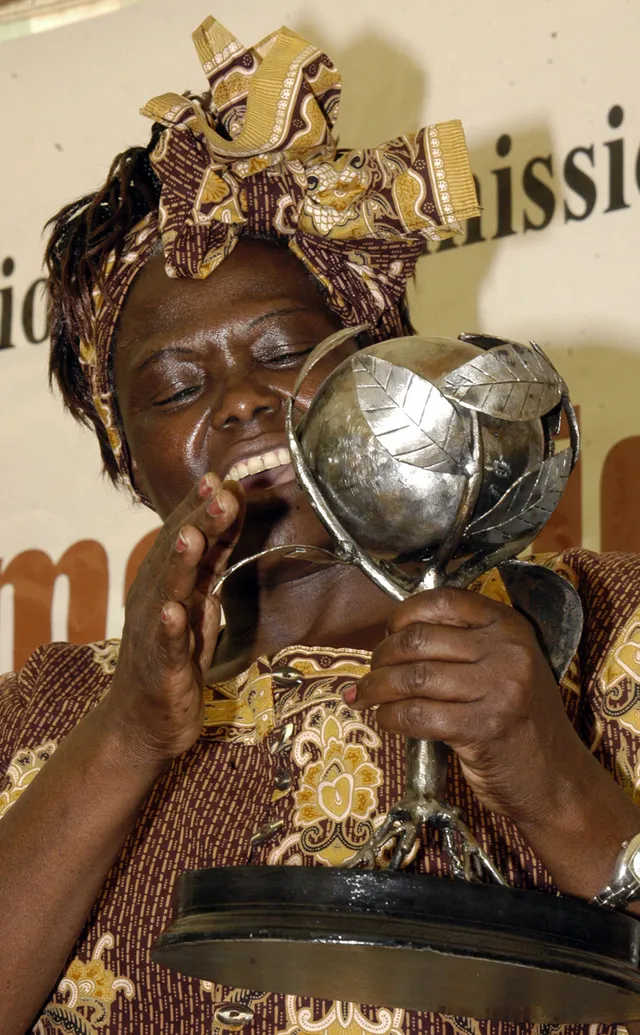
When the Norwegian Nobel Committee announced in October 2004 that Wangari Muta Maathai had won the Peace Prize, it was breaking new ground. She was the first African woman to receive the honor and, as the committee framed it, the first laureate recognized for linking the protection of the environment to the cause of peace itself. The award, the citation read, was "for her contribution to sustainable development, democracy and peace."
For a woman who had begun three decades earlier by handing seedlings to rural women, it was an improbable culmination — and one earned through years of confrontation that left her, on more than one occasion, beaten and jailed.
From a highland village to a doctorate
Maathai was born on April 1, 1940, near Nyeri in Kenya's central highlands, into a farming community where formal schooling for girls was far from guaranteed. Her academic path proved exceptional. She studied in the United States, earning a bachelor's degree in biology in Kansas and a master's degree at the University of Pittsburgh, before completing doctoral studies in veterinary anatomy at the University of Nairobi, per NobelPrize.org.
In doing so she is widely credited as the first woman in East and Central Africa to earn a Doctor of Philosophy degree, according to Britannica. She went on to chair the department of veterinary anatomy at the University of Nairobi and become an associate professor — firsts for a woman in the region.
Planting an idea in 1977
Maathai's signature work began in 1977, when she founded the Green Belt Movement under the auspices of the National Council of Women of Kenya. The concept was disarmingly simple: pay rural women a small stipend to plant indigenous trees. The trees would slow deforestation and soil erosion, restore firewood and clean water, and provide income — while giving the women who planted them a measure of agency.
The scale grew far beyond a local conservation effort. Nobel-era reports and many obituaries cite more than 30 million trees planted over roughly three decades, while the Green Belt Movement and the Wangari Maathai Foundation report figures above 50 million. The numbers are best treated as approximate and drawn from the movement's own records, but the order of magnitude — tens of millions — is consistently reported.
When trees became politics
What made Maathai a global figure was not only the planting but the resistance she met. Under President Daniel arap Moi, control of land was a tool of power, and Maathai's insistence on protecting public green space repeatedly put her at odds with the state.
In 1989 she fought a plan to build a high-rise complex in Nairobi's Uhuru Park, and in 1992 she joined a hunger strike there — at a spot protesters called Freedom Corner — to demand the release of political prisoners. Police forcibly cleared the demonstrators, and Maathai was among those beaten unconscious and hospitalized. A decade later, she led protests against the privatization of Nairobi's Karura Forest, during which she and others were assaulted by guards before the government eventually halted the allocation of public land. The Nobel Committee pointed precisely to this fusion of activism and conscience, observing that Maathai had taken a "holistic approach to sustainable development that embraces democracy, human rights and women's rights in particular."
From protest to parliament
Kenya's political opening finally brought Maathai inside the system she had long challenged. In December 2002, after Moi's party was defeated, she won the Tetu parliamentary seat by a landslide, and in January 2003 she was appointed assistant minister in the Ministry for Environment and Natural Resources, a post she held until 2005. It was from within government, not outside it, that she received the Nobel call the following year.
Legacy
Maathai died of complications from ovarian cancer on September 25, 2011, in Nairobi, at the age of 71. Her influence endured well beyond Kenya: she helped inspire a United Nations tree-planting campaign, and the Green Belt Movement continues its work today.
Her admirers celebrate a woman who proved that an environmental cause could also be a democratic one. Critics during her lifetime, including officials in the Moi government, dismissed her campaigns as obstruction. What is not in dispute is the through-line of her life: that protecting the soil, the forests and the people who depend on them was, for Maathai, inseparable from protecting their freedom.