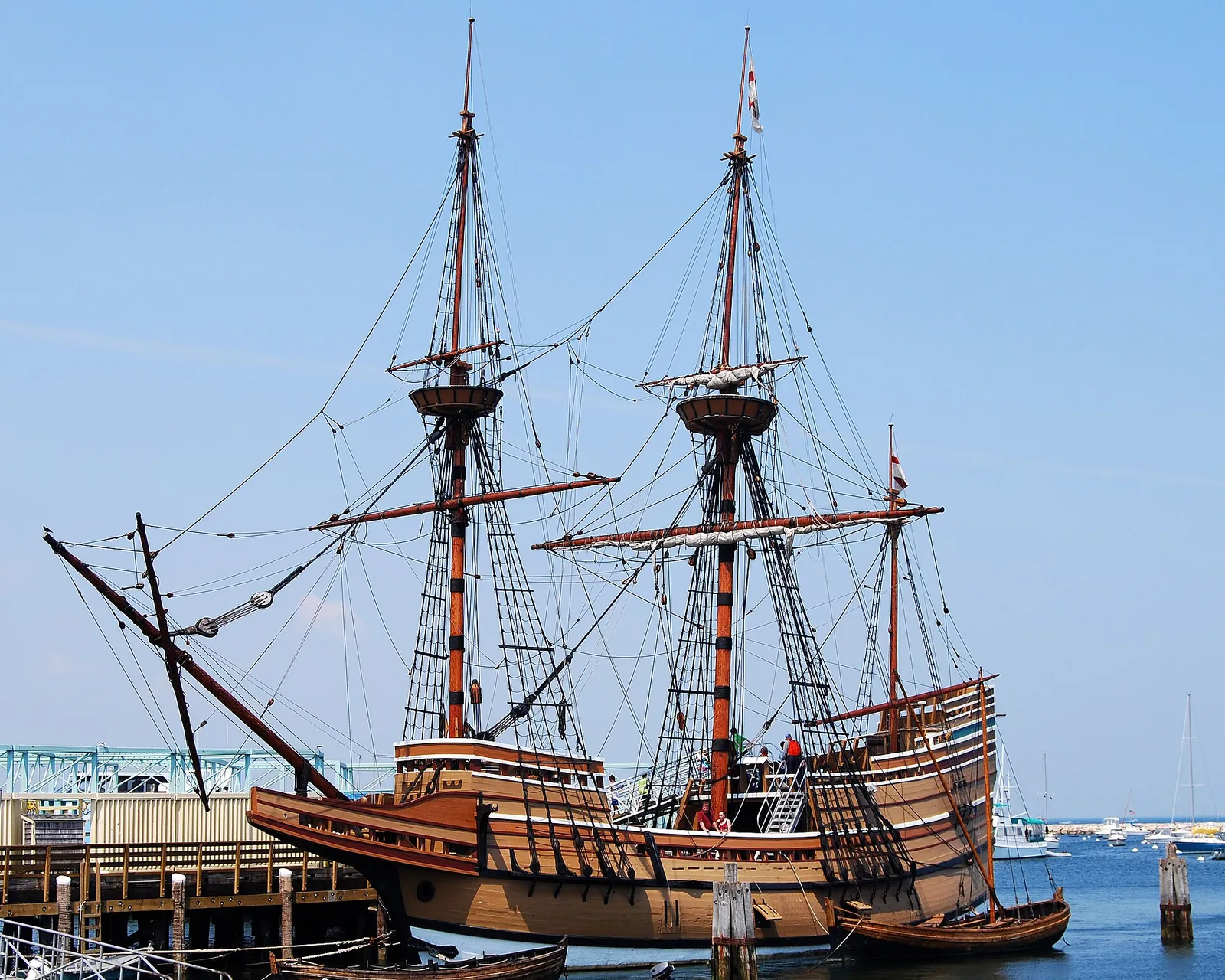
Two ships crossed the Atlantic to the shores of what would become the United States within a year of each other, four centuries ago. One is woven into the national mythology, complete with buckled hats and a founding feast. The other is largely absent from it. A new book, reviewed for NPR's Fresh Air, argues that understanding America means holding both in view at once, as NPR's Maureen Corrigan wrote.
The two vessels
The Mayflower is the famous one. In 1620 it carried English Pilgrims to Plymouth, in present-day Massachusetts, a voyage long enshrined as a story of religious freedom and self-government — the seed, in the popular telling, of the nation to come.
The White Lion is the ship the mythology left out. In 1619, a year before the Mayflower, it brought the first enslaved Africans to English North America, landing them in Virginia. That arrival marks the beginning of a very different American story: the country's long entanglement with slavery, which would shape its economy, its politics and its conscience for centuries. The book, titled Two Ships, sets these arrivals side by side, published to coincide with the 250th anniversary of American independence.
Not the facts, but the meanings
The book's central argument, according to the review, is that the power of these two voyages lies less in the bare facts of what happened than in the meanings later generations attached to them. Each ship became a symbol — a shorthand for a competing vision of what America fundamentally is: a haven founded on liberty, or a nation built in significant part on bondage.
Those symbols have been wielded deliberately. The review notes that the abolitionist Frederick Douglass often reached for the "two ships" comparison to force the contradiction into view, while Abraham Lincoln tended to avoid it. Different groups, across different eras, have elevated one ship or the other to argue about who truly belongs at the center of the national story.
How the Mayflower drifted from politics to pageantry
Part of what makes the contrast striking is how the Mayflower's meaning softened over time. The review describes how, by the later 20th century, the ship had been drained of much of its political charge and absorbed into commercial ritual — Pilgrim hats, Thanksgiving decorations, holiday sales. A once-potent origin symbol became, in large part, seasonal iconography.
The White Lion traveled the opposite path. For most of American history it was scarcely acknowledged. More recently — the review points to the prominence given to 1619 in public debate over the past several years — the ship and its date have been pushed back to the center of arguments about slavery's place in the national narrative, and about how the country's beginnings should be taught and remembered.
Why it resonates at 250
The timing is pointed. A milestone anniversary invites a nation to tell itself a story about its origins, and Two Ships is a reminder that there has never been just one. The book does not ask readers to choose between the vessels but to see them together — two arrivals, a year apart, that between them contain both the aspirations and the injustices woven into the country from the start.
For a general reader, the value of the framing is its clarity. The argument over American identity can feel abstract; two ships make it concrete. One brought people seeking freedom. The other brought people stripped of it. The United States, the book suggests, is the improbable, unfinished project of reconciling the two — a task that, 250 years on, it is still working out.