
A web, not a road
The phrase conjures a single ribbon of sand unspooling toward the horizon, dotted with camel bells. The reality was messier and far more interesting: the "Silk Road" was a shifting network of overland tracks and maritime lanes that linked China, Central Asia, India, Persia, the Arab world and the Mediterranean from roughly the 2nd century BCE until the rise of European sea power in the 15th and 16th centuries. There was no single route, and — crucially — no such name at the time.
The term itself is modern. The German geographer Ferdinand von Richthofen coined Seidenstrasse ("silk road") in 1877 to describe ancient trade links between China and the West, according to UNESCO's Silk Roads Programme. The label was something of a marketing triumph that has outlived its accuracy: Richthofen originally used the term for specific routes, and the romantic, unified "Silk Road" of popular imagination emerged only in the 20th century.
Zhang Qian opens the west
The documented history begins with diplomacy, not commerce. Around 138 BCE, the Han dynasty emperor Wu dispatched an envoy named Zhang Qian westward to seek allies against the nomadic Xiongnu. Zhang Qian was captured, held for years, and returned having seen the wealthy kingdoms of Central Asia. His missions are conventionally credited with opening the routes westward, and the World History Encyclopedia dates the formal establishment of the network to the Han dynasty around 130 BCE.
What followed was less a single trade artery than a relay. Goods rarely traveled the whole distance in one merchant's hands; they were bought, sold and resold across thousands of kilometers. Silk moved west — so prized in Rome that it became a marker of luxury — alongside spices, paper, gunpowder, glass and the prized "heavenly horses" of Central Asia the Han coveted for their cavalry.
The real cargo: ideas, faith and disease
Historians today emphasize that the most consequential exports were not material. Religions traveled the routes most powerfully: Buddhism spread from India into China along these corridors, with scriptures translated into Chinese at oasis hubs. The cave-temple complex at Dunhuang, on the edge of the Taklamakan desert, became a spiritual and artistic crossroads; its first grottoes were carved in 366 CE, and its sealed "Library Cave" later yielded a trove of manuscripts.
The same connectivity carried catastrophe. The bacterium Yersinia pestis is thought to have originated among rodents in the Central Asian steppe, and the caravans and ships that moved silk also moved infected fleas. The Black Death traveled these networks to the edge of Europe, killing tens of millions between 1346 and 1352, according to History.com. The Silk Road, in other words, was a vector for pandemics long before the word existed.
Cities that grew rich on the road
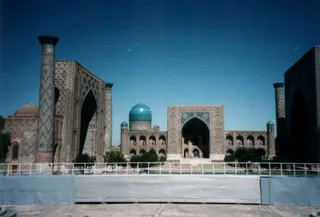
The network's true engines were its cities. Samarkand and Bukhara, in present-day Uzbekistan, became fabled centers of trade, learning and Islamic scholarship; Kashgar anchored the western edge of the Chinese deserts. To the south and over the seas ran the maritime spice routes, linking Indian, Arab and Chinese ports — a reminder that the "road" was as much water as sand.
This legacy is now formally protected. In 2014, UNESCO inscribed "Silk Roads: the Routes Network of Chang'an–Tianshan Corridor" on the World Heritage List, a roughly 5,000-kilometer transnational property spanning China, Kazakhstan and Kyrgyzstan with 33 component sites.
Decline — and a 21st-century echo
The overland routes did not vanish so much as lose their advantage. As European powers opened reliable ocean routes from the 15th century, and as the Ottoman expansion reshaped commerce across the eastern Mediterranean, sea trade increasingly outcompeted the slow, taxed, caravan-based overland exchange. The web frayed.
Its name, however, has proved durable enough to repurpose. In September 2013, speaking in Kazakhstan, Chinese leader Xi Jinping announced the "Silk Road Economic Belt," the land half of what became the Belt and Road Initiative — a sprawling infrastructure and investment program now spanning more than 150 countries, as the Council on Foreign Relations details. Whether one reads it as revival or rebranding, the gesture confirms the original point: the Silk Road was always less a place than an idea about how distant worlds connect.