In the early 14th century, an emperor of the Mali Empire set out across the Sahara on a journey that would make him one of the most famous Africans in medieval history. His name was Musa, and his title was mansa — a Mandinka word usually rendered as "king" or "emperor." The pilgrimage he undertook in 1324 carried so much gold that Arabic chroniclers were still writing about it generations later. Today he is widely described as the richest person who ever lived — a claim that says as much about modern fascination as it does about medieval Mali.
An empire built on gold and salt
Mali rose in the 13th century along the upper Niger River, expanding into one of the largest empires of its era. Its power rested on control of the trans-Saharan trade, which moved gold north toward the Mediterranean and brought salt, copper and goods south in return. According to Encyclopaedia Britannica, Musa came to the throne around 1312 and reigned until roughly 1337, though the exact dates remain uncertain. Under him, Mali reportedly stretched across much of West Africa.
Medieval West Africa was, by some estimates, among the world's leading sources of gold. That output underpinned not only Mali's prosperity but also currencies far beyond its borders — a detail that lends plausibility to the stories that followed Musa abroad.
The pilgrimage that astonished Cairo
Musa, a Muslim ruler, made the hajj to Mecca in 1324–1325. Arabic sources describe an immense caravan crossing the desert: thousands of attendants, camels laden with gold, and an entourage clad in fine cloth. The most influential account comes from the Egyptian scholar al-Umari, who visited Cairo roughly a decade after Musa passed through. As recorded by World History Commons, al-Umari reported that Musa and his company spent and gave away so much gold in Egypt that its value fell and remained depressed for years.
Historians treat the specific figures — tens of thousands of porters, hundreds of gold-bearing staff-carriers — with caution; such numbers were often rhetorical, meant to convey overwhelming abundance rather than serve as a literal census. What is documented is the impression Musa left: he became, in effect, the first sub-Saharan African ruler widely known across both the Islamic world and Europe.
Timbuktu and the scholarship of Mali
The pilgrimage's legacy was not only economic. On his return, Musa is associated with a flourishing of building and learning in cities such as Timbuktu and Gao. He is credited with commissioning Timbuktu's Djinguereber Mosque and with supporting the Sankore complex, which became a renowned center of Islamic scholarship. Over the following centuries, Timbuktu accumulated vast collections of manuscripts on law, astronomy, medicine and theology — a written intellectual tradition that endured long after Mali's decline.
Some popular accounts attribute the mosques' design to a single Andalusian architect, al-Sahili, and claim Sankore hosted tens of thousands of students. Scholarship has since qualified these stories: al-Sahili's documented role appears more decorative than architectural, and precise enrollment figures are not reliably attested. The broader point stands — under Mali, Timbuktu became synonymous with trade and learning.
A face on the map
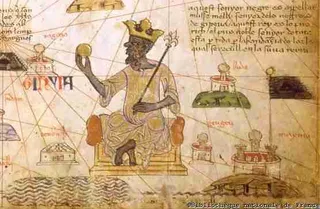
Musa's fame reached medieval Europe in striking visual form. The Catalan Atlas of 1375, attributed to the Majorcan mapmaker Abraham Cresques and held today at the Bibliothèque nationale de France, depicts a crowned African king enthroned in the West African interior, holding aloft a large gold nugget. It is among the earliest European images of a sub-Saharan African sovereign — testament to how far Musa's reputation had traveled.
The richest man ever?
The modern label "richest person in history" is where documentation gives way to speculation. Figures such as $400 billion circulate widely online, but economic historians reject them as unverifiable. The historian Hadrien Collet, among others, has argued that Musa's wealth simply cannot be meaningfully calculated, since converting medieval, empire-scale resources into modern personal net worth is methodologically impossible.
What survives, then, is not a balance sheet but a legend grounded in real history: an emperor whose gold reshaped a region's economy, whose patronage helped make Timbuktu a beacon of scholarship, and whose image — gold in hand — fixed Mali's grandeur in the medieval imagination, and in ours.