

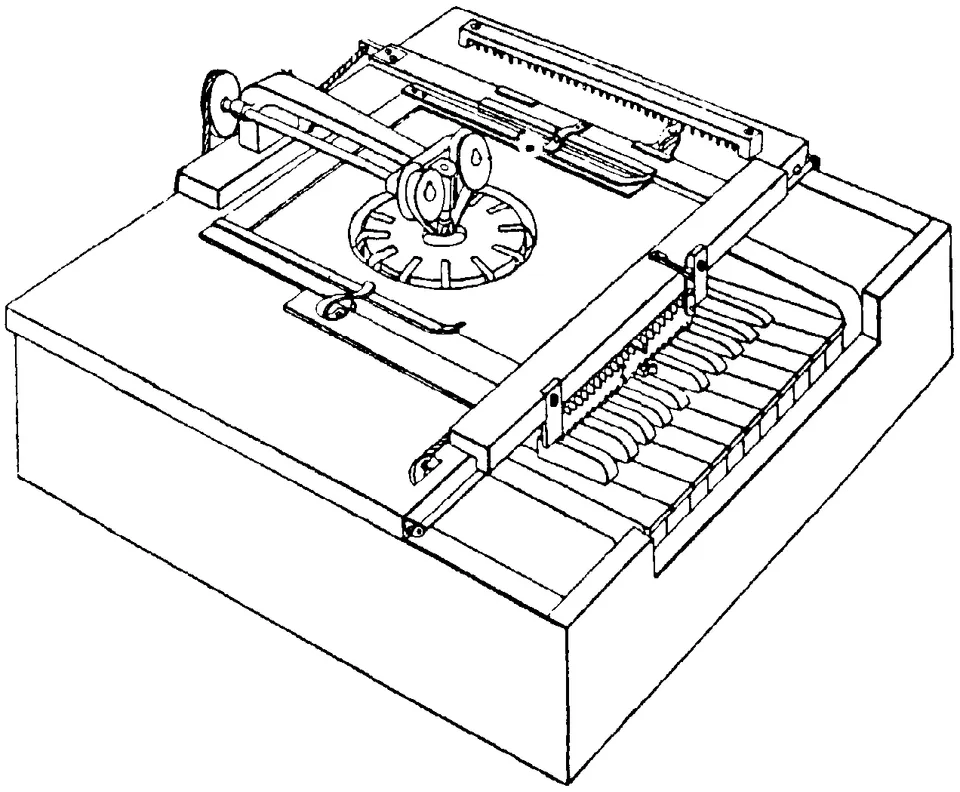
On 23 June 1868, the US Patent Office granted patent No. 79,265 to Christopher Latham Sholes, Carlos Glidden and Samuel W. Soule for a "Type-Writer," an early machine for putting printed letters on a page, according to Britannica. The keys on that prototype were not yet arranged in the order familiar to billions of people today. But the patent set in motion a chain of revisions, commercial deals and habit that produced QWERTY — the layout named for the first six letters of its top row — and locked it into place for more than 150 years.
A printer, a lawyer and a mechanic
Sholes was a Milwaukee newspaperman, printer and sometime politician. The typewriter began, by most accounts, as a side project: after working with Soule on a machine to number pages and tickets, Sholes was encouraged by Glidden to extend the idea to printing letters and words, Britannica notes. The three men were credited as co-inventors on the 1868 patent.
Their earliest keyboards were not QWERTY at all. Some early arrangements were broadly alphabetical, on the reasonable assumption that letters in A-B-C order would be easiest to find, Smithsonian magazine reports. Over several years of tinkering, the layout shifted repeatedly until it settled into something close to the QWERTY pattern.
The jamming myth — handle with care
The explanation almost everyone has heard goes like this: on early typewriters, each key swung a metal type bar up to strike the page, and when two neighbouring bars were hit in quick succession they clashed and jammed. Sholes, the story says, deliberately scattered common letter pairs — and may even have set out to slow typists down — so the bars would not collide.
This claim should be treated carefully, because scholars disagree about it. Critics point to an obvious hole: if the goal were to separate frequent pairs, the very common English combination "er" would not sit side by side, as it does on every QWERTY keyboard, Smithsonian notes. The notion that the layout was engineered specifically to reduce typing speed is widely repeated but poorly supported.
In a 2011 paper, "On the Prehistory of QWERTY," Kyoto University researchers Koichi and Motoko Yasuoka argued that the layout grew not from a single anti-jamming master plan but from the needs of early users — including telegraph operators who transcribed incoming Morse code and found a strictly alphabetical keyboard awkward. In their account, the arrangement changed many times under competing demands and gradually grew into QWERTY. The honest summary is that mechanical constraints, operator feedback and trial-and-error all plausibly played a part, and that the tidy "designed to slow you down" tale is more legend than documented fact.
Enter Remington
What is not in dispute is how the layout reached the mass market. In 1873, Sholes and his backers approached E. Remington and Sons — a gun and sewing-machine maker with the factories to manufacture at scale. Sholes sold his share of the patent rights, reportedly for about $12,000.
Remington refined the machine and brought out the Sholes and Glidden Type-Writer, which went on sale in 1874 at around $125, Smithsonian reports. The company also trained typists, seeding a generation of users who had learned exactly one layout. As QWERTY machines spread and the industry consolidated around the turn of the century, the layout effectively became the standard.
Why it never died
QWERTY's survival is a textbook case of what economists call path dependence: once a technology is widely adopted, the cost of switching everyone at once becomes prohibitive even if a better option exists. In the 1930s, August Dvorak patented an alternative layout designed for efficiency and comfort, and enthusiasts have championed it since. Yet typewriters gave way to computers without dislodging QWERTY, which migrated onto keyboards and then onto glass touchscreens largely out of habit rather than necessity.
Sholes himself reportedly preferred later, reorganised layouts. The world kept the one it had already learned. More than a century and a half after that June 1868 patent, the legacy of a Milwaukee printer's side project remains, quite literally, at our fingertips — even if the story we tell about it deserves an asterisk.