A library buried for two millennia
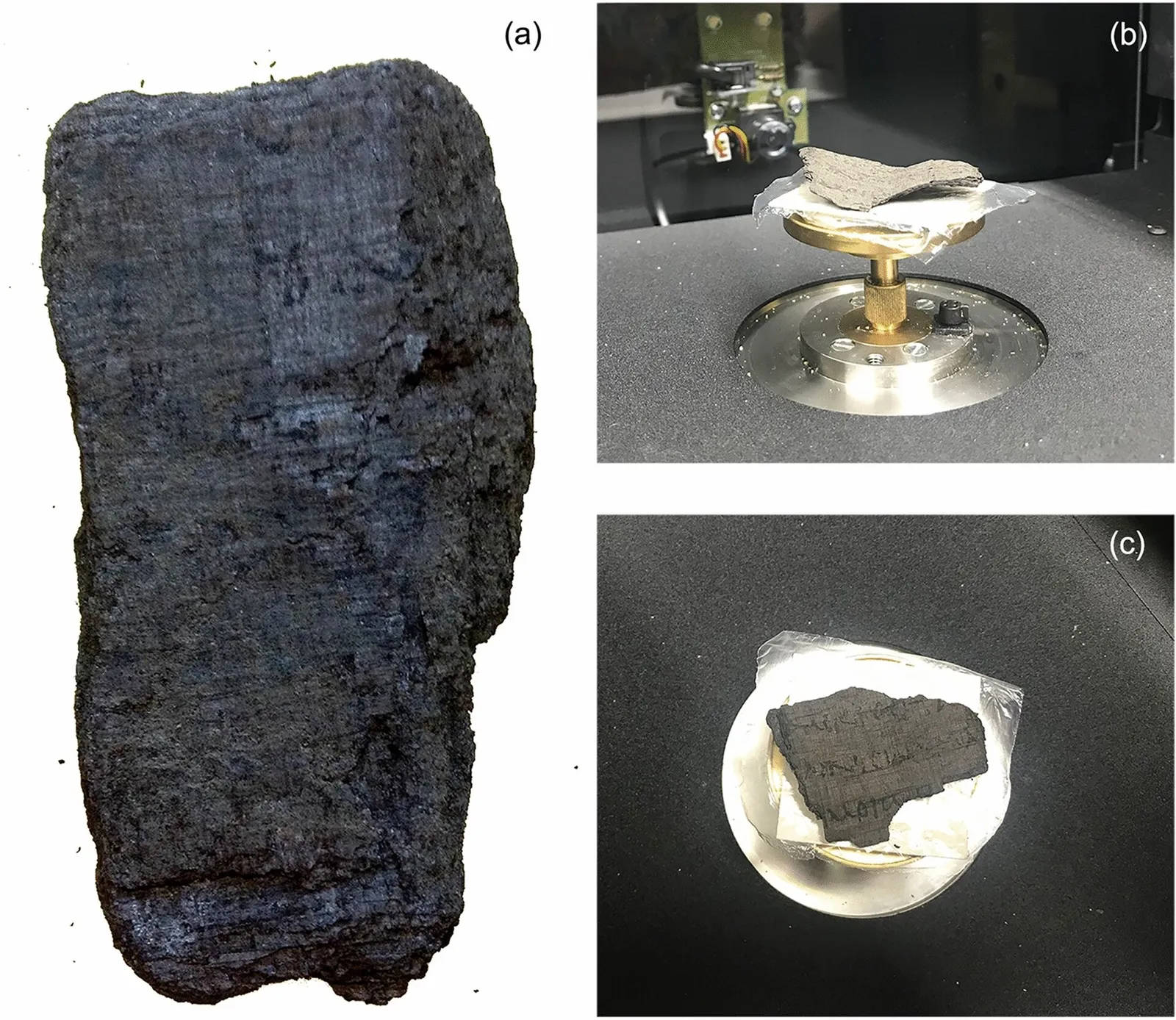
When Mount Vesuvius erupted in 79 AD and buried the Roman town of Herculaneum under tens of meters of volcanic debris, it also entombed something irreplaceable: the only library to survive from classical antiquity. Housed in the so-called Villa of the Papyri, hundreds of papyrus scrolls were carbonized almost instantly — transformed into fragile black cylinders that crumble at a touch.
For most of the time since their 18th-century excavation, those scrolls remained unreadable. Attempts to physically unroll them destroyed many; the survivors ended up scattered across European collections, including three held at Oxford's Bodleian Libraries. Now, using X-ray scanning and artificial intelligence, researchers have begun reading them without the papyrus ever leaving its rolled form.
How the technology works
The process begins with imaging. One Oxford scroll, known as PHerc. 172, was taken in 2024 to the Diamond Light Source, a synchrotron particle accelerator in Oxfordshire whose X-rays are far more intense than a hospital machine's. Those beams penetrate the tightly wound layers and capture a three-dimensional picture of the interior without disturbing a single fiber.
The resulting data is then released through the Vesuvius Challenge, a prize competition launched in March 2023 by the investor Nat Friedman, the entrepreneur Daniel Gross and the computer scientist Brent Seales of the University of Kentucky, who pioneered the "virtual unwrapping" technique. Researchers worldwide apply machine-learning models to detect faint traces of ink on each layer and to computationally "segment" the scroll so that each sheet can be read as if flattened. In the case of PHerc. 172, the ink appears to contain a denser contaminant — possibly lead — that makes it unusually visible in the scans, an accident of chemistry that made it an especially readable subject.
What the scroll says
The first word recovered from the scroll's interior was diatropē, the ancient Greek for "disgust." Other legible words point to moral philosophy. In May 2025, researchers went further, decoding the scroll's title and authorship: PHerc. 172 is a work On Vices by Philodemus of Gadara, the prolific Epicurean philosopher and poet of the 1st century BCE. The Vesuvius Challenge awarded a $60,000 prize for the identification — the first time a still-rolled Herculaneum scroll had been titled noninvasively.
A prize competition that changed the field
The competition has been a remarkable accelerant. Launched with more than $1 million in prizes, it invited the world's researchers to tackle the scrolls as an open contest; it has now awarded some $1.8 million in total. In October 2023, Luke Farritor, then a 21-year-old college student, became the first person to read a word from inside a sealed Herculaneum scroll — porphyras, meaning "purple." By December 2023, a three-person team had won the $700,000 Grand Prize by recovering several readable passages from another scroll.
This week, papyrologists and computer scientists are gathered at a conference in Naples, running June 22–26 with a press presentation on June 25, to share the latest results. Organizers say some two dozen scrolls are now under study, and have suggested that newly analyzed texts may include some of the oldest surviving works in Roman history and material bearing on ancient Greek religion — claims that, at the time of writing, await full publication and peer scrutiny.
Why it matters
The Herculaneum papyri are the only library to come down from the ancient world, however damaged. The roughly 1,800 scrolls recovered so far are thought to be largely Epicurean, reflecting the philosophical tastes of the villa's owner — but scholars believe many more lie in unexcavated chambers, and hope the full collection may yet yield lost works of Greek and Latin literature. For now, the words re-emerging from a single charred cylinder — about disgust, fear and foolishness, written by a Greek philosopher before the birth of Christ — are a reminder of how much antiquity may still have to say, once the tools exist to listen.