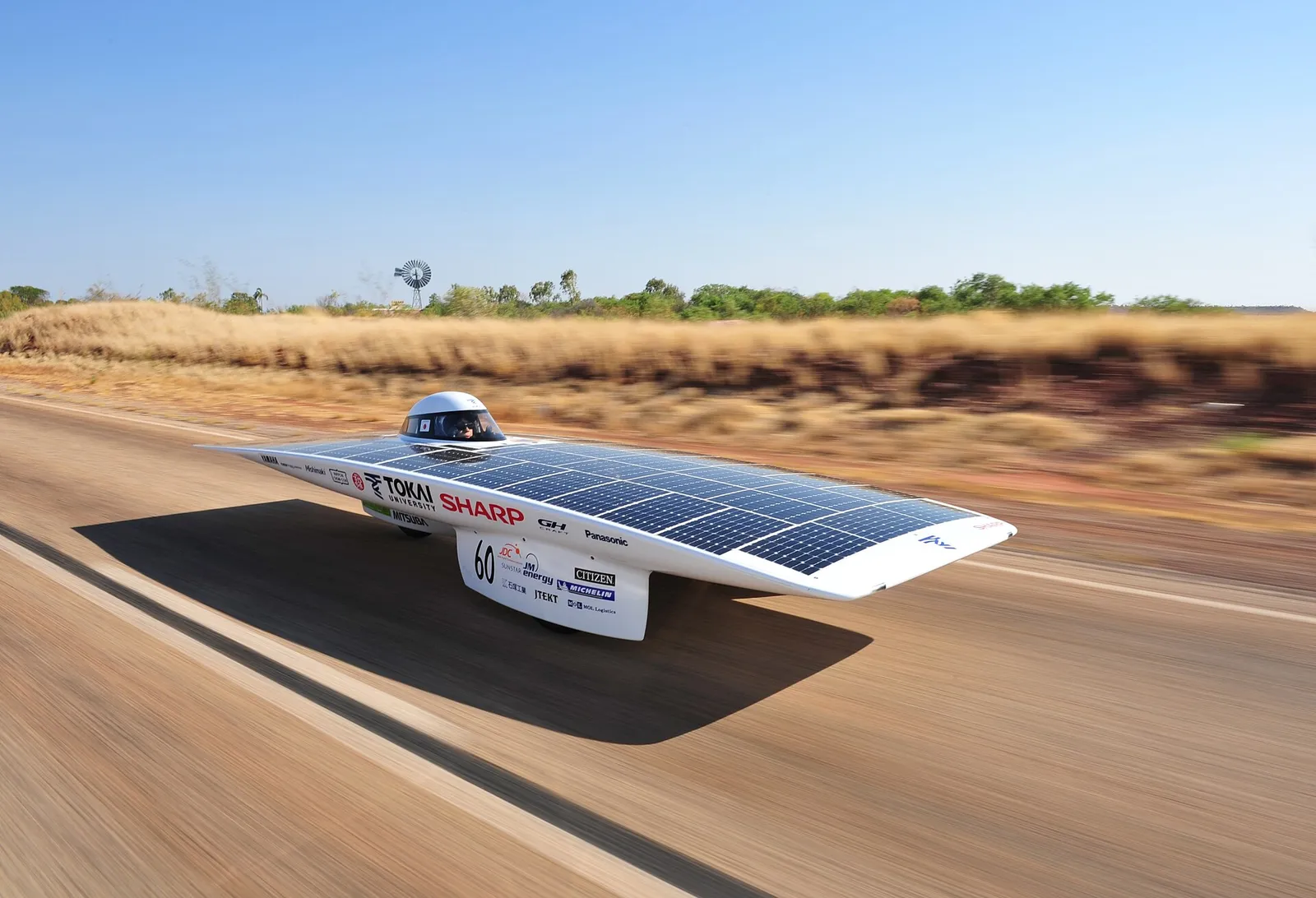
The route runs 631.7 miles, from Fort Worth through the pine woods of east Texas, across the hill country, and out into the flatlands of the west, finishing at Fort Stockton. The cars driving it were built by teenagers, and they carry no fuel at all.
This is the Solar Car Challenge, a five-day cross-country event in which 24 high school teams from six states drive vehicles they designed and assembled themselves, powered only by the sun falling on them.
How the cars work
The engineering is conceptually simple and unforgiving in practice. Photovoltaic panels on the car's upper surface convert sunlight into direct current. That current passes through a charge controller, which regulates the flow into a battery pack. The battery drives an electric motor.
The constraints are what make it difficult. Battery capacity is capped at 5.25 kilowatt-hours, less than many domestic backup batteries, and teams choose between lead-acid and lithium iron phosphate cells, trading weight against storage. Motors typically produce two to three horsepower, roughly what a decent lawnmower manages. A full battery will carry a car about 250 miles with no sun at all.
Even so, these vehicles reach speeds of up to 70 miles per hour on open highway, which is a consequence of how little they weigh and how carefully they are shaped.
The event runs five divisions, including a newly added Cruiser class for a four-passenger vehicle with the solar array built directly into the bodywork rather than mounted above it.
What the students actually do
Teams build the frame, the body, the array mounting, the suspension and the electrical system. Commercial parts and 3D-printed components keep costs manageable, but the integration is the students' problem, and so are its failures.
The Greenville High School team began designing its car in 2024 and finished construction in the spring of 2025, according to its captain, Ethan Kiowski. That timeline is typical: roughly two years between the first sketch and the starting line.
Much of the learning has little to do with electronics. Teams manage budgets, coordinate dozens of people over many months, and run their own failure analysis. A weakness in a battery compartment does not show up in a design review. It shows up at mile 200, in July, in Texas.
Distance, not speed
The scoring reflects the nature of the problem. The winner is the team that accumulates the most miles across the five days, not the one that arrives first.
That distinction matters. It shifts the contest away from outright pace and toward energy management: reading cloud cover, deciding when to run harder and when to conserve, and judging how much reserve to keep for a stretch of road with no sun. The teams are solving, at a small scale, the same problem that faces anyone building around an intermittent power source.
The programme has been running a long time. It began as an education initiative in 1989, with the first race in 1995, and organisers say more than 85,000 students across 39 states have taken part since.
The cars left Fort Worth on Monday. What gets them to Fort Stockton is whatever the sky provides, and whatever the students worked out in advance about how to use it.