Indonesia is moving three army battalions, about 1,500 personnel, into Kalimantan from outside the region to fight wildfires, along with six helicopters for water-bombing, according to Al Jazeera.
The announcement came from the cabinet secretary, Teddy Indra Wijaya. President Prabowo Subianto ordered the increase during a visit to the region on Saturday.
"We're taking mitigation measures," Prabowo said. "The important thing is to immediately stop the spread of fire spots."
The scale
At least 200,000 hectares, about 495,000 acres, burned in Kalimantan between January and July this year. The report sets that against previous seasons: larger than the fires of 2019 and 2023, smaller than those of 2015.
That comparison is the useful part. Indonesia's fire seasons are not evenly bad, and the years that get named are the El Nino years, when the dry season runs longer and deeper than usual. 2015 remains the benchmark disaster. A season already exceeding 2019 and 2023 by July, with the driest months still to come, is a serious one by the standards of a country that has a great deal of experience with this.
The stated cause is dry conditions driven by El Nino.
Why it crosses borders
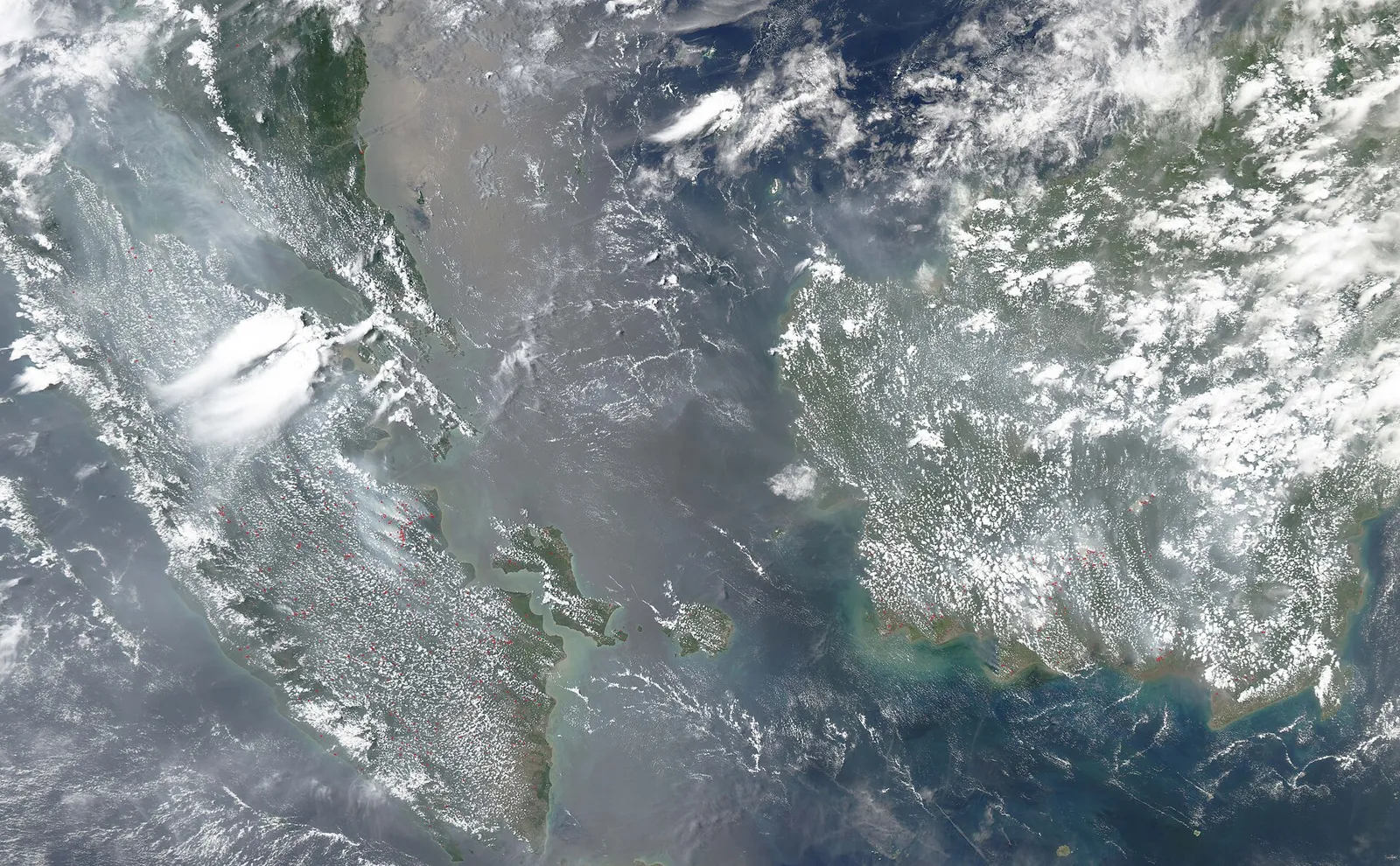
Smoke has reached Malaysian Borneo, and six areas of Sarawak have recorded air quality in the "unhealthy" band. The report does not give numerical readings.
Transboundary haze is the reason Indonesian fires are a regional diplomatic issue rather than a domestic one. Smoke from Kalimantan and Sumatra travels on prevailing winds into Malaysia, Singapore and southern Thailand, closing schools, grounding flights and filling hospitals in countries that had no part in starting the fires. It has produced years of friction between neighbors and a regional haze agreement that has never fully solved it.
What makes these fires hard to put out
Much of the land that burns in Kalimantan is peat. Peat is partly decomposed organic matter, metres deep in places, and when it is dry it burns downward and underground, where water dropped from a helicopter does not reach it. A peat fire can smoulder below the surface through a rainstorm and resurface afterwards. That is why deployments on this scale are needed to fight fires that, in a forest of ordinary soil, would be containable with far less.
It is also why the fires produce so much smoke relative to the area burning, and why the haze persists for weeks after the visible flames are gone.
What is not established
The report does not name the affected provinces within Kalimantan beyond the region itself, does not give a hotspot count, and records no evacuations, casualties, school closures or airport closures. It does not report any formal complaint from the Malaysian government, and it does not attribute the fires to land clearing or to any particular actor.
Fires in Indonesia are politically charged for exactly that reason: the question of how much is drought and how much is deliberate clearing for plantations recurs every season and is generally contested. We have not seen evidence on that question in this account and are not going to assume an answer to it.