In 1958, Hans Guetinger moved his family from Bavaria to Brieskow-Finkenheerd, a village in East Germany near the Polish border, where he went to work at a power station. His wife Frieda had encouraged the move. At the time it was a decision about work and where to live.
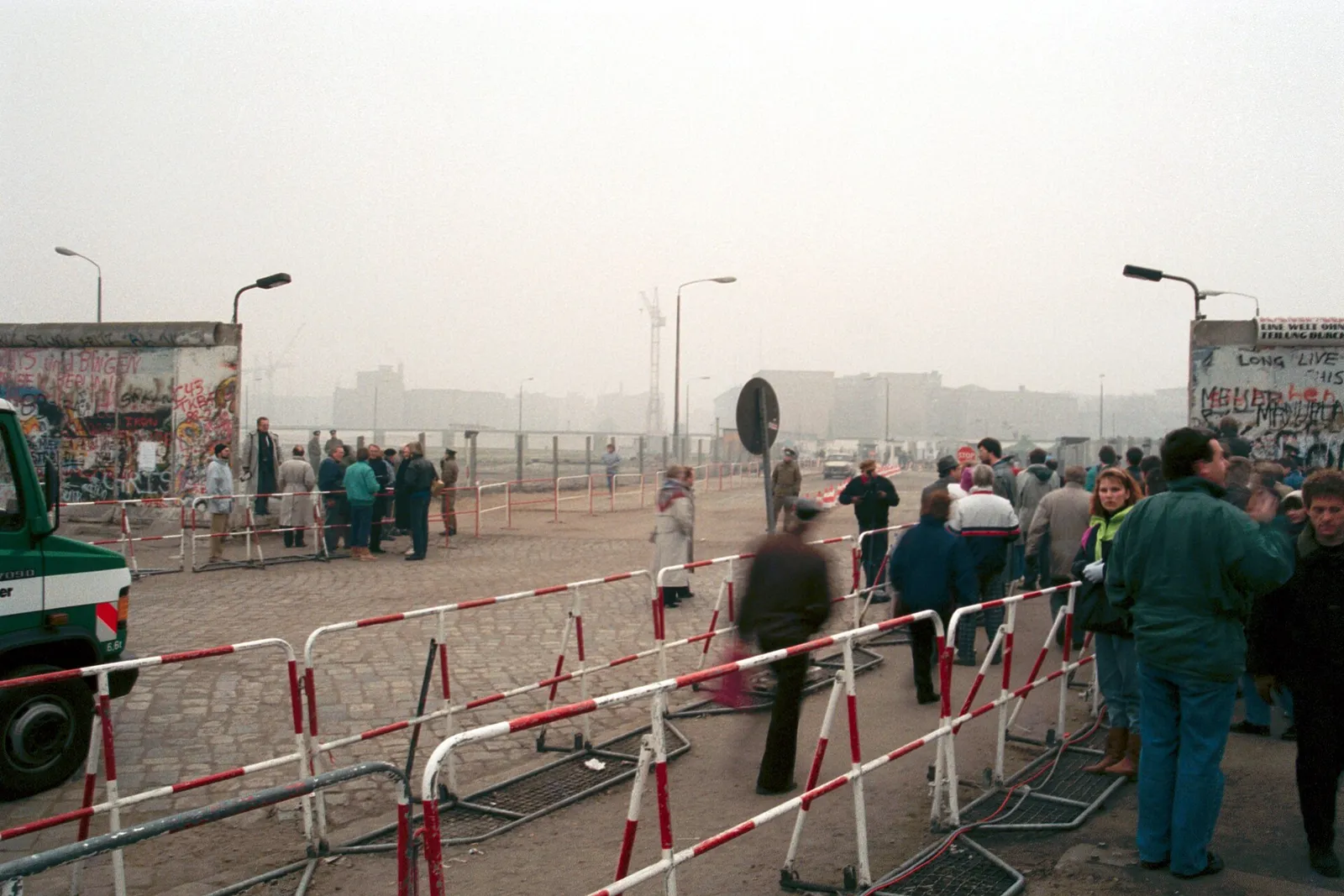
Three years later, in August 1961, construction began on the Berlin Wall, and it stopped being that kind of decision.
Al Jazeera has told the family's story through Hans's nephew Erich Guetinger, who is 75, a historian and author, and who lives in what was West Berlin.
The visit
Erich's father Ernst was the youngest of three brothers from Babenhausen. Hans was the eldest. Ernst died in 2008; Hans, according to the account Erich gives, never got back to the family's Bavarian home town before he died.
In the summer of 1969, Erich made the journey east to see his uncle's family, including his cousins Dieter and Guenter.
The numbers around that journey give a sense of what had happened to the country in the intervening years. Some 2.7 million people moved from east to west between 1949, when Germany formally split into two states, and 1961, when the Wall went up. In 1961 West Germany had about 51 million people and East Germany about 18 million. By 1969 the West had risen to about 61 million and the East had fallen to roughly 17 million.
An estimated 75,000 people were imprisoned for trying to escape across the border between 1961 and 1989. The Wall itself ran 155 kilometers, about 96 miles.
The other separation
Erich's own life carries a second border. He met Yan-Yun in 1973, moved to West Berlin in 1974 to study Chinese politics, and married her in 1977. She was born in Beijing; her family fled to Taiwan when she was two, and she came to West Germany as a nurse. In 1988 the two of them traveled to mainland China together.
The parallel is not laboured in the telling, and it does not need to be. A man who grew up with relatives on the wrong side of one border married a woman whose family had been separated by another, and they went back to look.
East Germany's own population was less homogeneous than the standard account of it suggests. Some 70,000 contract workers came from Vietnam, and more than 20,000 young people from Mozambique.
What the fall did not end
The Wall came down in November 1989. What Erich describes is the discovery that the removal of a barrier is not the same as the end of a division.
The German phrase for it is "Mauer im Kopf", the wall in the mind. Around the thirtieth anniversary of reunification, a Bertelsmann Foundation study based on research by the Berlin polling institute pollytix found that 84 percent of eastern respondents felt a unified Germany should have kept more elements of the East German state and society.
That figure is easy to misread as nostalgia for a one-party state. It is better understood as a statement about how unification was carried out: as an accession, in which one system's institutions, laws, currency and professional qualifications replaced another's more or less wholesale, and the people on the receiving end were asked to adapt entirely.
The account also touches the 1992 riots at Rostock-Lichtenhagen, which fell in the same period.
The value of one family
There is a reason this kind of story keeps being told through single families rather than through statistics, and it is not sentimentality. National histories describe what a state decided. A family history records what those decisions cost people who had no part in making them: a job taken in the wrong village, a hometown never seen again, a visit that required a train, a permit and eleven years.
This account rests on a single publication, and we could not corroborate its family detail elsewhere, which in the nature of the material is unsurprising. The historical figures in it are presented without individual attribution except the survey, which is credited to the Bertelsmann Foundation.