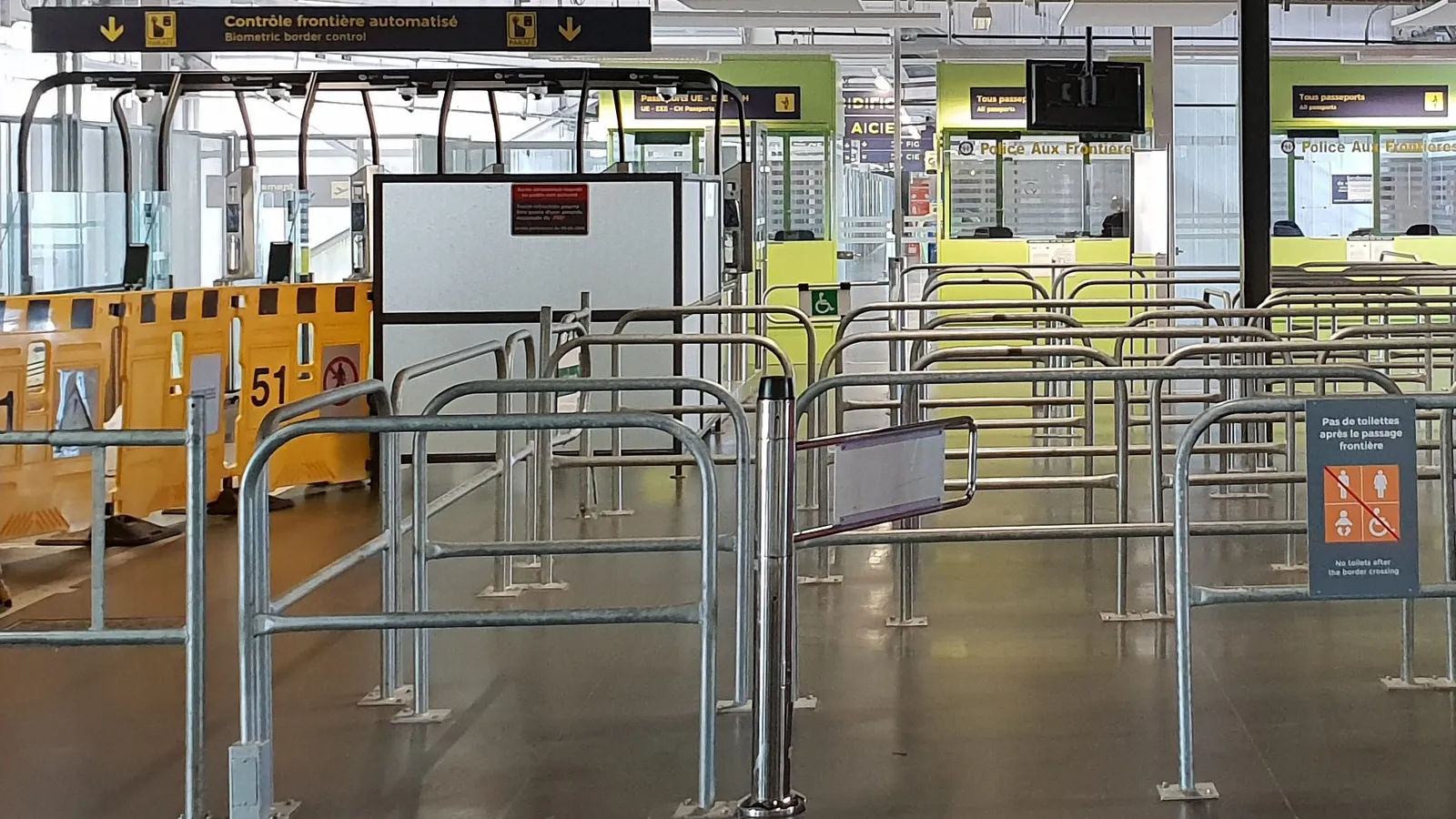
Anyone travelling to Europe on a non-EU passport this summer is meeting a border process that did not exist a year ago, and in many airports it is taking considerably longer than the one it replaced.
The Entry/Exit System, or EES, records non-EU travellers biometrically instead of stamping their passports. On a first crossing into the Schengen area, border officers capture fingerprints and a facial image, which are stored in a shared database and used to track the 90-days-in-180 limit automatically. On later trips, the registration is already on file and the check should be quicker.
That is the design. The transition has been the problem.
What happened at the rollout
The system was phased in from late 2025 and reached full application across the 29 participating countries on April 10 this year.
The clearest illustration of what followed came days later at Milan Linate, where an easyJet flight to Manchester departed with 34 of its 156 passengers aboard. The remaining 122 were still in the passport queue, Euronews reported. Other flights that day left with dozens of empty seats belonging to passengers who were inside the terminal.
The arithmetic behind the queues is straightforward. First-time biometric enrolment takes several minutes per traveller, against seconds for a stamp. Because almost every non-EU arrival is a first-timer in the system's opening season, the slow path is the normal path, and a few wide-body arrivals landing together is enough to produce a queue measured in hours.
What the industry says
Airports Council International Europe and Airlines for Europe, the two main industry bodies, have pressed for changes and documented waits of two to three hours at peak periods after the April launch, against typical pre-EES processing measured in tens of minutes. ACI Europe's director general, Olivier Jankovec, said in a statement calling for an urgent review that "significant discomfort is already being inflicted upon travellers, and airport operations are being impacted."
Airlines for Europe went further, characterizing the situation as a systemic failure rather than teething trouble and asking for checks to be relaxed through the summer peak.
The bodies identify three causes beyond the technology itself: too few border officers for the volume, configuration and equipment faults at some posts, and low take-up of pre-registration, which would move enrolment off the airport floor.
What the Commission says
The European Commission disputes that EES is the sole explanation. A Commission spokesperson has said the launch was successful and that extended queues have often been linked to other factors including flight scheduling, staffing levels and ordinary peak-season demand.
There is a mechanism for relief. Member states may temporarily suspend or scale back EES checks for a limited period after full implementation to manage pressure. Industry requests to extend that flexibility deeper into the summer had not been granted as of late June.
The Commission's underlying case for the system is that it closes a real gap: paper stamps were easy to misread, easy to forge and gave no reliable way to identify people who overstayed.
What travellers can do
Pre-registration, where available, is the single useful step. Some countries and airports allow biometric details to be submitted in advance, and pilots have run at airports including Lisbon and Stockholm Arlanda, though coverage remains patchy.
Beyond that the advice is unglamorous: allow substantially more time than usual for immigration on arrival, and treat tight connections through Schengen hubs with suspicion. The first registration is the slow one; subsequent trips should be faster.
A second change is already scheduled. ETIAS, a pre-travel authorization comparable to the US ESTA or the UK's ETA, is due in 2027 and will require an online application and a fee before departure. In principle it should reduce work at the border. In practice, the EES experience suggests the transition itself is the part worth planning around.