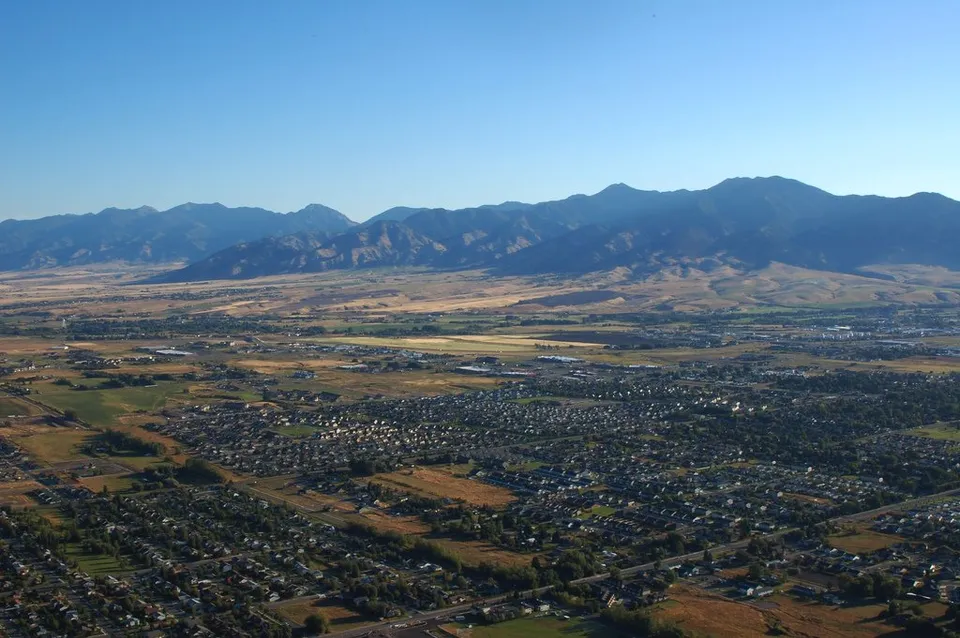
Bozeman Yellowstone International Airport is among the busiest airports in the United States for private aircraft, serving a valley that has become one of the country's more sought-after addresses. Business aviation traffic there grew again last year, and the airport authority has committed to a substantial expansion.
Twenty minutes away, residents of two mobile home parks spent the spring refusing to pay their lot rent.
The rent strike
King Arthur Park and Mountain Meadows had been owned for around four decades by a landlord whose increases were, by residents' accounts, modest. After the parks changed hands, tenants received notice of increases averaging about 11 percent, roughly $97 a month.
On May 1 tenants voted to withhold rent, Montana Free Press reported, holding back close to $53,000. Organizers described it as the first rent strike in Montana in about half a century. Their demands included negotiated lease terms, repairs, and a right of first refusal to buy the parks if they are sold again.
Mobile home parks are unusually exposed to this. Residents typically own the home and rent the ground beneath it. Moving a home is expensive and often impossible, so a lot rent increase is close to unavoidable, which makes the parks attractive to investors and precarious for the people in them.
The numbers
Bozeman has the highest rents in Montana, averaging roughly $2,000 to $2,100 a month. A Montana Free Press analysis found a household needs to earn around 182 percent of area median income to afford the median home, or roughly $220,000 a year.
About half of renters in Gallatin County are cost-burdened, spending more than 30 percent of income on housing, according to the county's housing strategy.
The market has cooled without becoming affordable. "Now we're in this spot where there's stability, but it's not a good stability," Mayor Joey Morrison told Montana Free Press. "It's a stability that's still extremely expensive."
The other side of the argument
It would be easy to write this as a story about wealthy incomers and leave it there, and that would be incomplete.
Developers and housing economists in the valley argue the binding constraint is supply, not demand: that Bozeman has not built enough for the workforce it has attracted, and that restricting growth would raise prices rather than lower them. The city estimates it needs on the order of 1,200 new units a year to keep pace with job growth. Projects aimed at that gap are underway, including several hundred workforce units.
There is also a case that the in-migration brought real benefits, in employment, tax base and services, to a region that spent decades losing young people. Residents who have watched their own home equity rise are not uniformly opposed to what happened.
The city has tried to respond through its affordable housing ordinance, revised last year, which has produced several hundred restricted-price units with more in the pipeline. At the state level the record is thinner: a tenant protection bill for mobile home park residents was vetoed by Governor Greg Gianforte in 2023 on the grounds that it went too far in restricting landowners' rights, and a subsequent proposal for a dispute resolution programme did not pass.
What the two facts have in common
Private aviation traffic and lot rents are not connected by any single transaction. They are both indicators of the same shift: a place whose desirability now substantially exceeds what local wages can bid for, in an economy where housing is the asset that absorbs the difference.
That pattern is not unique to Montana. It describes Aspen and Jackson Hole before it, and a growing number of places where remote work and second homes met a constrained housing stock. What Bozeman offers is an unusually clear view of it, and residents willing to test what happens when they stop paying.