
Pick up a block of butter and a stick of margarine and you are holding two products that are, on paper, strikingly similar: both must be at least 80% fat, with water making up most of the rest. Yet they behave differently once heated — and the differences come down to chemistry.
Same fat content, different fat
Butter is made from cream, so its fat is mostly saturated. Saturated fatty acids have no double bonds, so the molecules are straight and pack together neatly, forming dense, stable crystals. That gives butter its firm-but-spreadable quality and a range of melting behaviors. Margarine starts as liquid plant oil, whose unsaturated fats have kinks that stop them packing tightly; to make it solid, manufacturers rearrange the fats through a process called interesterification (which replaced the partial hydrogenation that once produced trans fats, banned in US food from 2018). The upshot is that margarine can be engineered to be firmer or softer than butter, but its crystals respond to heat differently.
Water, steam and flaky layers
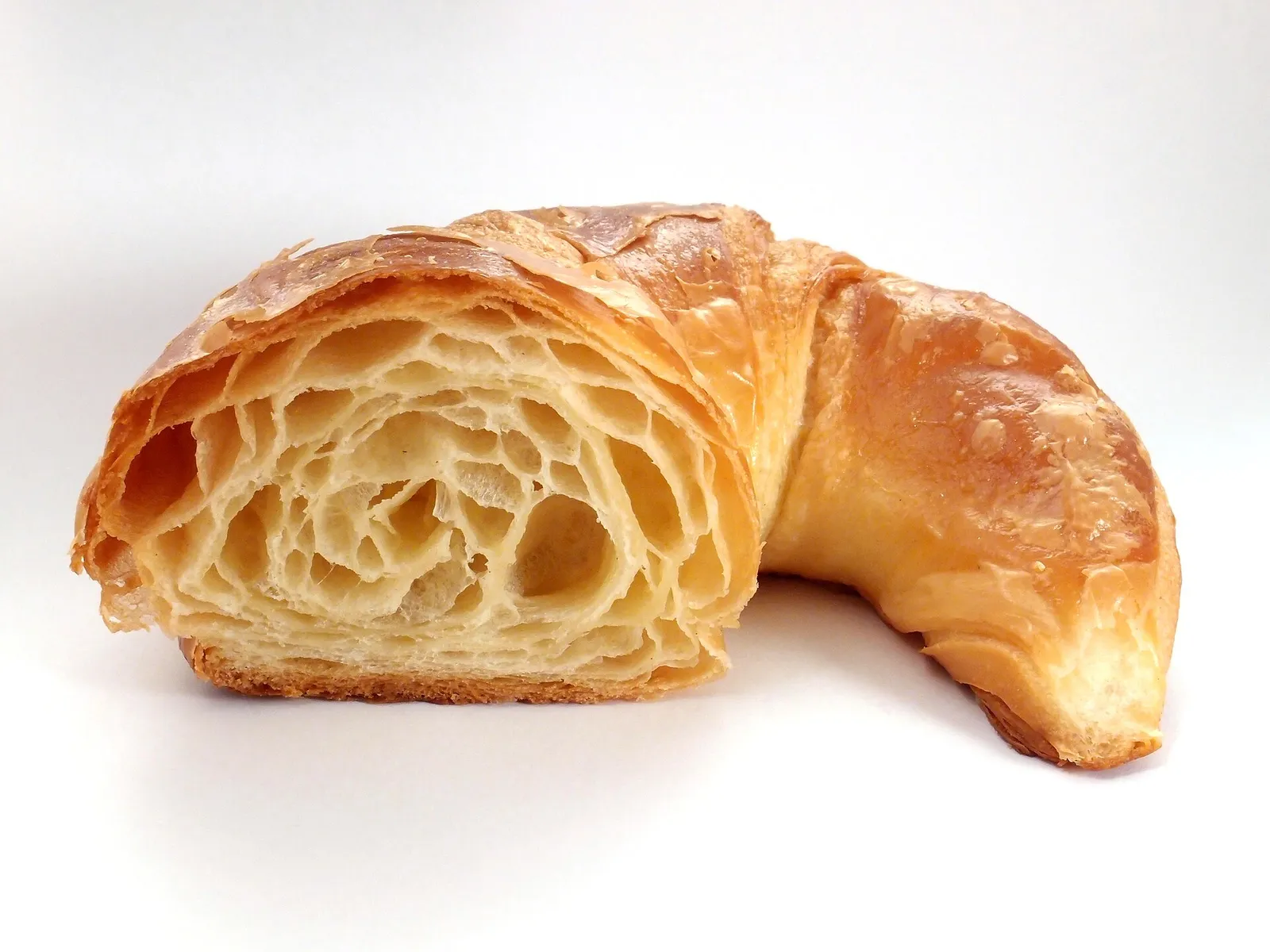
Both fats carry water — but where that water sits matters. In butter, it is held in an emulsion with milk solids. In a laminated dough such as a croissant or puff pastry, that water flashes to steam in the oven and physically pushes apart the thin sheets of dough, creating the airy, crisp layers. Margarine produces some steam too, but does not perform as well in lamination, in part because the fat must stay solid and pliable enough to be rolled paper-thin without melting in — a working window butter's crystal structure handles especially well.
Why butter browns better
Here butter has a decisive edge. The Maillard reaction — the browning chemistry that builds color and hundreds of flavor compounds — needs both proteins (amino acids) and sugars. Butter's milk solids supply both: proteins and lactose, a sugar. That is what gives shortbread its golden crust and brown butter its nutty aroma. Margarine has essentially no milk proteins and no lactose, so it browns less and tastes blander; cookies made with it come out paler.
Where margarine wins
Margarine is not simply the lesser option, though — it is different in useful ways. Because its fat can be formulated with a higher, more stable melting point, a firm margarine or vegetable shortening can keep cookies from spreading too much, yielding a thicker, cakier result, and can coat flour proteins to limit gluten and produce a very tender crumb. Industrial bakers use margarines engineered for specific jobs. One caveat, per the baking reference BakerPedia: today's low- and zero-trans-fat margarines can be more brittle, release less flavor and feel grainier than the older formulations they replaced, and results vary widely by brand.
Practical takeaways
Reach for butter when flavor and browning matter most — cookies, shortbread, brioche and any laminated pastry — and consider a higher-fat European-style butter for extra-flaky pie crust. Reach for a firm margarine or shortening when you want a thicker, paler cookie, a very tender crumb, or a dairy-free result. And don't swap one for the other mid-recipe without thought: differing water contents and melting points can change how a batter spreads, browns and sets. When in doubt, test a small batch first.