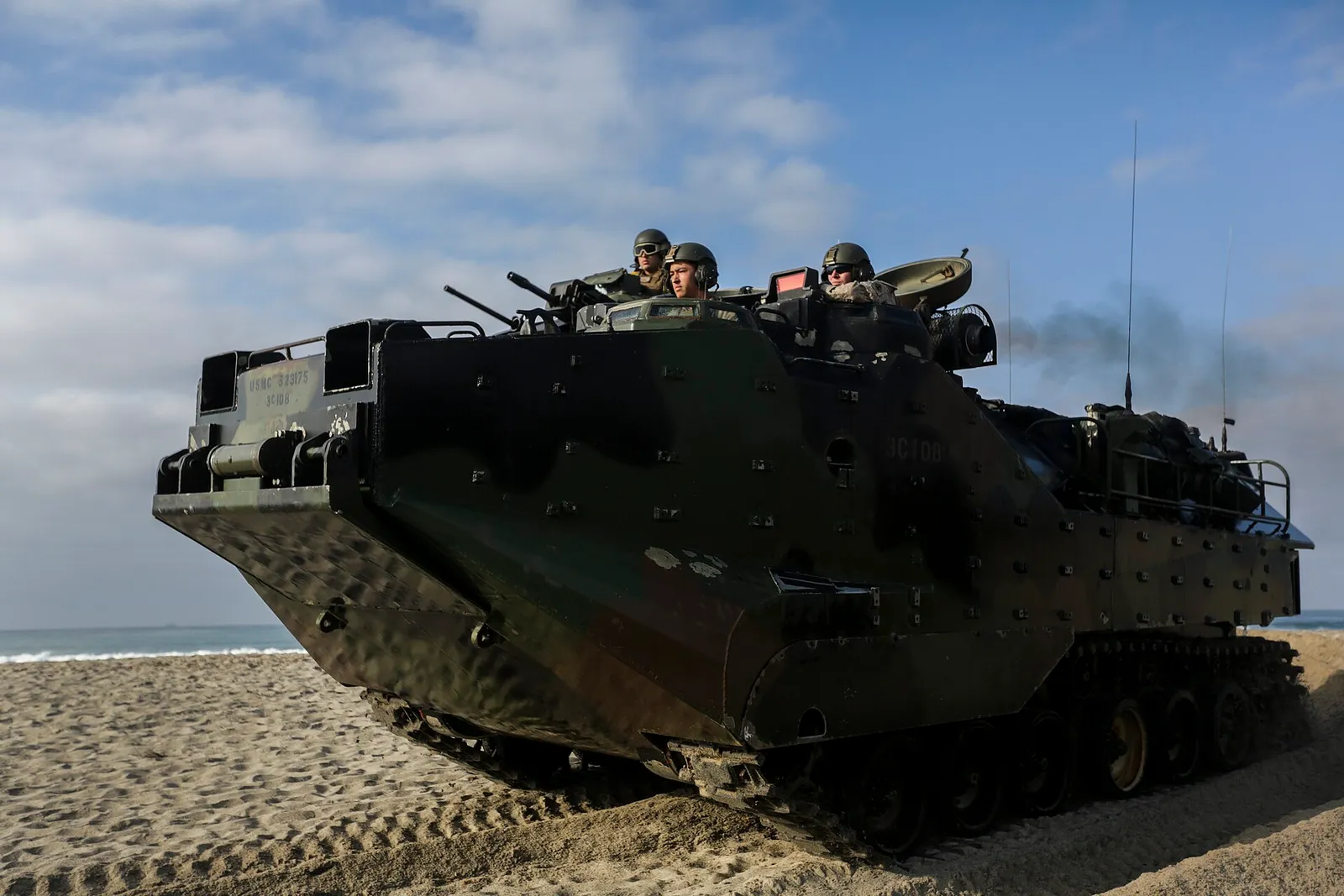
Ssangyong, the biennial amphibious landing exercise run jointly by South Korean and US marines, will not take place as planned in September, Al Jazeera reports. The announcement came on Monday from Han Seung-jeon, a spokesman for the South Korean Marine Corps.
The reason given is the war. "The US Marine Corps formally notified our forces in June that its ability to deploy forces during this year's Ssangyong exercise would be constrained due to the situation in the Middle East," Han said. The US Marine Corps cited constraints on force availability caused by the US and Israeli war on Iran.
Why a cancelled exercise is a real signal
Amphibious landings are among the hardest operations to conduct and the hardest to keep sharp, because they require ships, aircraft and ground units to work together in sequence. They are practiced precisely because the skill decays without practice.
Cancelling one for capacity reasons is also an admission of arithmetic. A military that could comfortably do both would do both. This is what a war in one theater costs a commitment in another, stated in a spokesman's briefing rather than in a policy document.
The other exercise, and a different reason
Ulchi Freedom Shield, which ended on August 22, was cut from eleven days to five. That reduction was ordered by President Trump, who cited cost and Seoul's refusal to take part in the conflict with Iran.
Those two curtailments have different explanations and should not be blurred together. One is described as a capacity constraint; the other is presented as a decision, connected to an ally's choice not to join a war. Readers can weigh whether the second is pressure. We are noting that the reasons offered are not the same.
North Korea's response to a smaller drill
Pyongyang has long characterized these exercises as rehearsals for invasion, and one argument for scaling them back is that doing so reduces tension.
That argument did not hold this time. North Korea responded to the reduced drills by launching ten short-range ballistic missiles.
South Korea says consultations are continuing about resuming the amphibious exercise. The Pentagon offered no immediate comment.
What we could not establish
We could not establish how many troops normally take part in Ssangyong, whether a new date is under discussion, when the North Korean launches occurred, or the US Marine Corps' own account beyond what Seoul has described. We verified this account from a single publication.